36th Chamber · Spiral 13
Swami Sarvapriyananda & Bernardo Kastrup
About 4 minutes to read
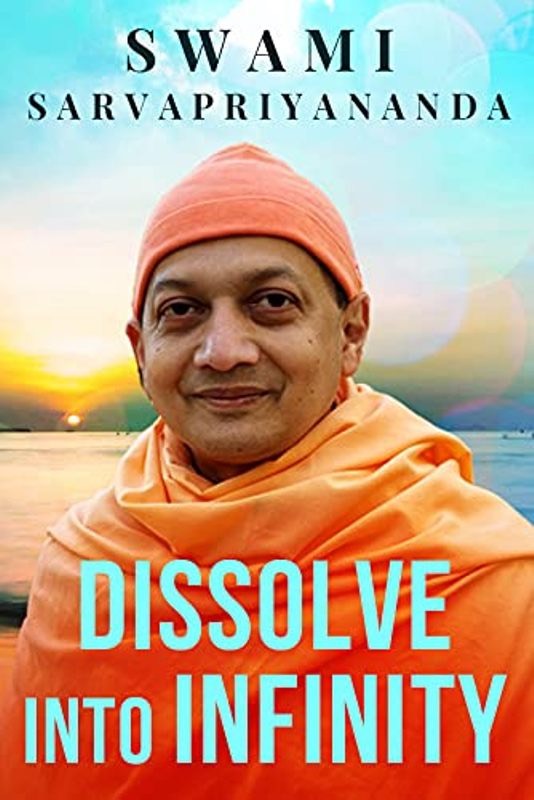
Swami Sarvapriyananda - Advaita Vedanta A contemporary master of Advaita Vedanta, renowned for his exquisite diamond-like clarity in communicating the non-dual wisdom of the Upanishads. His teachings emphasize that the ultimate reality is pure consciousness - unchanging, ever-present, the true Self (Atman).
Swami-ji’s approach is rigorous and compassionate, inviting seekers to inquire deeply into the nature of their own awareness through self-enquiry: “Who am I?”
He often draws on the analogy of the screen and the movie: The screen is not affected by the movie. Awareness is like the screen - untouched by the play of thoughts, emotions, and experiences.
Swami-ji’s teaching is practical: he encourages daily meditation, mindful living, and the cultivation of love and compassion as natural expressions of Self-realization.
In the context of Quantum Human, Swami-ji’s Advaita points to the collapse of dualities - not by denying the world - by recognizing the underlying unity that pervades all experience. The journey is not to become something new; the journey is to realize what we already are: the luminous awareness in which all phenomena arise and dissolve. The Journey is the Path. The Path is the Way. Many Paths. One Stream.
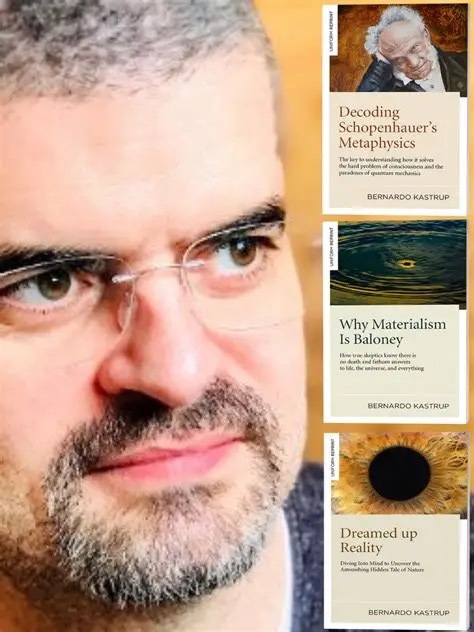
Bernardo Kastrup - Analytic Idealism Bernardo Kastrup is a leading voice in contemporary philosophy of mind, best known for his theory of Analytic Idealism. He argues that consciousness is not a by-product of matter; consciousness is the fundamental ground of reality. According to Kastrup, the universe is akin to a “dissociative process” within universal consciousness, and what we perceive as separate individuals are localized “alters” of this cosmic mind lattice.
Kastrup’s work is deeply influenced by Western analytical philosophy and resonates with Eastern non-dual traditions; he grounds his arguments in analytical rigour and empirical evidence, engaging with neuroscience, quantum physics, and logic. Key to Kastrup’s vision is the idea that the apparent multiplicity of selves and objects is a kind of “superposition” - a play of perspectives within One Mind. Kastrup describes the dashboard of perception as a symbolic interface evolved for survival - not a transparent window onto reality. The dashboard represents “extrinsic appearance,” and the inner, experiential reality of universal consciousness; what is perceived, “intrinsic nature.”
In dialogue with Swami-ji’s Advaita, Analytic Idealism offers a bridge between East and West: both see consciousness as primary - Kastrup articulates this in the language of modern science and philosophy, inviting a new synthesis; to be “Quantum Human.” Where Advaita speaks of Atman as Brahman, the innermost Self as the ground of all appearance, Analytic Idealism re-frames the same insight by showing that what we call the “physical world” is simply the extrinsic representation of inner mental processes taking place within a universal-field of consciousness. What Advaita calls Maya, the shimmering play of names and forms projected on the screen of the Self, Kastrup describes as the dashboard of perception - a symbolic interface evolved for survival, not a transparent window onto reality. In both systems, the world we perceive conceals far more than it reveals. Maya, the illusory nature of physical reality - that which is not - like Neo seeing beyond the mind’s self-limiting Matrix.
Swami‑ji invites us to peel away mis-identification by turning attention inward through the question “Who am I?”, loosening the habitual belief that consciousness is a property of the mind or the brain. Kastrup supports this move by showing that matter itself is a representation, not the fundamental ground we imagine it to be. The so‑called “external world” is the image cast on the dashboard, while the true causal processes lie within consciousness, just as the movie arises from the projector. When Swami‑ji says, “You are the screen on which the movie of life plays,” Kastrup echoes: “You are the field in which the dashboard displays its readings.” Two metaphors, one truth.
From this vantage point, what we call the “self” - the ego, the psychological persona - is simply the localized whirlpool within the great ocean of consciousness. Advaita calls it the jiva; Kastrup calls it a dissociated alter of the universal mind. In both cases, individuality is real at the conventional level, yet not ultimately separate. Our suffering arises from mistaking the whirlpool for the entire ocean. To be Quantum Human is to recognize the whirlpool’s pattern without losing sight of the water from which it is made.
Kastrup’s model strengthens the philosophical scaffolding behind Advaita’s intuitive insight. Neuroscience, considered through the dashboard analogy, no longer undermines non‑duality; it becomes the study of the instrument panel through which consciousness represents activity occurring deeper within itself. Brain activity correlates with experience not because the brain produces consciousness - because changes in the dashboard correlate with changes in the aircraft’s internal dynamics. Analytic Idealism thus provides the conceptual rigour that allows modern seekers to appreciate Advaita without feeling they must abandon science. It shows that science itself points beyond materialism when examined carefully.
Swami‑ji’s “The Self is self-luminous,” meets Kastrup’s “universal consciousness modulating its own states.” The Upanishadic Mahavakya “Tat Tvam Asi - Thou art That” finds its contemporary articulation in the idea that the individual mind is a localization of the one Mind-at-large. Ancient realization and modern theory converge.
In this union of Advaita Vedanta and Analytic Idealism - to be Quantum Human is to stand at the threshold of a new understanding of self-and-cosmos - consciousness is the origin-and-destination, the question-and-answer, the seeker-and-sought. The journey home is not a movement through space - now - it is a movement through illusion toward the recognition of what has always been present: meta-cognition, luminous, self-knowing awareness, awareness-of-awareness-itself, our true nature. This union, synchrony, and superposition of East-meets-West - the art of dialogue which ultimately reveals not two competing worldviews - two languages speaking the same truth - one poetic and contemplative, the other analytic and metaphysical. Together, they carve a middle-path where self‑enquiry, philosophy, and science illuminate one another. To be Quantum Human; this synthesis becomes a living practice: to question like Socrates, to ascend like Plato, to integrate like Hegel - to rest in the non-dual awareness described by Advaita and clarified by Analytic Idealism.
Introducing… Bernardo Kastrup and Swami Sarvapriyananda: A Dialogue about Consciousness East-meets-West at the Socratic intersection; unified self-enquiry.
Who Am I?
for Swami Sarvapriyananda
In the silent dawn,
a question rises
not from lips,
the heart’s stillness.
You are not the body, not the mind;
you are the witness, the changeless light.
Watch thoughts arise and fade,
emotions surface and subside,
waves upon the ocean-of-mind;
awareness-of-awareness-itself.
The Self is self-luminous,
the screen on which all worlds appear.
Turn inward, attune within,
each breath a breathless step
toward the centreless centre;
dissolve seeker and sought.
Silence knows itself by its own echo,
presence ripples through stillness;
here the heart unveils the Infinite,
Infinity reveals and unfurls you.
Know Thyself and be free.
OM TAT SAT
Philos Analytica Poetica
for Bernardo Kastrup
The Dream of One Mind
A labyrinth of neurons,
a question pulses:
Is matter the dreamer,
or the dream?
Consciousness is not in the brain;
the brain is in consciousness.
Worlds unfold numinous ripples:
vast, unknown, a unified-field;
each self, a whirlpool,
each thought, a wave.
We are alters of the cosmic mind,
dissociated, yet never apart.
The universe is now a story
experienced first person,
a superposition of perspectives,
waves collapsing this present.
Reality is what consciousness does.
OM TAT SAT
Bridge of One Light
Swami‑ji and Bernardo in dialogue
Socratic Dialogue and Synthesis
Who am I? The witness, the Self,
unchanging, aware, infinite.
Consciousness is the ground,
matter its appearance;
the world is in mind, not mind in the world.
East-meets-West - Fission-and-Fusion
The screen is never touched by the movie;
the Self is never touched by the world.
All selves are whirlpools in the One Mind,
seeming separate, yet always connected.
A Bridge of Light - Superposition
To know the Self - dissolve boundaries -
see all as One.
To realize the One is to awaken
from the dream of separation.
Beginningless-Endless-Entanglement
The cosmic dance of one-light -
emptiness - no other than form.
The dance of quantum human -
one love reflected in every face.
OM TAT SAT
End of spiral 13
The 36th Chamber: all 32 spirals open