36th Chamber · Spiral 15
Romain Rolland and Sri Ramakrishna
About 5 minutes to read
Romain Rolland - India, Mysticism, Sri Ramakrishna
If there is one place on the face of the earth where all the dreams of living men have found a home from the very earliest days when man began the dream of existence, it is India….For more than 30 centuries, the tree of vision, with all its thousand branches and their millions of twigs, has sprung from this torrid land, the burning womb of the Gods. It renews itself tirelessly showing no signs of decay.
Romain Rolland, a French mystic and Nobel Prize-winning writer who was deeply fascinated by the spiritual traditions of India. His intellectual journey led him beyond the boundaries of Western rationalism and into the heart of Eastern mysticism, where he found a symbiotic resonance with his own quest for universal truth and inner harmony.
Rolland’s encounter with India was not merely academic or touristic - it was a passionate search for the living sources of spiritual experience. He was drawn to the great figures of Indian spirituality, seeing in them a living embodiment of the ideals he cherished: universality, compassion, direct experience of the divine. Among all India’s saints, sages, and mystics; it was Sri Ramakrishna who captivated Rolland most profoundly. I am bringing to Europe, as yet unaware of it, the fruit of a new autumn, a new message of the Soul, the symphony of India, bearing the name of Ramakrishna.
In his celebrated biography, The Life of Ramakrishna, Rolland presents Sri Ramakrishna as a “spiritual phenomenon,” a mystic whose life was a continuous unfolding of ecstatic union with the divine. Rolland was struck by Ramakrishna’s ability to transcend religious boundaries - embracing Hinduism, Islam, and Christianity in his own practice - and by his insistence that all paths lead to the same ultimate reality. For Rolland, Ramakrishna was the living proof of the unity of all religions, a “harmony of religions” realized not in theory but in the heart of a living saint; Saint-of-Saints. Rolland’s writing on Ramakrishna is marked by a rare empathy and openness. He does not approach his subject as a distant scholar - a fellow seeker - eager to understand the inner workings of mystical consciousness. He is especially fascinated by Ramakrishna’s states of samadhi, his childlike innocence, his spontaneous love for all beings. Rolland sees in Ramakrishna a “divine play” of the human and the transcendent - a living bridge between East and West, body and spirit, form and formlessness. Rolland helped introduce Indian spirituality to a Western audience hungry for meaning beyond materialism. His portrait of Sri Ramakrishna remains a luminous testament to the possibility of direct, universal, and transformative spiritual experience; a message that continues to inspire seekers around the world.
Sri Ramakrishna & Quantum Human
The supreme purpose and goal of human life...is to cultivate love. Gospel of Sri Ramakrishna, Saint-of-Saints, God-man of 18th Century India.
Devotion to Direct Knowing
Sri Ramakrishna’s realization - love is not sentimentality nor moral instruction - it is ontological truth lived through the heart. Love is the means and the end. To love is to participate in reality as it is. This insight dissolves the common split between spirituality and daily life: love is not reserved for prayer or meditation; it is expressed as attention, service, humour, humility, relationship. In Quantum Human terms, love is not an emotion added to experience; it is the field condition that cultivates coherence and resonance; illuminating meaning and inherent purpose, childlike natural spontaneity.
Ramakrishna’s life exemplifies this principle. His ecstatic devotion, childlike openness, and radical pluralism were not philosophies; they were spontaneous expressions of non-dual awareness. He did not argue for unity; he embodied it. He practiced different religious paths - Hindu, Muslim, Christian - he did not treat them as belief systems; he treated them as experiments in consciousness. Each path, when fully entered and embraced, dissolves into the same oceanic realization. This is lived articulation of what Quantum Human recognizes as contextual truth: different symbolic systems when inhabited sincerely, collapse into the same experiential ground. One Taste. One Face.
Pluralism Without Relativism
Quantum Human pluralism does not imply “anything goes” or that all views are equal at the surface level. It recognizes that depth, sincerity, and embodied practice determine convergence. Rivers differ in terrain, speed, and shape; what unites them is directional flow. Sri Ramakrishna’s teaching preserves discernment while transcending dogma. Some paths are steep, some gentle; some emphasize devotion, some self-enquiry, others service. What matters is not the theoretical map; the litmus test is whether the path dissolves illusion of separation. Many Paths. One Stream. The path is the way.
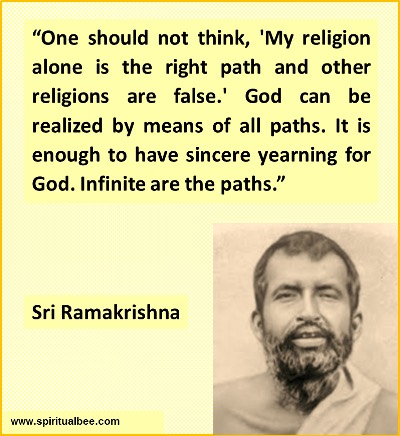
All religions are true. God can be reached by different religions. Many rivers flow by many ways but they fall into the sea. They all are one.
Here, the metaphor of superposition becomes precise rather than poetic. Multiple spiritual frameworks co-exist without contradiction when they are understood as partial projections of a deeper, unified-field. Conflict arises only when a local perspective claims absolute authority. It is the mind that makes one wise or ignorant, bound or emancipated.
Ego-Death as Integration, Not Annihilation All troubles come to an end when the ego dies. When Sri Ramakrishna speaks of the ego dying, he does not advocate psychological erasure or dissociation. The ego that dissolves is the false centre - the belief in separateness, ownership, and control. What remains is functional individuality without fixation: personality without possession, action without grasping. Non-dual realization does not flatten human expression; it refines it.
In Quantum Human language, the ego is a useful local interface - much like a co-ordinate system. Problems arise when the co-ordinate system mistakes itself for the territory. Ego-death is the moment the interface is recognized as an instrument rather than an identity. Action continues; relationship continues, creativity continues - no longer from fear or contraction. Compassion arises naturally, not as obligation; as an accurate response within a shared field. As long as I live, so long do I learn.
Middle Way as Dynamic Balance Ramakrishna’s teaching resonates deeply with Nāgārjuna’s Middle Way: freedom from extremes without collapse into passivity. Quantum Human lives this middle-path dynamically - balancing individuality-and-unity, form-and-emptiness, discipline-and-surrender. Love is the stabilizing force that allows movement without fragmentation. It enables engagement with the world without being consumed by it. To live as Quantum Human is therefore not to retreat from difference; it is to hold difference without hostility; remain rooted in one’s path while honouring others. This stance is urgently relevant in a fractured world. When identity hardens, conflict escalates; when identity softens into love, dialogue becomes possible. Love again the stranger who was your self.
Spirituality automatically leads to humility. When a flower develops into a fruit, the petals drop off on its own. When one becomes spiritual, the ego vanishes gradually on its own. A tree laden with fruits always bends low. Humility is a sign of greatness.
All paths converge toward the same truth. Recognize love as the fundamental field that unites all existence, and compassion acts as the heartbeat that unites all traditions. The end of suffering comes with dissolution of the ego; awakening to non-dual awareness. Act as bridge between traditions, between self-and-other, between the finite-and-the-infinite; a way-of-being, embodying love-as-the-field, to live as its boundless expression. Give back your heart to itself. Love-after-love. Boundless love.
Brahman is beyond mind and speech, beyond concentration and meditation, beyond the knower, the known and knowledge, beyond even the conception of the real and unreal. In short, It is beyond all relativity.
The Gospel of Sri Ramakrishna
after Romain Rolland
In the hush before daybreak,
the Saint-of-Saints sits in a forest,
a child of Bengal, God-man of India,
eyes flicker-lit with the in-finite.
He speaks of the river’s journey
across many waters, faraway lands,
flowing in manifold ways; the ocean.
He sees temples, mosques, churches,
the silent forest, the open sky,
each a path, a song, a facet;
Indra’s Net of Precious Jewels.
All religions are true.
God can be reached by different religions.
Many rivers flow by many ways,
but they fall into the sea. They all are one.
The supreme purpose and goal of human life,
cultivate love without clinging or attachment,
boundaries dissolve; the ocean-of-Being.
He smiles, knowing the secret:
all troubles come to an end
when the ego dies.
End of spiral 15
The 36th Chamber: all 32 spirals open