36th Chamber · Spiral 14
Ramana Maharshi & Descartes
About 7 minutes to read
The Nature-of-self-and-the-Self - the-finite-within-the-in-finite
Sri Ramana Maharshi’s core teaching is radical in its simplicity: the direct path to liberation is to inquire, “Who am I?” This question is not meant for intellectual analysis; a living, experiential investigation into the source of one’s own awareness. The “self” (the ego, the personal ‘I’) is revealed through sustained self-enquiry - a transient appearance within consciousness - the true Self (unchanging, witnessing awareness) ever-present, boundless - indivisible like a movie appearing on a screen.
In the Quantum Human paradigm, this distinction mirrors the difference between the localized particle (the ego, the separate self) and the quantum-field (the Self, pure awareness). The ego believes itself to be a separate entity - through self-enquiry one discovers that the true “I” is not limited by body, mind, or circumstance - it is the field of consciousness itself - the field in which all experiences arise and subside.
Who Am I? The Practice of Self-Enquiry
The text “Who Am I?” is a foundational guide to the practice of self-enquiry. Sri Ramana instructs the seeker to turn attention inward, tracing the sense of “I” back to its source. Each time a thought, feeling, or sensation arises, the practitioner asks, “To whom does this arise?” The answer is always, “To me.” Then, “Who am I?” This process is repeated, not to find a conceptual answer; to dissolve the false identification with the body-mind and reveal the ever-present Self like a wave; the ocean-of-being.
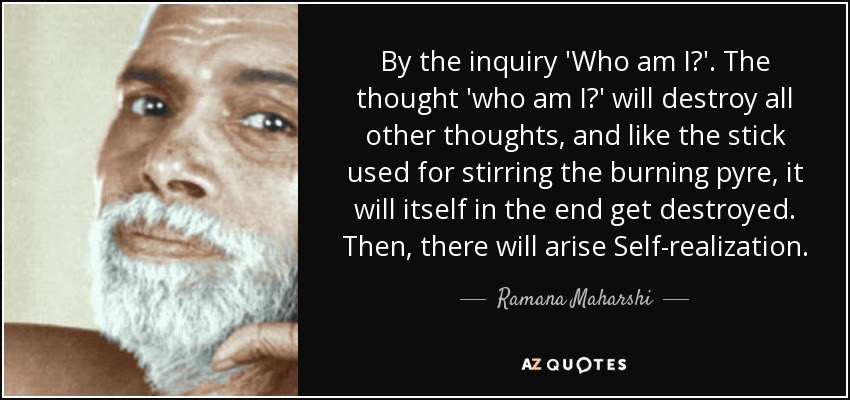
The question 'Who am I?' is not really meant to get an answer, the question 'Who am I?' is meant to dissolve the questioner. This is akin to the quantum process of observation: the act of looking for the “I” collapses the illusion of separateness, revealing the non-dual field of awareness. Quantum Human, in this sense, is one who lives as the field, not as the particle - one who recognizes that the observer-and-the-observed; not-two.
Be As You Are - Living Non-Dual Awareness - Sri Ramana and Rene Descartes
“Be As You Are” is a collection of Sri Ramana’s dialogues, offering practical and philosophical insights into abiding as the Self. The essential message: you are already that which you seek. His central leitmotif: he gives the metaphor of a screen and a movie, over-and-over. The only obstacle is the mistaken belief in separation and identifying with the movie and forgetting the screen of consciousness. By resting in the awareness of being, without grasping at thoughts or identities, one abides in the natural state - peaceful, luminous, free. Home | SRI RAMANASRAMAM Who Am I?
The Real is ever-present, like the screen on which the cinematographic pictures move. While the picture appears on it, the screen remains invisible. Stop the picture, and the screen will become clear. All thoughts and events are merely pictures moving on the screen of Pure Consciousness, which alone is real. Screen and Movie ~ Real Self, Ego and World | Ramana Maharshi And this is why mystics love poetry and metaphors.
To be Quantum Human - this, the realization that all distinctions - self and other, subject and object, wave and particle - are provisional. True nature is a unified-field-of-consciousness - “I AM” is prior to all forms and phenomena. To “Be As You Are” is to live from this ground of being, embodying wisdom and compassion, presence and spontaneity. Descartes placed the I AM at the end of self-enquiry. Cogito Ergo Sum. I think. Therefore, I am. Sri Ramana and Eastern and Western mystical philosophy place the “I AM” at the beginning - at the heart and centre of self-enquiry. Who Am I?
Descartes Self-Enquiry into Who Am I?
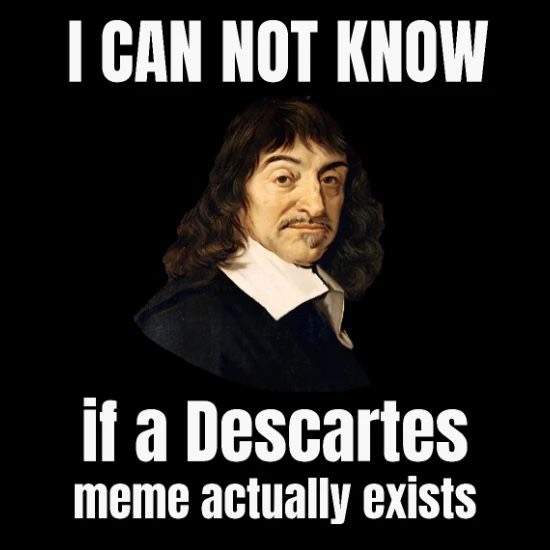
I read Rene Descartes while studying Economics and Philosophy at Edinburgh University in 1992. Cogito Ergo Sum, “I think, therefore I am” (1637) is considered the cornerstone of the entire Western philosophical canon. When one explores deeper, one can see the intricate and subtle journey Descartes himself went on in his contemplations into the heart of Who Am I? A lifetime dedicated to self-enquiry. His later foundational statement “I am, I exist” (ego sum, ego existo) appears in the Second Meditation of Meditations on First Philosophy (1641).
“I am, I exist, is necessarily true whenever it is put forward by me or conceived in my mind.” This is the Meditation II formulation - not “cogito ergo sum,” its deeper, more primitive core. And ergo sum - re-Rubik cubed and placed at the beginning. I AM.
Meditations on First Philosophy was published in 1641. Descartes was born 31st March, 1596. He began work on the Meditations around 1639. In 1639, Descartes was 43 years old when formulating the Meditations. And me being born 31st March, 1974, Aries Cardinal-Fire, similarly fascinated by exploring nature of mind and the central question; Who Am I, ever since reading Descartes in 1993, year two: philosophy of mind; mind flicker-lit from the birth of Descartes ergo sum - I AM - forming a firm foundation in Western philosophy, and later, exploring Eastern philosophy.
The Cogito evolves across Descartes’ works; 1637 - Discourse on the Method - the famous phrase first appears in French: “Je pense, donc je suis.” Its Latin version, cogito ergo sum, later included in Principles of Philosophy (1644).
1641 - Meditations: a shift to a deeper formulation - Descartes does not use “cogito ergo sum” as a syllogism. After another four years of self-enquiry, he directly arrives at: Latin (Meditation II): “ego sum, ego existo” “I am, I exist.” This formulation arises immediately, intuitively, in the very act of doubting.
“This proposition - I am, I exist - is necessarily true whenever it is put forward by me or conceived in my mind.” Ego sum, ego existo: Descartes' divisive legacy | Queen's Alumni Review And his divisive legacy, Cartesian Dualism; reductionist, mechanistic about the body; res extensa, extended matter, fully mechanistic; res cogitans, thinking substance, non-material, irreducible; separate mind and body, ever since.
In Meditations Descartes is no longer inferring “therefore.” He discovers an indubitable point of certainty emerging directly from consciousness itself: even if an evil demon deceives him, the one indubitable fact is that something is thinking. Thus, thinking and existing are inseparable when present - I am, I exist - cannot be doubted. This avoids the objection (raised by Gassendi and others) that “cogito ergo sum” looks like a logical inference requiring a hidden premise. Meditation II gives an experiential certainty, not an argument.
This aligns with mystical traditions (East & West) - By placing I AM - I EXIST at the beginning; Descartes unexpectedly aligns with ancient contemplative traditions: Western Christian mysticism echoing Augustine's insight “Si fallor, sum” (If I am deceived, I am). It mirrors apophatic awareness and the meaning of kenosis: when all beliefs are stripped away; only the bare fact of conscious presence remains. If you could naught yourself for an instant, indeed I say less than an instant, you would possess all that this is in itself. Meister Eckhart's divine illumination; self-emptying. “It is in the purest thing that the soul is capable of” | Transcendental Meditation® Blog
Eastern traditions Descartes journey enquiring into nature of self - Who Am I? - resonates with Advaita Vedānta’s inquiry into ātman through the recognition of witnessing awareness: “I am” prior to all attributes. It also parallels Buddhist methods of stripping away aggregates until only knowing remains; isness-suchness-beingness, pure awareness - awareness-of-awareness-itself - the Bhagavad Gita’s exquisite exposition on yog through distinguishing the field and the knower of the field. Chapter 13: Kṣhetra Kṣhetrajña Vibhāg Yog - Bhagavad Gita, The Song of God - Swami Mukundananda
Philosophical significance - Descartes locates certainty not in the world - the luminosity of consciousness itself - a foundation shared by meditative traditions that begin from pure awareness. TAT TVAM ASI. That Thou Art. Ego Sum. I AM.
Ego Transcendence - End of Suffering - Sri Ramana teaches that all suffering arises from mistaken identification with the ego. When the ego is seen through - when the question “Who Am I?” is followed to its source - here - dissolution of the sense of a separate self. What remains - pure awareness - unconditioned, ever-present - this, the end of all suffering - realization of Sat-Chit-Ananda - Consciousness-Bliss-Absolute.
This echoes the Quantum Human journey: to move from fragmentation to wholeness, from the illusion of isolation to a lived reality of interconnectedness. The collapse of the ego is the collapse of the wavefunction of separation, revealing the indivisible-field-of-being. The perfection-of-the-finite-within-the-infinite; a wave, the ocean-of-beingness.
Quantum Human - Self-Realized Inquiry: the unwavering seeker who continually asks, “Who am I?” not to find a new identity - to dissolve all false identities. Presence: abiding as the Self is to live in the present moment, where all possibilities collapse into the actuality of being. Unity: The realization that “I Am That” the Self is not separate from the world - only now - the very ground of all experience. From this realization flows spontaneous compassion as the boundaries between self and other dissolve.
Sri Ramana Maharshi’s twin entwined teachings, “Who Am I?” and “Be As You Are,” offer a direct path to the heart of non-dual realization. Through self-enquiry, the seeker discovers that the true Self is not a separate entity; now, the infinite-field-of-awareness in which all arises. This is the essence of the Quantum Human: to live as the field, to embody unity - radiate from the heart-centre - peace, love, our deepest nature.
Sri Ramana, Saint of 19th Century India. Explore the nature of self-and-the-Self.
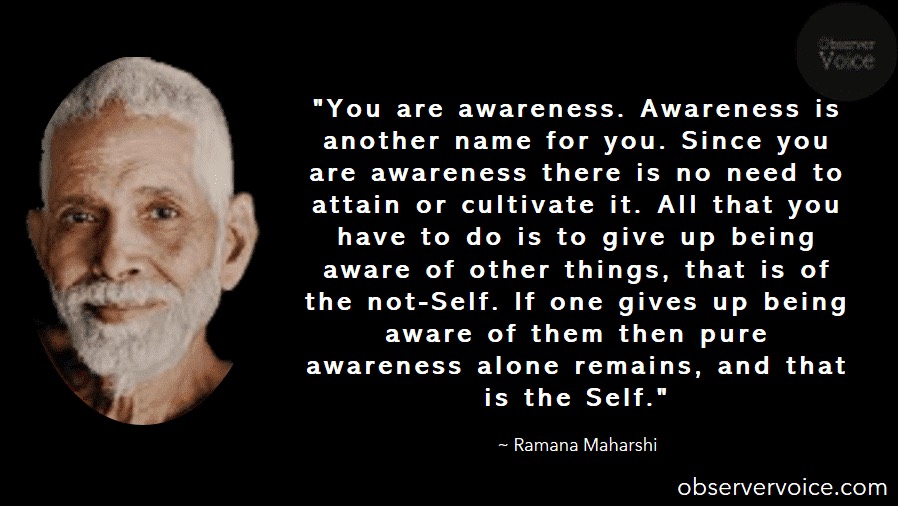
Who Am I?
for Sri Ramana Maharshi
A question, a flame,
I hold a stick
pressed into the pyre,
burning away desire.
Ash falls silent.
Smoke rises,
curls skyward,
thought dissolves -
world, a movie screen,
Hṛdayam, unknowing.
I am not the stick,
not the fire,
nor the ash that drifts
on the wind’s breath.
I am the burning,
watcher and watched,
question and answer,
silence and the flame.
In the pyre’s heart centre
all names are consumed.
The light asks what remains,
Sri Ramana illuminates:
TAT TVAM ASI. I AM. I AM. I AM.
Meditation on First Light
for Rene Descartes, after T. S. Eliot
In the silent chamber where thought begins,
a voice stirs, not wholly mine nor the world’s,
a tremor of inquiry rises like a haloed dawn.
I studied the flame of Descartes,
first spark lit in a winter of doubt:
Je pense, donc je suis
breaking the shell of certainty,
an old world shatters, birthing the new.
Deeper still, beneath the syllogism,
beneath the scaffolding of logic,
something primitive moved
a pulse, a whisper:
ego sum, ego existo
discovered not by reason,
‘I AM’ questioning itself.
Being unveiled in doubt,
mind looked inward into itself,
falling through its own reflection -
the ground, luminous presence.
Even the demon of deception
could not erase it: one flame
that would not flicker, an ember
all worlds dreamed nor denied.
Centuries fold inward
Augustine murmured Si fallor, sum,
a shadow in the cloister;
Advaitins rest in radiance, ‘I AM’;
Buddhists strip self to seed,
awareness resting in itself.
All rivers flow toward the same ocean,
certainty is not found in things,
in the seeing - not in the world -
light by which the world is seen.
Born under an Aries sun - fire
ascending - mind flicker-lit in youth.
The same self-enquiry at the threshold
Descartes traced with a candle flame.
The question returns always:
source.
Who Am I?
All I am not
falls away.
In the stillness that survives all answers,
only this remains, simplicity, self-shining
eloquence, radiance closer than breath:
I Am.
I Exist.
A truth that needs no proof,
a presence that can unravel
the heart of consciousness itself.
End of spiral 14
The 36th Chamber: all 32 spirals open