36th Chamber · Spiral 19
Quantum Physics meets Eastern Philosophy
About 11 minutes to read
ब्रह्मैवेदं सर्वम्। तत्त्वमसि। अहं ब्रह्मास्मि।
Brahmaivedam sarvam. Tat tvam asi. Aham Brahmasmi.
“All this is indeed Brahman. That thou art. I am Brahman.”
- Mahavakyas from the Upanishads
“Perhaps no figure better embodies the connection between quantum physics and Vedas than Erwin Schrödinger. The Austrian physicist’s engagement with Vedantic philosophy profoundly shaped his worldview and scientific interpretations. Schrödinger didn’t merely dabble in Eastern philosophy - he studied it seriously, reading the Upanishads in German translation and incorporating their insights into his understanding of quantum mechanics.
Schrödinger famously declared: “The plurality that we perceive is only an appearance; it is not real. Vedantic philosophy has sought to clarify it by a number of analogies, one of the most attractive being the many-faceted crystal which, while showing hundreds of little pictures of what is in reality a single existent object, does not really multiply that object.”
This statement reflects the core Vedantic concept of Maya (माया, māyā, meaning illusion or appearance) and Brahman (ब्रह्मन्, brahman, meaning ultimate reality). According to Advaita Vedanta, the apparent multiplicity of the universe masks an underlying unity. Schrödinger saw direct parallels with quantum mechanics, where seemingly separate particles demonstrate mysterious correlations suggesting deeper interconnection.” Vedas & Quantum Physics: What Great Minds Discovered An excellent overview of the historical East meets West, ancient and modern, fission-and-fusion synthesis; exploring the connections between what great minds found in India.
Six Major Schools of Indian Philosophy
1. Sāṃkhya - Enumeration / Discriminative Knowledge
Foundational system: Reality consists of two irreducible principles. Puruṣa - pure consciousness (many, passive, witnessing, non-material, non-local), Prakṛti - nature/matter (one, dynamic, unconscious, material, local). And the connection between the two; prana, chi, ki, élan vital; akasha. Holism; the core insight into reality.
Liberation comes through discriminative knowledge (viveka): knowing Puruṣa is not Prakṛti. Non‑theistic, analytic, metaphysical. And this is what the ancients knew. Foundational metaphysics for Yoga, Nyāya, Vaiśeṣika, and Vedānta, and indirectly Mīmāṃsā.
2. Yoga (Pātañjala Yoga) - Discipline / Integration
Sāṃkhya in practice. Yoga integrates Sāṃkhya metaphysics wholesale; Puruṣa-Prakṛti dualism. Pātañjala adds: Iśvara; a special Puruṣa, optional theism, a systematic psycho-somatic method; Aṣhṭāṅga Yoga. Focus: stilling the fluctuations of the mind - yoga-citta-vṛtti‑nirodhaḥ - Samadhi, complete absorption between subject-and-object.
Applied Sāṃkhya; same ontology, applied theory into embodied liberation technology.
3. Nyāya - Logic / Epistemology
How we know what Sāṃkhya describes. Nyāya develops rigorous logic and theory of knowledge (pramāṇas). It accepts plurality of selves like Sāṃkhya’s many Puruṣas, a real world of objects and causation. Often theistic.
Nyāya supplies epistemic justification for Sāṃkhya-style realism and dualism.
4. Vaiśeṣika - Categories / Ontology
What the world is made of. Vaiśeṣika classifies reality into categories; substance, quality, motion, etc. Early atomism; later merges with Nyāya. It assumes a real, structured Prakṛti-like world.
Vaiśeṣika provides a physical ontology compatible with Sāṃkhya’s Prakṛti; though framed differently.
5. Mīmāṃsā (Pūrva-Mīmāṃsā) - Ritual & Dharma
Action within Prakṛti. Mīmāṃsā focuses on Vedic ritual, duty, and action (karma). Less interest in liberation metaphysics. It assumes: a real world; law-like causation (karma → result).
Mīmāṃsā shares cosmological realism and causality assumptions. It does not prioritize Puruṣa-liberation.
6. Vedānta (Uttara‑Mīmāṃsā) - End of the Vedas
The great transformation. Vedānta engages Sāṃkhya concepts critically. It accepts much of its psychology and cosmology. It rejects dualism at the highest level. Puruṣa ≠ many → Brahman is one. Prakṛti becomes Māyā (dependent appearance).
Vedānta builds on Sāṃkhya, then sublates it into non‑dual awareness.
Saṃkhya is the architectural framework and master key of classical Indian thought:
Purusha and prakriti are composed of 25 Tattvas (elements). This cosmological framework gives structure to matter. Purusha/Soul/Consciousness is primary to matter and is non-material, non-local. It is Purusha which gives rise to the material realm of matter. In this way, consciousness is fundamental. This conceptual map shows how matter and consciousness are connected; and how to apply logic to liberation.
The other schools either apply it, justify it, ritualize it, or dissolve it into unity. Theory maps the terrain. Practice explores it. Vedānta returns you home.
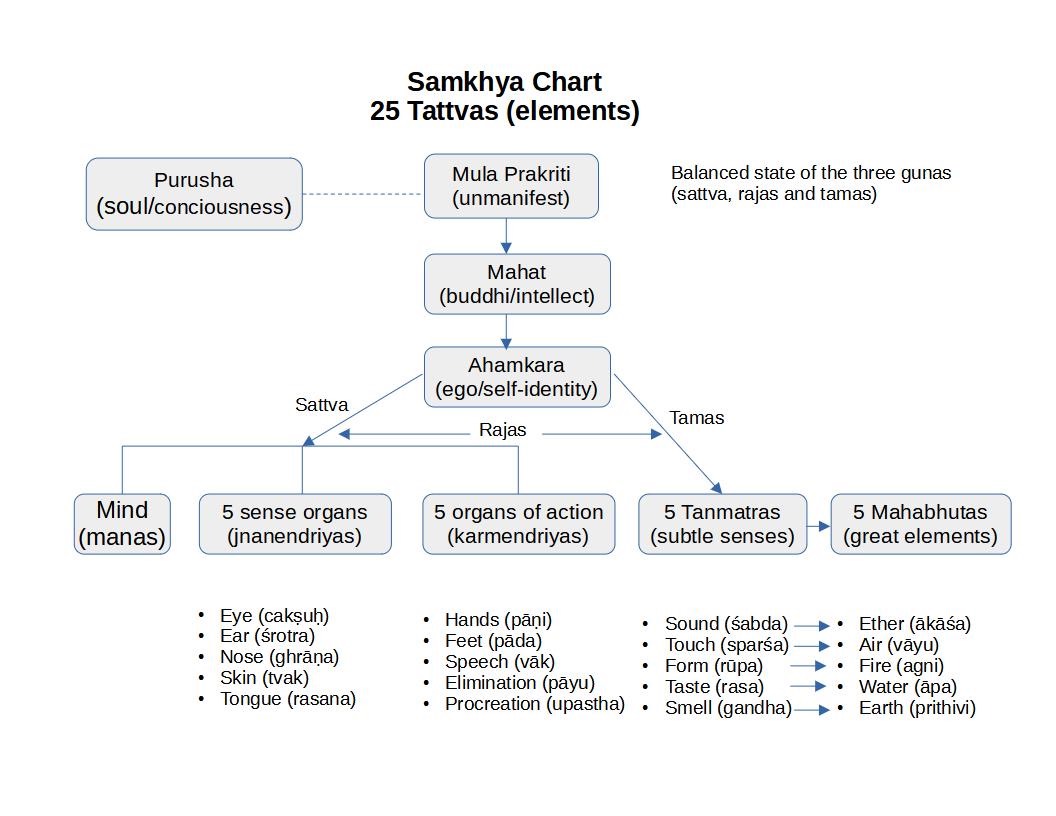
“Purusha, often described as pure consciousness, embodies the witness, a silent observer, detached and free from the activities of the material world. Like a serene mirror reflecting the world without being affected by it, Purusha remains untouched by the constant flux of Prakriti.
Prakriti, conversely, represents the dynamic force of nature, the source of all material manifestation. It is the ever-changing, evolving principle from which the universe arises. Comprising three Gunas - Sattva (purity, harmony), Rajas (activity, passion), and Tamas (inertia, darkness) - Prakriti remains unmanifest when these qualities are in equilibrium. However, any disturbance in this balance triggers the evolution of the remaining 23 Tattvas, leading to the manifestation of the material universe.
Unveiling the 25 Tattvas
These 23 Tattvas unfold from Prakriti in a specific order, each building upon the previous one. Buddhi, or Mahat (cosmic intelligence), emerges first, providing the capacity for discernment and decision-making. From Buddhi arises Ahamkara (ego, the sense of “I”), which shapes our individual identity and self-awareness.
Next is Manas (the mind), constantly engaged in processing thoughts, perceptions, and memories, much like a central processing unit navigating the influx of information from the senses.
Following Manas are the ten Indriyas, divided into Jnanendriyas (cognitive senses) and Karmendriyas (action senses). The five Jnanendriyas - Shrotra (hearing), Tvak (touch), Chakshus (sight), Rasanā (taste), and Ghrāna (smell) - receive sensory input from the external world. The five Karmendriyas - Vāk (speech), Pāni (hands), Pāda (feet), Upastha (genitals), and Pāyu (excretion) - facilitate our interaction with the environment.
Subtler than the Indriyas are the five Tanmatras (subtle elements): Shabda (sound), Sparsha (touch), Rūpa (form/sight), Rasa (taste), and Gandha (smell). These Tanmatras are the precursors to the gross elements, representing the potential for sensory experience.
Finally, the five Mahā-bhūtas (gross elements) - Ākāsha (space/ether), Vāyu (air), Tejas/Agni (fire), Āpaḥ (water), and Prthvī (earth) - constitute the tangible building blocks of the physical world, arising from the Tanmatras and providing the foundation for all material forms.” Understanding the 25 Tattvas in Samkhya: A Clear Explanation - India's Biggest Dashakarma Bhandar | Poojn.in A clear, lucid, illuminating overview.
“So, the first thing which we'll have to understand is that when we talk about the elements; there's an understanding that we refer to those elementary particles which make up the universe; which is around us, whatever material world that is around us.
We believe that the elements which yoga sutras refer to are those elements which are composing the world.
My proposition is that the elements are actually categories of sensory experience actually felt by you; these elements are not something which are illusionary; those are the very elements which you will experience within your body.
The five elements which the yoga sutras refer to our Earth. So, when you say there is predominance of element of Earth in a certain part of the body - it would mean that you would feel heaviness, firmness, inertia; those are the qualities of the elements of earth.
If you are having element of water which is predominant; you will have a sense of balance; flow in that part of the body.
If it's element of fire; it will actually seem to spread unconnected like water; there is continuity in fire, you will find something different. It is just there; at one place, at another place; unconnected.
Then you'll have air and ether; which we will talk about the first class we had experienced.” Iyengar Yoga class By Birjoo Mehta @ World Yoga Festival - YouTube
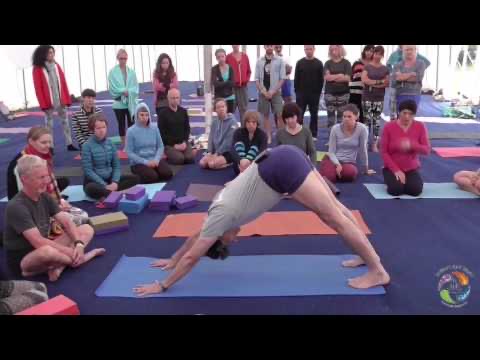
I filmed this class at the inaugural World Yoga Festival, 2016. Birjoo takes you on a subtle journey into experiencing and embodying the first three elements; earth, fire, water. A two-hour masterclass into exploring the nature of you; Know Thyself.
Ancient Foundations (Pre-1000 BCE to 500 CE) - Five Koshas
Vedic and Upanishadic texts: Describe the body as composed of koshas (layers), with prana (life force) flowing through subtle channels (nadis). These ideas resemble quantum fields and non-local energy.
“According to the yoga tradition, every one of us has five bodies, each made of increasingly finer grades of energy.
The five progressively subtler bodies that compose our personality are described in a yoga classic called the Taittiriya Upanishad:
“Human beings consist of a material body built from the food they eat. Those who care for this body are nourished by the universe itself.
Inside this is another body made of life energy. It fills the physical body and takes its shape. Those who treat this vital force as divine experience excellent health and longevity because this energy is the source of physical life.
Within the vital force is yet another body, this one made of thought energy. It fills the two denser bodies and has the same shape. Those who understand and control the mental body are no longer afflicted by fear.
Deeper still lies another body comprised of intellect. It permeates the three denser bodies and assumes the same form. Those who establish their awareness here free themselves from unhealthy thoughts and actions, and develop the self-control necessary to achieve their goals.
Hidden inside it is yet a subtler body, composed of pure joy. It pervades the other bodies and shares the same shape. It is experienced as happiness, delight, and bliss.”
These five bodies are called koshas, or “sheaths,” in Sanskrit, because each fits in the next like a sword in a scabbard. Only the densest is made of matter as we know it; the other four are energy states invisible to the physical eye, though we can easily sense their presence inside us when we pay close attention. Since the inner bodies are the source of our well-being during life and are the vehicles we travel in after death, India’s ancient yogis developed specific exercises to strengthen and tone each one in turn.” The Koshas: 5 Layers of Being And Yoga International; an excellent source for yoga philosophy and embodied practice. Consciousness-Quotient-Squared - E=MC²
“In this 60 minutes 5 Koshas Level 3 class, Vishva-Ji will guide you on a deepening journey through the 5 Koshas layers. This practice will help you purify and expand your awareness of each layer creating harmony between the physical, pranic, mental/ emotional, intuitive and bliss layer holding the space within yourself to connect with your true nature and resting in expansive beingness. The Mantra used is Anando Asmi meaning I am Bliss.” Yoga Practice to Expand Awareness | Panchkosha (5 Kosha) | Create Harmony Within - YouTube Level 3 is advanced; this class has headstand as an inversion pose. Instead; practice rabbit pose, or half shoulder stand.
Pātañjala and Buddha: Two Eightfold Meta-Maps
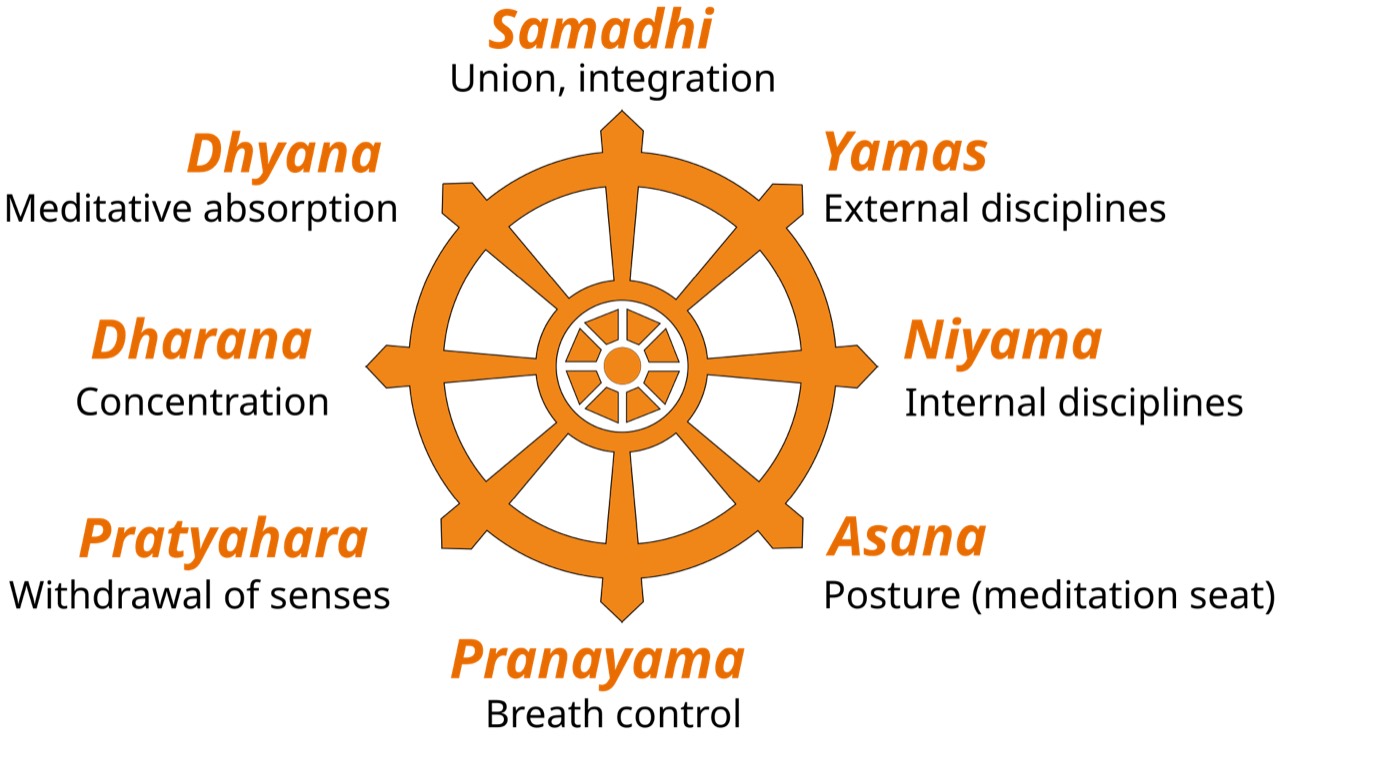
Two ancient eightfold maps stand like twin mandalas at the threshold of Quantum Human: Patanjali's Eight Limbs of Ashtanga Yoga and the Buddha’s Noble Eightfold Path. One grows from the yogic soil of Samkhya, where Purusha, the witnessing consciousness, learns to disentangle itself from Prakriti, the moving field of nature, mind, body, sensation, emotion, memory and becoming. The other flowers from the Buddha’s direct diagnosis of suffering, its cause, its ending, and the middle way of practice that leads beyond confusion into clear seeing; seeing reality as-it-is. CQ²
Pātañjala gives yoga its classical architecture: yama, niyama, asana, pranayama, pratyahara, dharana, dhyana, samadhi. Ethics, inner observance, posture, breath, sense-withdrawal, concentration, meditation, complete absorption.1 A ladder and a wheel. A map and a method. The body is not rejected; it is embodied. Patanjali gives the litmus test; stira-sukham-asanam; steadiness in the body cultivates stability in the mind; being comfortable in the body gives rise to being at ease in the mind. The breath is not decoration; it is the bridge and pranayama is the fourth-limb which acts like a trunk, and it is the breath which aerates the tree like sap. The senses are not enemies; they are gathered back into the lamp of attention and light of awareness. The scattered mind becomes single-pointedly focused by paying attention with kindness, then transparent flow state - merging discipline-and-surrender - at the intersection - at the still point of the turning world; the seer abides in their true nature. And as Yogrishi Vishvketu regularly says; “your true self is joyful, playful, blissful, expandable, and fearless.”
Ask yourself; what temporary traits do you want to cultivate on the path. Be like an inner garden, plant, grow and blossom longer lasting and beneficial states - and at the same time - uproot and let go of any afflictive habits. Embody CQ²
The Buddha gives meditation its noble path: right view, right intention, right speech, right action, right livelihood, right effort, right mindfulness, right concentration. Wisdom, ethics, and meditation. Seeing clearly, intending kindly, speaking truthfully, acting harmlessly, working without violence, cultivating beneficial states, re-remembering the present moment, and stabilizing the mind until insight and wisdom ripen; compassion spontaneously arises. This is not belief as ornament. It is practice as liberation. The Dharma becomes embodied conduct, moment-by-moment, breath-by-breath.2
“You need wisdom and compassion like two wings of a bird, to fly.” H. H. 14th Dalai Lama’s oft-repeated mantra which mirrors the left-and-right-hemispheres.
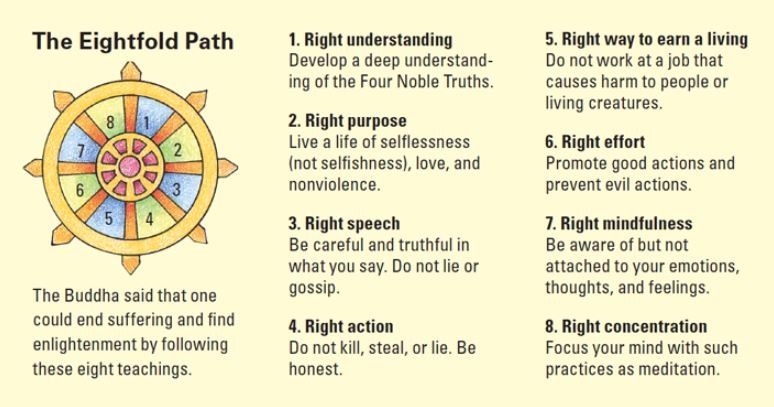
Quantum Human: these two meta-maps are foundational because they unite theory-and-practice, philosophy-and-feel, map-guide-and-path. Patanjali roots yoga in disciplined integration: the refinement of body, breath, senses and mind until consciousness recognises itself. Buddha roots meditation in the middle way: the refinement of view, conduct, attention and concentration until suffering is understood and released. One clarifies the architecture of inner stillness. The other clarifies the ethics of awakened living. Together they form a double helix of embodied awareness.
Their synchronicity is striking: both begin with how we live before they speak of higher states. Both understand that consciousness is trained through relationship, speech, action, breath, attention, discipline-and-surrender. Both move from the outer-to-inner, from behaviour to being, from fragmented habit to coherent presence. Both say: do not merely think spirituality; embody it. Do not merely admire the map; walk it. Do not merely speak of compassion; become it in the nervous system, posture, breath, word and deed; body-breath-and-mind together - everything entangled - interconnected.
Their contrast is equally fertile. Patanjali, shaped by Samkhya, speaks through discernment: Purusha and Prakriti, seer and seen, witness and field, the still point and the dance. Liberation is kaivalya, the disentangling clarity of awareness no longer mistaken for the movements of mind. Buddha speaks through dependent arising and no-self: there is no fixed essence to defend, only conditions arising and passing, craving releasing, compassion widening, emptiness made practical. Patanjali asks the seer to stand free. Buddha asks the self to be seen through. Different doors. Same fresh air.
In Quantum Human language, Patanjali is yoga as inner engineering: body-breath-mind tuned into coherence. Buddha is meditation as radical seeing: attention purified until reality is met as-it-is. Patanjali offers the yogic spine of practice. Buddha offers the meditative heart of the path. One stream becomes two currents: stillness-insight, discipline-compassion, witness-emptiness, form-and-formless. “The path is beginning-less-and-endless, and we are all beginners on the path.” Geshe Sonham Rinchen.
End of spiral 19
The 36th Chamber: all 32 spirals open