36th Chamber · Spiral 16
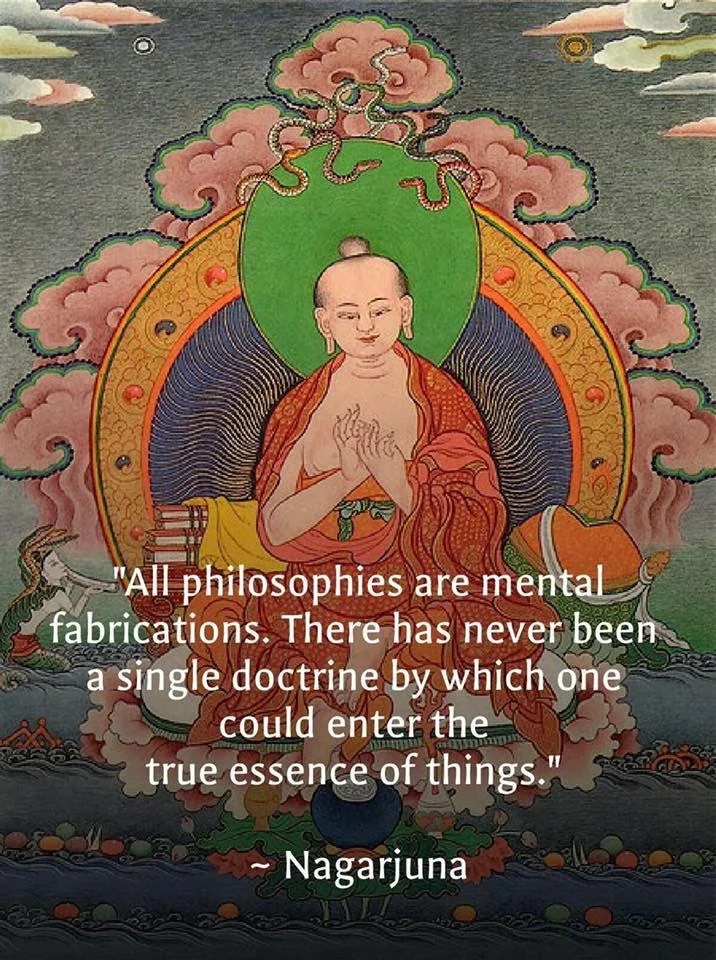
Nāgārjuna and H. H. 14th Dalai Lama
About 7 minutes to read
There is not the slightest difference between samsara and nirvana. There is not the slightest difference between nirvana and samsara.
Nāgārjuna’s Mūlamadhyamakakārikā is the foundational text of the Madhyamaka (Middle Way) school of Mahāyāna Buddhism. It is widely regarded as one of the most profound philosophical works in world history. In this text, Nāgārjuna systematically explores the nature of reality, emptiness (śūnyatā), and dependent origination, showing that all phenomena are empty of inherent existence - not as nihilism, as a dynamic, relational process. And sunyata and dependent origination act like entangled twins.
Why is it so profound - especially for the Quantum Human paradigm?
Emptiness - Relational Reality
Just as it is known
That an image of one's face is seen
Depending on a mirror
But does not really exist as a face,
So the conception of "I" exists
Dependent on mind and body,
But like the image of a face
The "I" does not at all exist as its own reality.
Nāgārjuna’s insight is that nothing exists independently; everything arises in dependence upon causes, conditions, and conceptual designation. This mirrors the quantum view that particles do not have fixed, independent properties until observed - they exist in a web of probabilities and relationships. To be "Quantum Human" is to live in superposition, embodying both/and rather than either/or, and recognizing the interconnectedness-of-all-things. Beyond all dualistic distinctions.
The Middle Way: Beyond Extremes The cessation of all views is nirvana. Nāgārjuna’s Middle Way avoids the extremes of eternalism (things exist inherently) and nihilism (nothing exists at all). Instead, he points to a dynamic, process-based reality. This is deeply resonant with Quantum Human embodiment; one who is not fixed in identity but is a process - observer-and-observed, wave-and-particle, always in transformation. Since all is empty, all is possible. Entities do not exist in their causes, in their conditions, in aggregations of many things, or in individual things. Therefore, all entities are empty.
Collapse of Dualities - Nāgārjuna’s philosophy collapses the duality between subject and object, self and other, observer and observed. In quantum physics, the act of observation is not separate from the observed phenomenon; the two are entangled. To be Quantum Human is to experience and embody non-dual awareness, living as the question-and-answer, seeker-and-mirror. Balance-the-opposites. CQ²
Practical Wisdom for Transformation - Nāgārjuna’s teaching is not only theoretical - it is a guide to liberation. By seeing through the illusion of inherent existence, one becomes free from attachment and aversion, able to move fluidly through life’s paradoxes. Optimal learning from a Quantum Human perspective; someone who integrates wisdom-and-compassion, theory-and-practice, and moves beyond fixed identities into a field of infinite potentiality. Wisdom and compassion, two wings; fly.
Mūlamadhyamakakārikā is the essential text for understanding the Middle Way. Its vision of emptiness, relationality, and the collapse of dualities is profoundly aligned with the Quantum Human paradigm - a being who lives in superposition, embraces paradox, and recognizes the interconnected, participatory nature of reality.
Nāgārjuna’s Fourfold Negation: A Practice of De-Reifying Reality - Nāgārjuna’s fourfold negation, or catuṣkoṭi, is not a metaphysical doctrine about what reality is. It is a disciplined method for undoing how the mind falsely fixes reality. Its power lies precisely in refusing to settle into any of the four logical positions that ordinary cognition habitually relies upon: existence, non-existence, both, or neither. Each “corner” is dismantled not to replace it with a superior theory - it exposes the instability of all views when taken as final truths. True. False. True-False. False-True. Re-Rubik Cube all possibilities - move beyond linear constraints - non-linear - non-binary - Q-Bit.
Seen through the lens of functional contextualism, Nāgārjuna’s negations operate less like abstract logic and more like a therapeutic intervention. To say “it exists” is to freeze a phenomenon into a self-subsisting object. To say “it does not exist” is to deny lived experience and slip into nihilism. To claim “both” collapses into contradiction, while “neither” risks becoming another subtle metaphysical position.
Nāgārjuna’s genius is to show that each stance fails functionally: none of them liberate the mind from clinging; all of them perpetuate reification. In this reading, the tetralemma becomes a practice of loosening identification. When we say “I am anxious,” we treat anxiety as an inherent self-property. When we say “I am not anxious,” we negate lived reality. When we say “I am both anxious and not anxious, we intellectualize the tension. When we say “I am neither,” we abstract away from experience altogether. Nāgārjuna’s method gently but relentlessly reveals that none of these positions work when the goal is freedom from suffering. What remains is not a new belief; now, a shift in how experience is held: self as process, not substance; meaning as contextual, not intrinsic. Everything is relational. Everything-is-connected.
This is why emptiness (śūnyatā) in Nāgārjuna is not nihilism. Emptiness names dependence, not absence. Phenomena function, appear, and matter - but only within conditions. The tetralemma trains awareness to stay with this relational flow without collapsing it into rigid conclusions. In Quantum Human terms, it is an education in superposition: learning to remain with “not-this, not-that” without forcing premature closure. Q-BISM is a quantum theory which acts as a modern superposition mirror.
And so, therefore, the fourfold negation is not something to believe; it is something to inhabit. It teaches the mind how to stop mistaking its own conceptual scaffolding for reality itself. What is negated is not the world; it is our addiction to certainty. What is revealed is a middle-way where insight arises not from asserting truths; from releasing the need to have them. Be like Neo exploring beyond the minds’ constructed material Matrix. Exploring Nagarjuna's Fourfold Negation Through Functional Contextualism
Nāgārjuna and the Middle Way: Deconstruction of Essence
Whatever is dependently co-arisen
That is explained to be emptiness.
That, being a dependent designation
Is itself the Middle Way.
Nāgārjuna is a philosopher whose originality lies not in advancing a new metaphysical position - his genius lies in demonstrating the incoherence of the metaphysical assumptions that philosophy habitually relies upon. Central to his work is a sustained critique of svabhāva - the notion that entities possess an intrinsic, self‑existing nature.
Nāgārjuna’s claim is not that things fail to exist; it is that they cannot exist in the way philosophical realism presupposes; as independent, self-grounding substances.
Nāgārjuna’s method is strikingly systematic. Across the Mūlamadhyamakakārikā, he applies reductio arguments to core philosophical concepts such as causation, motion, time, identity, and agency. In each case, he shows that positing intrinsic essence leads to contradiction. For example, if causes possessed inherent nature, they could neither change nor give rise to effects; if motion were intrinsically real, it could not be coherently located in either the mover, the path, or the act itself.
These arguments do not deny ordinary experience; they reveal that experience functions coherently only when understood relationally and dependently.
A key philosophical perspective is Nāgārjuna’s articulation of the two truths: conventional truth and ultimate truth. Conventional truth concerns the everyday world of language, practices, and ethical life; ultimate truth is the insight that these conventions lack intrinsic grounding. Crucially, ultimate truth does not refer to a hidden metaphysical reality behind appearances. Rather, it is the clear understanding of the dependent, contingent nature of appearances themselves. To reify emptiness as an ultimate substance would re-instate the very essentialism Nāgārjuna dismantles.
The Middle Way avoids eternalism and nihilism. Eternalism mistakes convention for absolute reality; nihilism mistakes the critique of essence for a denial of function. Nāgārjuna’s philosophy shows that the absence of intrinsic nature is precisely what allows phenomena to arise, interact, and matter at all. Emptiness is therefore not a metaphysical conclusion - it is a methodological insight - one that dissolves attachment to views while preserving the intelligibility of lived experience.
Nāgārjuna (Stanford Encyclopedia of Philosophy) An excellent Western academic overview; a step-by-step precise and rigorous analysis of Nagarjuna’s profound Middle Way philosophy and the interdependent nature of all phenomena.
“The Dalai Lama opens The Middle Way with an elegant argument for the power of compassion in cultivating a happy life. From there, he connects core ideas of Buddhist philosophy to the truths of our shared condition. His Holiness delivers a sparklingly clear teaching on how the Buddhist ideas of emptiness and interdependency relate to personal experience and bring a deeper understanding of the world around us.
In down-to-earth style, this book sets forth a comprehensive explanation of the foundational teachings of the Mahayana tradition based on the works of two of Buddhism's most revered figures. Using Nagarjuna's Middle Way, the Dalai Lama explores Buddhist understandings of selflessness, dependent origination, and the causal processes that lock us in cycles of suffering. He grounds these heady philosophical discussions using Tsongkhapa's Three Principal Aspects of the Path, presenting a brief explanation of how to put ethical discipline, wisdom, and compassion into practice.
Through these beautifully complementary teachings, His Holiness urges us to strive, "with an objective mind, endowed with a curious skepticism, to engage in careful analysis and seek the reasons behind our beliefs." The Middle Way: Faith Grounded in Reason by Dalai Lama XIV | Goodreads
The Middle Way
for Nāgārjuna, after W. S. Merwin
There is no path,
only the walking of it.
There is no river,
only water that forgets its name.
Emptiness is not absence,
it is fullness of space; beyond
words, beyond dualistic distinctions.
Samsara is Nirvana, Nirvana is Samsara,
the gate beyond swings both ways,
the wind - neither coming nor going.
You look for the end and find the beginning,
you search for the self and find an empty sky
reflected in a pool; Simba, his father's face.
What is, is not. What is not, is.
The world is a question to itself
that answers itself by vanishing.
Consciousness-Quotient-Squared. Cognitive awareness, Emotional intelligence, Somatic presence, Ethical discernment, Aesthetic sensitivity, Metaphysical intuition, Interpersonal resonance, Temporal awareness. CQ² - flow state - merge discipline and surrender - and at the still point of the turning world - Samadhi - complete absorption between the finite-and-the-in-finite - beyond all disturbances. And there the dance is.
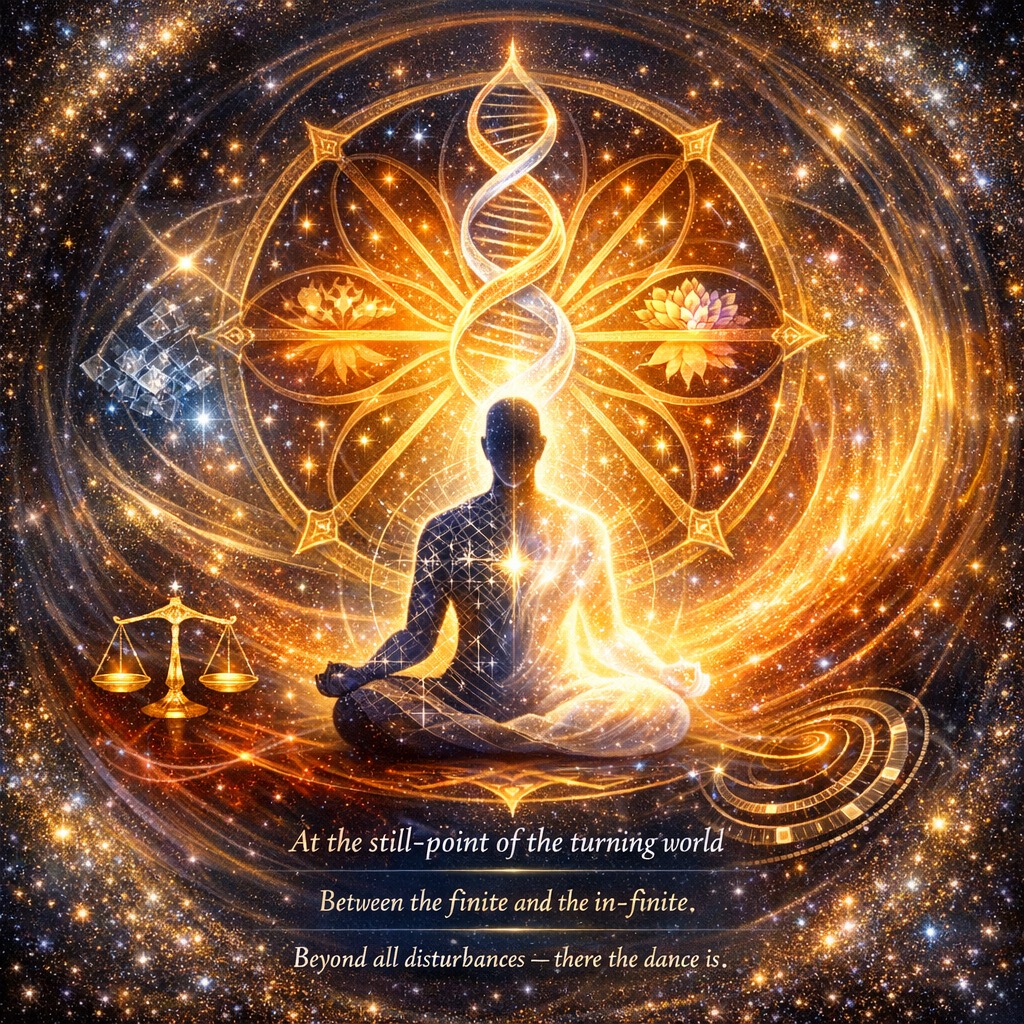
Still Point - Turning World
Breath settles -
discipline loosens,
mind opens.
Wheel turns, no hub;
finite thins to field -
stillness becomes dance.
Unsurpassed Enlightenment
I. after Dōgen
Moon on an empty sky -
painted silence.
The rice cake reveals:
form dissolves
in a dew drop.
Thought burns to ash.
I AM the centreless spiral,
turning without turning.
The world exhales once -
nothing is not One.
II. after Don Paterson
Moon on the inking sky,
a painted hush.
The rice cake’s truth:
form dissolves
in one bright drop.
Thought burns to carbon.
I am a spiral without its middle,
a ghost of a circle learning to close.
The whole world takes one breath
and breathes me back to me.
III.
Moon on empty sky - painted
silence - the rice cake’s truth:
form dissolves into light.
Thought recedes like a wave.
I AM a spiral without centre.
The whole world breathes One.
End of spiral 16
The 36th Chamber: all 32 spirals open