36th Chamber · Spiral 23
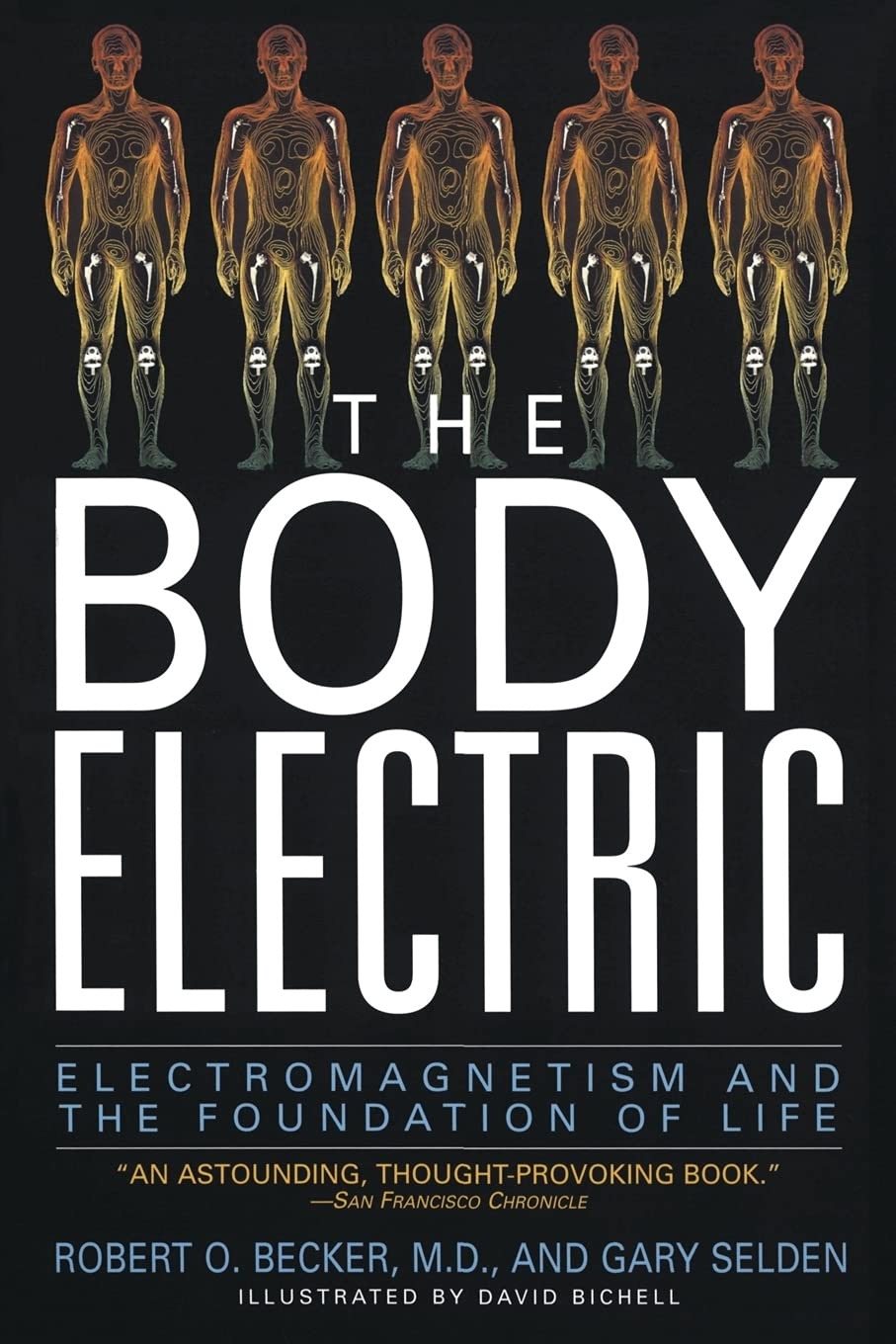
The Body Electric
A new piece by the author · about 5 minutes to read
“Real science is creative, as much so as painting, sculpture, or writing. Beauty, variously defined, is the criterion for art, and likewise a good theory has the elegance, proportion, and simplicity that we find beautiful. Just as the skilled artist omits the extraneous and directs our attention to a unifying concept, so the scientist strives to find a relatively simple order underlying the apparent chaos of perception.” Robert O. Becker, The Body Electric: Electromagnetism and the Foundation of Life.
The Body Electric begins where conventional anatomy becomes quiet. Robert O. Becker showed that the body is not governed by chemistry alone. Direct-current electrical potentials participate in wound healing, bone repair, regeneration, and cellular coordination. Before the chemistry of repair fully unfolds, an electrical pattern helps establish where healing must occur. The organism is not merely assembled from substances; it is continuously organized by signals. Becker was way ahead of time.
“Two separate currents, then, one from the nerves and one from the bone matrix, were producing potentials of opposite polarity, which acted like the electrodes of a battery. These living electrodes were creating a complex field whose exact shape and strength reflected the position of the bone pieces. The limb was, in effect, taking its own X ray.”
This changes the image of the human being. The body becomes less like a biochemical machine and more like a living field: tissues communicating through voltage gradients, ionic currents, nerves, extracellular matrices, and connective pathways. Becker investigated nerves and surrounding tissues as components of a body-wide electrical communication system. Movement itself enters this conversation. Mechanical pressure on bone produces electrical effects - often discussed in relation to piezoelectricity and fluid flow - so every step becomes a small exchange between structure and charge.
Here the microcosm of the human body begins to echo Walter Russell’s cosmology. Russell imagined creation as rhythmic polarity: compression and expansion, charging and discharging; form emerging through ordered motion. Becker brought a related intuition down into flesh. At the scale of the organism, electrical differences help organize matter, direct repair, and preserve form. Russell offered a cosmic metaphor; Becker supplied experimentally testable biological mechanisms. The two should not be equated; they meet at the Socratic intersection, one provocative idea: pattern precedes structure.
Quantum biology carries this inquiry deeper. It asks whether living systems exploit phenomena such as electron transfer, proton tunnelling, coherence, and quantum sensitivity. Becker’s bioelectricity is principally classical electrophysiology, not proof of quantum healing. Yet both fields challenge the belief that life can be understood by cataloguing chemicals alone. The decisive question becomes not only what molecules are present? but what organizes their activity across scales?
Jeremy Narby’s The Cosmic Serpent opens another door. His encounter with Amazonian knowledge and DMT-inspired visions led him to explore correspondences among consciousness, symbolism, and molecular life; particularly DNA. " Narby investigates how shamans across cultures might have accessed molecular-level knowledge of DNA through altered states of consciousness, bridging indigenous wisdom and modern science." The Cosmic Serpent — Summary & Key Takeaways - a timeless lens
It is tempting to connect this with Becker’s account of electrically active tissue and bone. No established evidence, however, shows that DMT visions arise by activating piezoelectric structures in the skeleton. The relationship is better understood as a convergence of questions: can altered consciousness reveal dimensions of embodied pattern that ordinary perception filters out? Quantum by another way; non-local effects.
Ancient practices have long approached the body in similarly dynamic terms. Yoga describes prāṇa moving through nāḍīs and gathering at chakras. Chinese medicine speaks of qì circulating through meridians. Tai Chi turns this circulation into slow, coordinated movement; martial arts concentrate it through posture, breath, timing, and intention. Acupuncture intervenes at specific points within that relational map.
These systems are not simply archaic descriptions of nerves or electrical wires. Nāḍīs cannot be reduced to axons, nor meridians identified straightforwardly with connective-tissue planes. Their maps include sensation, attention, breath, emotion, movement, and meaning. Yet they may preserve experiential knowledge of how the organism regulates itself as a whole. The body electric, the five Koshas of the yogic body, the body electrified. Michael Levin’s work on bioelectricity; chi, qì, prāṇa by a modern name.
From this perspective, yoga reorganizes the body through sustained posture, breath, and attention. Tai Chi cultivates balance through rhythm and weight transfer. Martial arts coordinate intention with force. Acupuncture applies localized stimulation that can influence neural, connective-tissue, circulatory, and pain-regulation processes. Each practice works through relationships rather than isolated parts. This is where a frequency-based healing model enters - careful distinctions matter - holism, not isolated parts.
Becker’s work supports the broad proposition that bioelectric organization matters to healing. It does not, by itself, validate Rife machines, biofield tuning, or the claim that a particular externally applied frequency restores a unique “native electrical state.” Those applications require their own controlled evidence. “Coherence” must also be defined operationally: which measurable signal becomes more coherent, at what frequency, in which tissue, and with what reproducible clinical outcome?
The strongest formulation of a frequency machines’ purpose would therefore be a hypothesis rather than a settled conclusion:
My work explores whether carefully characterized frequencies can support biological regulation by influencing measurable electrical or physiological patterns. Rather than suppressing symptoms alone, the aim is to investigate whether disrupted coordination can be guided toward a more stable state. Discipline-and-surrender; flow state. CQ²
The reimagined body is neither merely chemical nor vaguely energetic. It is layered: molecular and electrical, mechanical and informational, subjective and social. Chemistry provides materials; bioelectricity contributes organization; movement changes tension and charge; breath modifies physiology; attention changes experience and regulation.
Becker, Russell, quantum biology, Narby, and the subtle-body traditions do not form a single chain of proof. They form something more useful: a constellation of perspectives orbiting the possibility that life is maintained through patterned relationships. The machine and the organism meet here - not as controller and controlled, now as signal and listener.
“The scientist must be free to follow unexpected paths as they appear.”
The goal is not to impose order from outside. It is to ask whether the body can be offered a sufficiently precise cue to remember how to organize itself. That is the deeper journey: from treating the body as an object to encountering it as an event - electrical, rhythmic, adaptive, and continually becoming. Love again the stranger who was your self.
Breathe-feel-connect. Being-and-becoming. Self-regulation is a superpower. The Body Electric. Be as you are. Be present. Pay attention with kindness. Be now. Moment-by-moment. E=MC²
End of spiral 23
The 36th Chamber: all 32 spirals open