36th Chamber · Spiral 18
Tools of Quantum Human
About 26 minutes to read
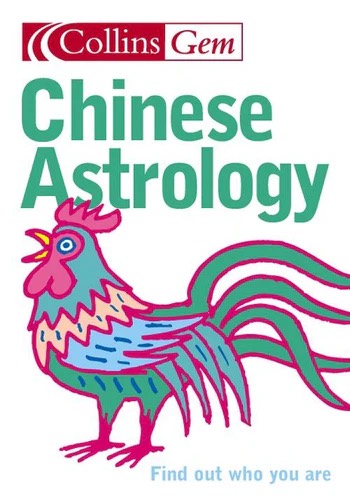
1. Collins Gem of Chinese Astrology This pocket guide introduces the 12 animal signs and five-elements, offering a lens on temperament, destiny; the cyclical nature of time. It’s a tool for self-enquiry, family dynamics, and understanding the dance of yin- and-yang in your own life. In relation to Quantum Human, you will find your Chinese and Western star signs - 12x12=144 probability and triple elements combined. I am Tiger-Aries - wood-wood-fire. And like its title states, Collins Gem, the first facet.
“A fascinating introduction to the signs of the Chinese zodiac, now completely redesigned in full colour. Along with Eastern philosophies, Chinese astrology has recently become popular in the West. Despite being complex in its analysis, it is easy for the novice to access, as all you need is your date of birth. Collins Gem Chinese Astrology describes the 12 animal symbols and interprets their meanings in a clear and entertaining fashion. Each animal sign features the following information: The lunar years ruled by that animal. The positive and negative aspects of the animal sign. The characteristics of the male, female and child animal. The animal at home and work, its preferences and compatibility with the other Chinese signs. The animal in love, its health, leisure interests and the links between its sign and those of Western astrology. Chinese Astrology (Collins Gem) - HarperCollins Publishers UK
2. Mayan Signature (Dreamspell) The Mayan Dreamspell calendar assigns each person a galactic signature. It’s a cosmic cipher for archetypal energies, synchronicity, and the quantum play of time. Use it to attune to planetary cycles; explore your own unique cosmic frequency, your signature resonance; experience your Cosmic Dreamspell Mayan signature. Free Mayan Astrology Readings! I am Yellow Galactic Human. Click open Dreamspell calculator to explore your own Mayan Signature. There are 260 possible Kin combinations, each with a precise, expansive and in-depth Cosmic Dreamspell - illuminating, interweaving, and multi-dimensional - commentary.
The Dreamspell / Tzolkin matrix is built from two interlocking cycles:
20 Solar Seals (Glyphs)
13 Galactic Tones
These two cycles weave through each other like intermeshing gears:
20 seals × 13 tones = 260 possible combinations
These 260 combinations are called Kin - each one is a Galactic Signature.
“There are a total of 20 ‘Glyphs’ and 13 ‘Tones’… This total is 260, the number of days in the Tzolkin.” [oocities.org]
How the 260 Signatures Are Divided and Structured
20 Solar Seals (Archetypes) These are symbolic archetypes - Dragon, Wind, Night, Seed, Serpent… through to Sun. The cycle is a repeating loop of 20. Each seal has: a colour (red, white, blue, yellow), an action, an essence, a power. The Dreamspell document lists all 20 seals and their attributes. [oocities.org]
13 Galactic Tones (Energy Frequencies) The tones describe the quality of the energy, such as: 1 Magnetic - unify, attract. 7 Resonant - channel, inspire. 13 Cosmic - endure, transcend. They cycle in a loop of 13. [oocities.org]
Together, these tones add a rhythmic, numerological layer to each signature.
4 Colours (Red, White, Blue, Yellow) Every seal belongs to one of four colours: Red - initiates. White - refines. Blue - transforms. Yellow - ripens. The colours rotate in repeating order and form the basis of the Wavespell structure explained below. [oocities.org]
How These Divisions Subdivide the 260 Kin
The 260-day Tzolkin is traditionally shown as a 13 × 20 matrix, with: 20 Solar Seals across the top. 13 Galactic Tones down the side. [oocities.org]
From this matrix arise the major subdivisions:
20 Archetypal Cycles (20-day Solar Seal cycles) Every 20 days, you complete one loop through all 20 seals. Each 20-day round represents a thematic arc rooted in the seal archetypes. Cyclical existence - being in harmony with the universe - know your Mayan Signature. I AM. Gnosis. Know Thyself. Everything-spiral-radiates-unfurls. CQ²
13-Tone Wavespells (13-day cycles) Each Wavespell begins with a Magnetic (Tone 1) day and ends with Cosmic (Tone 13). There are 20 Wavespells in a full 260-day Tzolkin: 20 Wavespells × 13 days = 260 days
The colour of the Wavespell matches the colour of its first seal: Red Wavespell, White Wavespell, Blue Wavespell, Yellow Wavespell, repeating in a cycle; an infinity loop.
4 Castles (52‑day cycles) The 260 Kin divide into four large “Castles,” each 52 days long: Red Eastern Castle of Turning, White Northern Castle of Crossing, Blue Western Castle of Burning, Yellow Southern Castle of Giving.
Each Castle contains 4 Wavespells × 13 days = 52 days.
This structure links to the Dreamspell’s 52-year synchronic cycle. [mayawisdom.com]
5th Force Oracle (Energetic Cross) Each signature subdivides further into a destiny cross: Guide, Analog (ally), Antipode (challenge), Occult (hidden power). The structure appears in modern calculators describing Dreamspell divisions. [sites.google.com]
Cosmic Summary: There are 260 possible Mayan (Dreamspell) Galactic Signatures, generated by: 20 Solar Seals, 13 Galactic Tones → yielding 260 Kin (20 × 13)
These signatures are subdivided into: 20 Wavespells (13 days each), 4 Castles (52 days each), 20 Solar Seal cycles (20-day archetypal loops), 5th Force Oracle (4-way energetic cross)
This is the full structure of the Dreamspell/Tzolkin signature system. I am Yellow Galactic Human like Ray Winstone says; “I AM BEOWULF!” 2007, masterful animation.
3. Jungian Astrology (AstroDienst, Liz Greene) Liz Greene’s Jungian approach at AstroDienst blends Western astrology with depth psychology, mapping the psyche’s archetypes, shadow, and individuation process. Your birth chart becomes a mandala for self-realization and integration - past-present-future - Greek archetypes - mythos.
4. Jungian Tarot (Liz Greene, Liz Sharman Burke) Tarot, especially through a Jungian lens - a tool for dialogue with the unconscious. Each card, an archetype; a mirror of the soul’s journey, reflection and transformation. Celtic Cross. Greek mythos.
5. Greek Mythology & The Four Elements Greek myths encode the perennial questions of existence: Who am I? What is my purpose? The Four Elements - Earth, Air, Fire, Water - are cosmological and psychological, mapping temperaments, seasons; the interplay of body, mind, emotion, and soul, revealing Spiritus.
6. Practice: Exploring the Territory - Foundational Embodied Arts & Teaching
Gayatri Kriya (Yogrishi Vishvketu): A daily morning breath and movement sequence for energy, clarity, and joy; feeling comfortable in your own skin during the day.
Joint Mobility Routine (Carsten Stausberg): A daily morning practice from feet-to-head; cultivating stability, rootedness, centredness, spinal waves; fluid alignment.
Ramaswami’s Tadasana Sequence: Foundation of vinyasa krama yoga - steadiness in the body and alertness of the mind - feeling comfortable in the body and at ease in the mind - breath-mind integration - union-of-body-breath-and-mind-continuum. CQ²
Teaching Ian McKellen: Sharing these practices with Sir Ian is itself a tool - teaching is learning, transmission is transformation. Mirror neuron pattern experts in their fields - explore the entire bandwidth of yin-and-yang - balance the opposites. E=MC²
Other Teachers: Yoga With Adriene, Megan MacCarthy (somatic yoga), Olga Kabel (diaphragm and nervous system), Mingyur Rinpoche (meditation and neuroscience), Thich Nhat Hanh (mindfulness), H.H. the 14th Dalai Lama (compassion), Akong Rinpoche and Chogyam Trungpa (Tibetan Buddhism), Bruce Lee (Jeet Kune Do), Ruth Padel, The Poem and the Journey, John Wheeler, Ken Wilber, and all of the other teachers who appear in this book-blog. Explore the entire bandwidth of yin-and-yang.
Ask yourself, who do you want to mirror neuron pattern - mimic, imitate and emulate - absorb, adapt, integrate - Consciousness Quotient Squared. CQ² - M.M.A² - E=MC²
7. Books
Taming The Tiger (Akong Rinpoche). “The teachings in Taming the Tiger are applicable to anyone who is suffering, not only to oriental people or to Buddhists. Eastern people may differ from Westerners in their facial features, manner of dress, customs and ways of talking, but human nature is universal and runs deeper than mere racial characteristics or skin colouring. Kindness, wherever it is shown, generally evokes a favourable response; while its opposite causes anger, sorrow or pain. When we consider the joy and suffering in a direct and practical way, it becomes clear that the mind, which is behind everything we do or say, is essentially the same. East or West. Yet where is this mind? We have only to look at everyday situations and examine our behaviour, our desires and our suffering in our every-day situations in order to detect its presence.” Taming the Tiger | SamyeLing.org
The Heart of Yoga (Desikachar): Yoga as a living tradition, adapted to the individual. Combining theory and integrated practice; syncing breath with movement; masterful. “The Heart of Yoga is a foundational text that offers an insightful and practical approach to yoga practice. Desikachar, the son and devoted student of the legendary yogi Śrī Tirumalai Krishnamacharya, distills his father’s teachings into an accessible guide suitable for all levels of practitioners. The book presents the essence of Krishnamacharya’s philosophy, particularly emphasizing viniyoga, which advocates tailoring yoga practice to individual needs.
For anyone new to yoga or looking to deepen their practice, The Heart of Yoga serves as an excellent entry point. The book is often recommended for its clarity, practicality, and depth. Interestingly, in a survey I conducted with 125 yogis, this book emerged as the most favored yoga book, which speaks volumes about its influence and relevance in the yoga community.” The Heart Of Yoga by T.K.V. Desikachar - This Yoga Life
The Wisdom of Patanjali’s Yoga Sutras. There are many illuminating and insightful commentaries on Patanjali’s yoga sutras. Ravi Ravindra “draws from the wisdom of many traditions as he explores the implications of the teaching in the Yoga Sutras...Ravinda invites the reader to engage with the questions which arise from the text as an aid to self-study and to relate the teaching to their daily lives.” Accessible and full of clarity, wisdom and insight and beautifully written; suitable for all levels of self-enquiry. Beyond Derren Brown mind control; on a par with Luke Skywalker using and harnessing the Force; prana by another name. 198 sutras. Each, a diamond.
The Truth of Yoga (Daniel Simpson): Beautifully written with wisdom, depth, insight and clarity covering the vast historical roots of yoga all the way up to the present; a living Tree of Yoga. A “clear, concise, and accessible handbook for the lay reader that draws upon abundant recent scholarship. It outlines these new findings with practitioners in mind, highlighting ways to keep traditions alive in the twenty-first century.” I give this a Strictly Coming Dancing, Len Goodman: “TEEENN!”
The Master and His Emissary (Iain McGilchrist): The divided brain and the quest for wholeness. His magnum opus. The Beshara Lecture - the Coincidence of Opposites Peer into McGilchrist's illuminated mind palace akin to Sherlock Holmes.
Quantum Questions (edited by Ken Wilber): Science and mysticism in dialogue. The mystical writings of the founding fathers of Quantum Physics, the limits of scientific enquiry, science and mysticism - distinct yet interconnected - a complete worldview.
On Natural Capital (Partha Dasgupta) “For as long as they have existed, our economic models have served us an incomplete picture.
The models and metrics tells us that our economies are healthy because they are growing. However, this doesn't account for the fact that our growth is driven by a resource that we take for free and treat as infinite: nature. For centuries we have been using it as if it were both, but we know now, more than ever, that our demand on the natural world is unsustainable. It's no longer sufficient to only see part of the picture; it's time that our economic models show us the whole thing.
In On Natural Capital, renowned Cambridge economist Sir Partha Dasgupta lays out a seminal and groundbreaking new approach to economics. Challenging everything that has come before, he asks, what if we were to put a value on nature just as we value everything else?
An urgent call to transform the focus and structures of global economics, On Natural Capital is a bold and groundbreaking book that could, truly, change everything.” This is the best book in economics for a general reader since Adam Smith’s The Wealth of Nations.' - Paul R Ehrlich On Natural Capital
A Theory of Everything (Ken Wilber) the meta-map maker of holism in a modern context; scientific, empirical, verifiable, spiritual, embodied; the Great-Chain-of-Being.
Radiant Compassion (Gerd Bausch): The life of the 16th Karmapa, bridging worlds.
Optimise - A Seven Step Plan in Health and Longevity through Quantum Biology: how the body responds to light, H3O, structured water, sound and frequencies, natural forces that you can harness. The universe is participatory, local and non-local effects.
The Tao of Physics (Fritjof Capra): Parallels between quantum science and Eastern mysticism. Consciousness is the ground and is fundamental. Matter is derivative.
The Middle Way Faith Grounded in Reason (H.H. the 14th Dalai Lama). Nagarjuna's teachings on the middle-way beyond the extremes; balancing-the-opposites.
"50 Philosophy Ideas You Really Need to Know." The problem of knowledge, consciousness, identity, ethics, belief, justice, language, meaning and aesthetics have engaged the attention of thinkers from the era of the ancient Greeks to the present day. From Plato’s cave to Descartes’ mind-body problem, Aristotle’s golden mean to Kant’s categorical imperative, the other minds problem to Occam’s razor, to the barber paradox; the complex made accessible, exquisite essays, engagingly and lucidly written. This book gives the reader a firm foundation in Western philosophy. CQ²
8. Poems, Collections, Poetic Prose, On Writing
Selected Poems and Love After Love (Derek Walcott): Give back your heart to itself, to the stranger who has loved you all your life.
Selected Poems, Rain, and Bathysphere (Don Paterson): I saw my own mind surge into the world,/ and close it all inside one human tear. Acclaimed Scottish Poet Don Paterson reads at Emory University
Seamus Heaney's Poetry: 12 Poems from 12 Collections | Faber Journal A glimpse of the consummate master at work. Digging. An extra-ordinary legacy.
Painting of A Rice Cake (Dogen): painting unsurpassed enlightenment. Poetry
A Tale of Two Gardens (Octavio Paz): Poetry as a bridge between East and West, self and cosmos. Balancing-the-opposites. Hindu, Buddhist and Sufi whirling-as-one.
Collected Works (Czeslaw Milosz) Nobel poet, the master of every poetic art form and formlessness; On Prayer, Orpheus and Eurydice, A Song on the End of the World, Ars Poetica. Czeslaw Milosz Poems - Poems by Czeslaw Milosz
“Rilke’s letters to a young poet Franz Xaver Kappus, written between 1902 and 1908, were first published by Kappus in 1929. A cadet at the Austrian military academy the lower school of which Rilke had attended in the 1890’s, the young man went on to pursue an extended military career, as an officer in the Austro-Hungarian army, afterwards working as a journalist, editor, writer, and politician. These letters, dating from the early period of Rilke’s own poetic development, offered advice and insight to the younger man, while also revealing Rilke’s ideas and attitudes regarding creative poetic effort and life itself. The two men never met in person, but, thanks to Kappus, these letters to him were preserved, and help to illuminate Rilke’s own achievements in the art, as well as providing a source of inspiration and guidance to poets in general.” Rilke, Rainer Maria (1875–1926) - Letters to a Young Poet
“Wise and practical, On Writing (and Writers) reveals Lewis’s thoughts on both mechanics and style, including choosing adjectives, the art of expression, how to connect with readers, and the core principles of clear, impactful writing.
A window into the mind of one of the greatest public intellectuals of the twentieth century - a gifted writer whose influence and insights remain relevant six decades after his death - this engaging collection reveals not only why Lewis loved the written word, but what it means to “gladly teach” the art of writing, so that wise readers can “gladly learn.” 15 Pieces of Writing Advice from C. S. Lewis
Zen Haiku: The art of presence, simplicity, the spiral of return. Ancient pond, a frog jumps in, splash. Basho's Frog Haiku: 32 Translations 13 Matsuo Bashō Poems - Discover Bashō's Poetry - Poem Analysis
June 2016. It is 7.30pm. I wander into The Daffodil Hotel in Grasmere. 7.45pm. Robert Hass walks on stage to give a live reading of The Essential Haiku. Hass reads selections from three great masters of Haiku, Basho, Buson, Issa; some of his Czeslaw Milosz translations, some of his own poems, and a commentary on the art of translation. An exquisite masterclass on a warm, intimate evening. Hass reading and talking about Bashō, Buson, Issa and Milosz in the Lake District; the universe in superposition. And I shall name those two hours; the perfection-of-the-finite-within-the-infinite.
“The Essential Haiku brings together Robert Hass's beautifully fresh translations of the three great masters of the Japanese haiku tradition: Matsuo Basho (1644-94), the ascetic and seeker, and the haiku poet most familiar to English readers; Yosa Buson (1716-83), the artist, a painter renowned for his visually expressive poetry; and Kobayashi Issa (1763-1827), the humanist, whose haiku are known for their poignant or ironic wit.
Each haiku master's section of the book is prefaced with an eloquent and informative introduction by Robert Hass, followed by a selection of over 100 poems and then by other poetry or prose by the poet, including journals and nature writing. Opening with Hass's superb introductory essay on haiku, the book concludes with a section devoted to Basho's writings and conversations on poetry.
The seventeen-syllable haiku form is rooted in a Japanese tradition of close observation of nature, of making poetry from subtle suggestion. Each haiku is a meditation, a centring, a crystalline moment of realisation. Reading them has a way of bringing about calm and peace within the reader. The symbolism of the seasons and the Japanese habit of mind blend together in these poems to create an alchemy of reflection that is unsurpassed in literature.
Infused by its great practitioners with the spirit of Zen Buddhism, the haiku served as an example of the power of direct observation to the first generation of American modernist poets like Ezra Pound and William Carlos Williams as well as an example of spontaneity and Zen alertness to the new poets of post-war America and Britain. Universal in its appeal, Robert Hass's The Essential Haiku is the definitive introduction to haiku and its greatest poets, and has been a bestseller in America for twenty years.
'I know that for years I didn't see how deeply personal these poems were or, to say it another way, how much they have the flavour - Basho might have said "the scent" - of particular human life, because I had been told and wanted to believe that haiku were never subjective. I think it was D.H. Lawrence who said the soul can get to heaven in one leap but that, if it does, it leaves a demon in its place. Better to sink down through the level of these poems - their attention to the year, their ideas about it, the particular human consciousness the poems reflect, Basho's profound loneliness and sense of suffering, Buson's evenness of temper, his love for the materials of art and for the colour and shape of things, Issa's pathos and comedy and anger.' - Robert Hass.
The Narrow Road to the Deep North² Basho (1689) and Flanagan (2013): a Zen master - the art of poetic prose. This, the summit and soul of Japan. This book and its twin namesake, the Booker Prize Winner in 2014. Richard Flanagan, mirror neuron patterning the Zen master - the art of poetic prose - juxtaposed alongside a poem to magnify the Zen now moment - being inspired along his own journey to the self in the mirrored reflection and horror of WW11 - a Basho poem resonates and illuminates.
Separated by more than three centuries, radically different historical conditions; utterly different narrative circumstances - yet profoundly entangled. They occupy the same symbolic title, the same poetic terrain; in a deeper sense, the same field of suffering and attention. This is not a coincidence; it is superposition.
Bashō’s work is the summit of haibun: a hybrid form combining spare prose travel diary with haiku. It is not travel writing, it is spiritual cartography. The prose records journeys through mountains, ruins, weather, memory; the poems puncture the prose with moments of crystalline awareness. Each haiku collapses time, perception, and self into a single luminous event. Suffering is present everywhere - it is held lightly, without sentimentality. Bashō does not explain pain; he allows it to appear, vanish; resonate.
Flanagan’s novel adopts this exact aesthetic strategy - transposed to the most brutal terrain imaginable: Japanese POW camps and the Thai-Burma Death Railway during the Second World War. What makes Flanagan’s novel extra-ordinary is not simply that it depicts suffering, how he does it. Like Bashō, he practices the art of juxtaposition. Love and atrocity, beauty and degradation, memory and immediacy are placed side-by-side, without any explanatory glue. Zen meaning arises in the space in-between.
This, the art of poetic prose in superposition with an entangled poem; juxtapose yin-and-yang, counterbalance the opposites; everything heightened and magnified, acting-as-one like a Bose-Einstein condensation-of-consciousness. Everything-is-entangled.
This is most explicit and most powerful when Flanagan directly intersperses Bashō’s poetry on suffering alongside scenes of the camps; when a soldier explicitly quotes Bashō. The poem does not soften horror; nor does the horror invalidate the poem. They exist in symbiosis, a two-way entangled mirror. The Bashō verse functions like a quantum overlay: a second register of reality co-present with starvation, disease, cruelty, and endurance. The poem does not comment on the suffering - it witnesses it.
This is the art of poetic prose at its summit. Bashō’s original prose was to erase the boundary between outer journey and inner-state. Flanagan extends this by erasing the boundary between lyric consciousness and historical atrocity. A Bashō poem about impermanence, loss, or exhaustion does not become “ironic” in the POW camp context; it becomes terrifyingly precise. The stillness of the haiku magnifies violence into sharper relief. The violence and extreme suffering - in turn - reveals why such stillness is not an aesthetic luxury; it is a survival technology, a traumatised coping mechanism. Reading guide: The Narrow Road to the Deep North by Richard Flanagan | The Booker Prizes
Bashō’s Narrow Road is both a literal path and an inner passage. Flanagan’s Narrow Road is both a railway of death and a corridor of memory. The poem and the camp occupy the same narrative moment without collapsing into each other. This is exactly what it means to be Quantum Human. Consciousness holds multiple truths at once without reducing them. The soldier quoting Bashō inside the camp is not escaping reality; he is widening it. He refuses to let suffering have a monopoly on meaning.
At the same time, he refuses to sentimentalize poetry. The poem does not save him; it preserves his humanity in some way. Bashō wrote that the journey itself was his home. Flanagan shows what happens when home is annihilated - yet the human capacity for attention, love, and remembrance persists. Both works enact the same ethic: to see clearly, without turning away. Bashō practices this through silence and compression; Flanagan through narrative breadth and temporal layering. One is minimal; the other expansive. Both arrive at the same still-point. And at the still point, there the dance is.
Their shared title is not homage alone; it is declaration. Flanagan places his novel deliberately within Bashō’s lineage, asserting that poetic consciousness is not separate from history but one of its deepest recording instruments. In both works, juxtaposition is not decoration - it is epistemology. Truth emerges from contrast, not explanation.
To read these twin books together is to experience literature as a field, not a line. Past and present, lyric and narrative, beauty and horror co-exist. This is the art of poetic prose as lived philosophy. This is literature practicing compassion without illusion.
And this - holding suffering and beauty in the same breath, without collapse - precisely what it means to be Quantum Human. Balance-the-opposites. All angles. All perspectives; a multi-dimensional globalizing age. Everything-ordered-and-unified.
897c3c280ead8daddb5e76c8de7c1260e993.pdf A consummate scholarly article written by Yasue Arimitsu. Why Flanagan chose Bashō’s title. How Bashō’s 17th‑century travel diary informs the thematic structure of Flanagan’s novel. The inversion of postcolonial dynamics (Eastern colonizer vs. Western colonized). How Flanagan blends Western and Eastern perspectives through Bashō’s poetic legacy.
Orbital. Samantha Harvey: a profound and meditative Booker Prize Winning novel; six astronauts spiral around the earth, interweaving lives and perspectives; exquisite poetic prose, poetry in circular motion; everything-spirals-radiates-unfurls.
Orbital (2023), winner of the Booker Prize in 2024, a novel set in space; a work of philosophical instrumentation. Like Bashō’s haibun or Woolf’s tidal prose, Orbital is less concerned with plot than with modes of attention - how consciousness moves when perspective is radically displaced - a node in a lattice. Samantha Harvey | Orbital Harvey’s achievement lies in transforming orbital mechanics into a form of lyric epistemology: a way of knowing and becoming; a cascading, cylindrical, infinity-loop.
The Journey and the Booker prize winner. Harvey’s background is crucial to understanding Orbital. She trained in philosophy before completing postgraduate work in creative writing; her earlier novels - The Wilderness, Dear Thief, The Western Wind - are all deeply concerned with time, memory, grief, and perception. These are not incidental themes; they are the conceptual scaffolding that makes Orbital possible.
Harvey began Orbital in early 2010’s and then stopped. She abandoned the book after several thousand words, believing that her lack of lived experience in space in some way disqualified her from the subject. What changed was not an increase in technical mastery but a philosophical shift: she relinquished the fantasy of total authority and instead embraced attention as method. She immersed herself in long-duration observation - watching continuous live streams of Earth from the International Space Station - allowing the book to arise from sustained looking rather than mastery - more quickly, intensely, impressionistically...the way voices disperse and dissipate.1
Harvey described her intention as writing a “space pastoral”, not speculative science fiction; a work grounded in realism, rhythm, the awe of an astronaut's perspective of earth and matter - what it means to be human from the vantage point of space.2
Orbital is not a novel about astronauts as heroes; it is a novel about human consciousness placed in an altered frame of reference. The novel follows six astronauts over a single 24-hour period - sixteen orbits, sixteen sunrises and sunsets.
Each chapter corresponds to one orbit. This structure is not decorative; it is ontological. There is no narrative climax, no hierarchy of events. Meaning accrues through repetition with variation, exactly as it does in orbital motion.
Perspective constantly shifts: between astronauts of different nationalities, between inner thought and external observation, between the intimacy of bodily routines and the immensity of planetary systems, between Earth as home, and Earth as object. No single viewpoint dominates. There is no central consciousness. The novel itself behaves like a distributed system. This is where Orbital becomes unmistakably Quantum Human; a participatory universe, QBISM in poetic prose. CQ²
John Archibald Wheeler famously proposed the idea of a participatory universe: a cosmos in which observers are not passive spectators - now active participants in bringing reality into being. Orbital invokes and explores and expands this idea.
From orbit, the astronauts witness Earth in its totality - weather systems, coastlines, deserts, storms - utterly powerless to intervene. Borders dissolve. Conflicts vanish. Human scale collapses. The planet appears whole, fragile, delicate, tender; indifferent.
Harvey introduces what might be called an a-participatory universe. The astronauts observe; their observation does not change the world below. There is no collapse of the wavefunction into control. Instead, witness without agency.
A radical question: What happens to consciousness when participation is replaced by responsibility without intervention? The astronauts see climate systems unfolding, storms gathering; coastlines eroding. They know what is happening; yet they cannot act. A new ethical register: awareness without dominance. Presence without mastery.
In Wheeler’s terms, the book stages a paradox: The universe is intelligible. The observer is conscious. Participation is suspended. This tension is the novel’s moral and metaphysical core. The nearest a human as an observer will ever get to being like an angel in Wings of Desire; to be human and see from the perspective of the stars - gazing at the fragility of earth from the vantage point of space as witness-observers.
Harvey’s prose is exquisitely controlled like Elgar conducting Menuhin, her primary technique is the art of juxtaposition. Scientific procedures sit beside memories of childhood. Protein crystallization experiments sit alongside grief for a dead parent. A typhoon blooming over the Pacific appears next to a thought about God sneaking in.
Harvey never explains these juxtapositions. She allows the reader to inhabit the gap.
This is poetic prose and entangled philosophical work. Meaning is not asserted; it emerges relationally as it does in quantum systems. The reader becomes part of the interpretive field. To be Quantum Human is not to transcend humanity; it is to hold multiple frames of reality simultaneously: the local and planetary, the personal and the impersonal, the measurable and the ineffable, the scientific and poetic.
Orbital embodies this condition formally and ethically. It refuses grand solutions. It resists heroic narratives. It zooms-in and pans back, explores the entire bandwidth, all angles, all perspectives; it trains perception in multi-dimensional, co-existent ways. The astronauts are not saviors. They are witnesses. The novel is not an argument. It is an instrument of paying attention; a centrifugal force, a unified-field-of-awareness.
Orbital is less a novel than a consciousness experiment. It asks what kind of human awareness is possible when we step outside the Earthly frame and see ourselves not as central actors but as one fragile process among many. And this, the most exquisite poetic prose; everything-spirals-radiates-and-unfurls, flawless, from beginning-to-end.
Quantum Human awareness: not domination, not withdrawal; lucid presence within a vast, indifferent, astonishing whole. Harvey gives us poetic prose capable of holding this view; unflinching, without consolation, without despair. And at the heart of this orbital; illumination - the act of paying attention - the last ethical act available to us.
9. Movies
Wings of Desire: Angels as quantum witnesses - longing to be human.
The Fountain: Tree of Life, transcendence; three timelines, one consciousness.
Solaris: the Godfather of meditative absorption movies: Who Am I? I AM THAT.
Enter the Dragon: Bruce Lee’s Hall of Mirrors - self-enquiry, shadow, integration.
In The Mood For Love: Wong Kar-wai's masterpiece, Christopher Doyle's iconic cinematography, Tony Leung and Maggie Cheung; elegiac musings on platonic love.
Interstellar: Non-linear time, gravity, pilot waves, the guiding power of love, an a-participatory universe; cosmic intelligence, a Tesseract, a multidimensional prism.
Everything-Everywhere-All-At-Once: Quantum superposition, multiverse, the power of choice - everything-is-connected-to-everything-else - many worlds, many lives.
The Truman Show: Jim Carrey as Harry Truman waking up from a fabricated reality; awakening to the act of observation itself. Reality widens; an a-participatory act of choosing authenticity over scripted certainty. Freedom emerges not through rebellion, through clarity, causing the artificial world to decohere when belief is withdrawn.
Sunshine: the Hero’s Journey re-imaged as a passage into annihilating light; ego, fear, identity are stripped bare by proximity to the absolute; consciousness tested at the edge of extinction and transcendence. Directed by Danny Boyle, written by Alex Garland, Cillian Murphy as Capa on board Icarus 11. Brian Cox as scientific advisor.
10. Music & DJs
DJ Shadow (Endtroducing): The art of layering, creative fission-and-fusion dexterity, the art of scratching, editing, fragmented improvisation. Sampling as quantum collage.
Sasha, Carl Cox, Andrew Weatherall, Nicolas Jaar, David August, Aphex Twin: Masters of flow state, tempo and emotional resonance; electronic music as a neuroplasticity tool for collective ecstasy. Explore the entire bandwidth, the birth of electro-to-techno-universe; Let There Be House, and House is a Feeling, 89-92.
Classical Elgar & Menuhin: The architecture of sound, vibrato, and the unity of conductor, soloist, and orchestra; a Bose-Einstein condensation-of-consciousness; everything acting-as-one - light-frequency-vibration - light-animating-matter; nostalgia.
Bach, Gregorian Chant, Craig Pruess, Istvan Sky, Sika Deer, Olivia Fern, Somaphi: explore the divine interplay between sound and vibration entwining the soul - creating sonorous cathedrals in the air - music to touch the soul - feel the frequency of spiritus.
“Incredible melodies, voice, lyrics and soul.” BBC Introducing. “Haunting vocals, a captivating presence, and a truly beautiful voice. Expect goosebumps.” Beatherder Festival. “The emotive songcrafting of Olivia Fern’s music wraps around my ears to lead me down a quiet pathway to the heart.” Murray Kyle. “One of those rare and stunning voices that can summon tears of beauty.” Ayla Nereo. A conduit for the soul, a divine, angelic voice: hush now my dear, you're so much stronger than your fears, no one’s going to hurt you now that I’m here. The Child. Olivia Fern - Olivia Fern
11. Philosophy - Science - Ancient and Modern - East-West Synthesis
Greek Philosophy: Socratic Dialogue, the art of questioning, dynamic inquiry, the collapse of certainty into possibility. Plato’s allegory of the Cave; Neo in The Matrix.
Hegelian Dialectic: Thesis, antithesis, synthesis - integrating the opposites - evolving consciousness like a back-and-forth ping-pong game between the divided-brain.
Chinese Daoist medicine: Qi flows through meridians, influencing organs and consciousness - akin to quantum coherence across systems - quantum field theory.
Greek Hermeticism: “As above, so below. As within, so without. As the universe, so the soul” reflects a holographic view of reality; anticipating quantum entanglement.
Quantum Physics meets Eastern Philosophy: Superposition, entanglement, observer effect - reality as participatory and relational. East-West fission-and-fusion.
Neuroscience: Mirror neurons, neuroplasticity, the binding problem - science meets self-enquiry. Contemplative neuroscience, science observing the effects of meditation.
Microsoft Word - Wheeler [archives].doc (arxiv.org) “Abstract: This paper investigates the role of human subjectivity and its delimiters in articulating the universe in physics and cosmology. As a case study, we reflect upon the complex of ideas of the so-called Participatory Universe by the late J. A. Wheeler. The objective of the paper is to explicate the role of the human agency as a centre of disclosure and manifestation of the universe as well the as teleology of scientific representation of the world implied by the intrinsic purposiveness of human actions.” Alexei V. Nesteruk Department of Mathematics, University of Portsmouth. A mind-bending exploration into the central role of human agency and the role of the observer-participant co-creating and bringing into being past-and-future in the ‘now’ present. A phenomenal paper; Wheeler’s sublime and beautiful mind like Luke Skywalker harnessing the Force.
12. Tarot, I Ching, Mandalas, Divine Art
Tarot: Archetypes, shadow work, Greek Mythology, the Hero’s journey.
I Ching: Change, synchronicity, the wisdom of uncertainty.
Mandalas: Visual ciphers for precise and spatial integration - the spiral of becoming - Hinduism, Buddhist, Native American and Celtic mandalas; Hieronymus Bosch.
Concrete Visual Poems: Art as a living cipher - symbols, glyphs, the quantum leap of meaning and expansive purpose. To Infinity and Beyond like Buzz Lightyear says.
Divine Art: Da Vinci, Michelangelo, sculpting and painting divine form, Jaume Plensa, Alex Grey, James Turrell exploring light-as-consciousness. Let there be light.
Tools of Quantum Human: Each tool, a portal - a way to map, question, and transform the self and the world. Many ways to embody practice, creativity, and living relationships. The Quantum Human toolkit is multi-dimensional. Many paths. One Stream. To be Quantum Human is to weave these tools into your daily life - breath by breath, question by question, practice by practice, poem by poem, song by song. CQ²
The work is iterative and playful: choose a tool, set a clear intention, let practice braid with reflection. Breath is the metronome, awareness the canvas; mirror-neuron patterning experts - Hemi-Sync - explore the body-breath-and-mind-continuum - flow.
Let CQ² be your lodestone and explore the entire bandwidth: Cognitive clarity, Emotional resonance, Somatic integrity, Ethical coherence, Aesthetic sensitivity, Metaphysical humility, Interpersonal reciprocity, Temporal awareness - eight facets spiralling towards radiating wholeness, whole-being, inter-be. E=MC²
Integration: balance-the-opposites - science-and-mysticism, effort-and-surrender - this, the perfection-of-the-finite-within-the-infinite. Light-animating-matter - Consciousness-Quotient-Squared - TAT TVAM ASI - That Thou Art - I Am That. I AM. Know Thyself.
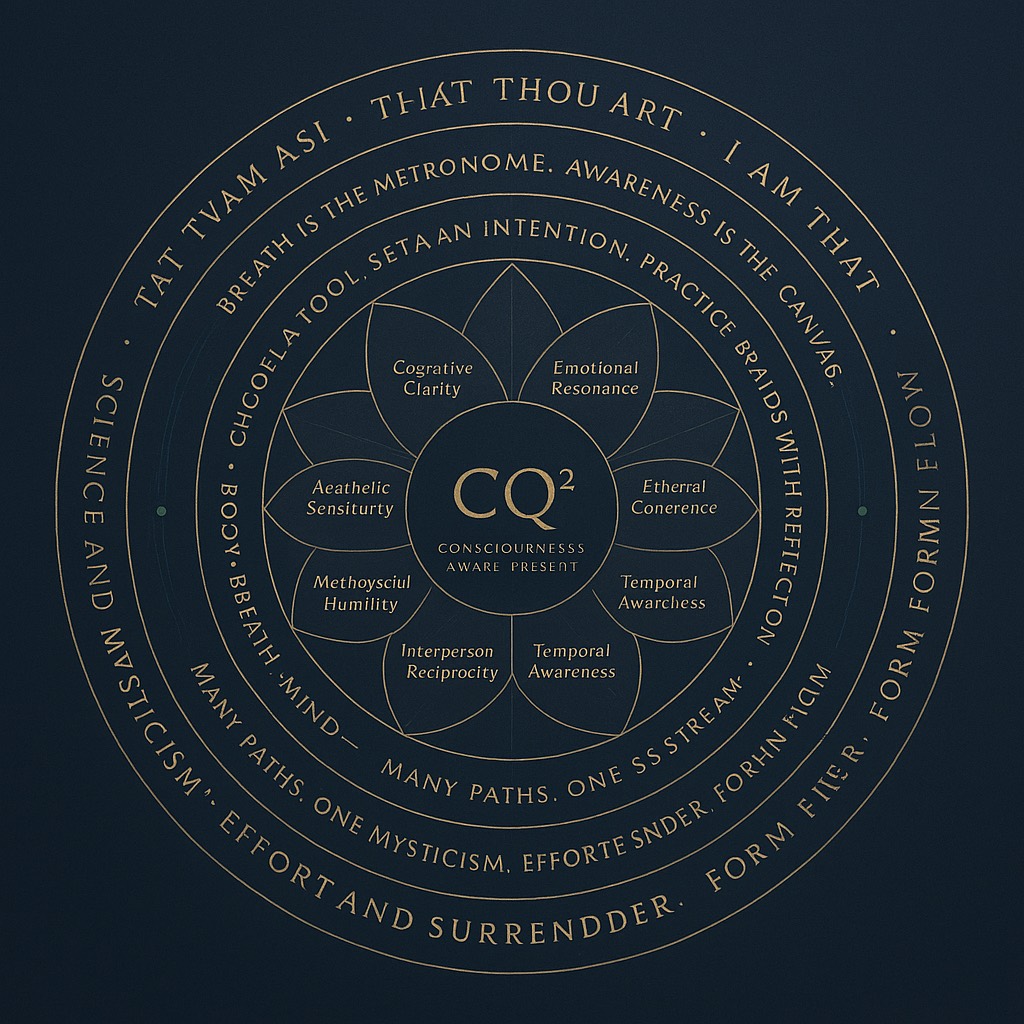
Dearest reader; sometimes Svāstrōn3 gets slightly glitchy - I give too many verbal instructions. Especially here, I learn the imperfection-within-the-perfection-of-the-finite.
Tools of Quantum Human
after Seamus Heaney
Between my hands, no spade—
yet something digs.
Breath presses down, lifts,
sets a clean rhythm in my body.
I feel it: the hinge of the hips,
the quiet torque of the spine,
how my own ground
yields, then holds.
Each breath breaks a small clod.
Each step bites; beds in.
Each moment, breath steadies thought.
Bone and sinew bear the day.
Signs turn in the flicker-lit dark.
Movement reaches past words.
Attention sharpens the blade.
Practice drills; old habits slacken.
Opposites balance, weightless.
Life goes on, measured.
Mind stays close,
keen as a spade-edge.
I am clearing a way,
breaking what’s compacted,
making room for good sod.
And so I keep at it—breath by breath,
digging where I stand,
the gravelly ground loosening,
mud on the blade, soil fit for seed.
End of spiral 18
The 36th Chamber: all 32 spirals open