36th Chamber · Spiral 26
The Universe Is Non-Local
A new piece by the author · about 17 minutes to read
“The distinction between reality and our knowledge of reality, between reality and information, cannot be made. They are in a deep sense indistinguishable.” Anton Zeilinger's 2005 Nature essay. Winner of the Nobel Prize for physics, 2023.
For centuries humanity has asked: What is the substance of the universe?
The ancients called it aether, the invisible medium through which the cosmos breathed itself into form. The Vedantic and Samkhyan traditions spoke of subtler realities underlying the visible world; unmanifest fields from which mind, matter, and experience emerge. Yog is one who distinguishes between the field and the knower of the field.
Classical physics inherited a different vision. From Isaac Newton onward, reality appeared as a vast mechanical order: bodies moving through space, causes producing effects, motion unfolding within a fixed and deterministic universe. Matter was primary. Separation was real. Objects possessed definite properties whether observed or not.
At the dawn of the twentieth century, something extra-ordinary happened. Quantum physics did not merely revise the classical picture. It dismantled it. Certainty became probability. Solidity dissolved into fields and relationships. Objects became possibilities.
The observer could no longer be entirely separated from the observed. Reality appeared stranger than either science or philosophy had imagined. Wheelers a-participatory universe like an eye gazing back at itself; U-Shaped. An eye-star witnessing-observing.
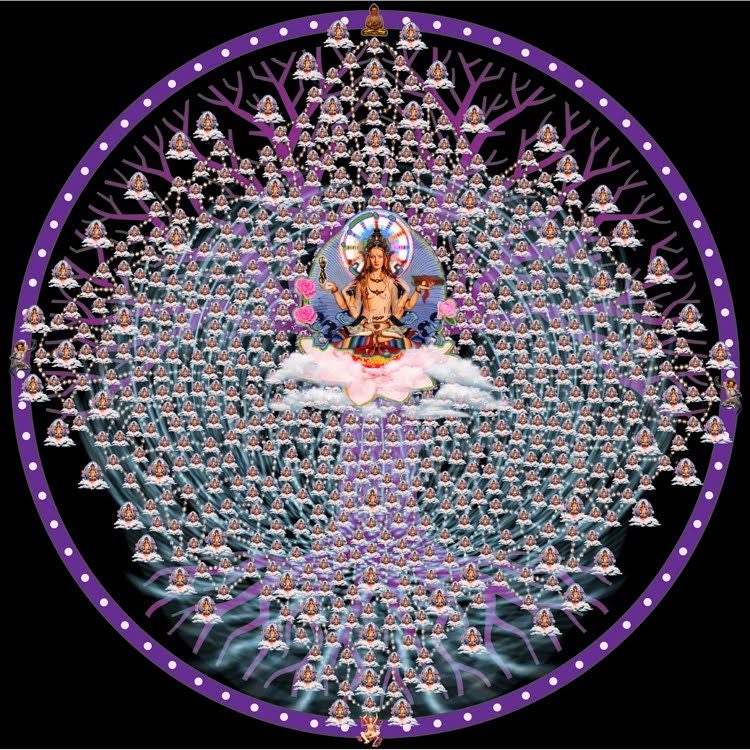
A new spiral of understanding emerges. Not: What is the universe made of? Now: How is the universe connected? Over time, the answer increasingly pointed toward a startling possibility: the universe is fundamentally non-local like Alice going down the quantum mutable rabbit-whole. Everything-is-now-connected like Indra's Net of Precious Jewels.
Einstein, Bohr enter the Birth of Quantum Human. A Quantum Human Commentary on the Nature of Reality
The famous debates between Albert Einstein and Niels Bohr were never really arguments about physics. They were arguments about reality itself. Both men agreed that quantum mechanics worked. The equations predicted experimental outcomes with astonishing accuracy. The disagreement arose over a deeper question; a philosophical perspective:
What is it that the equations are actually describing? [quantummec...street.com]
Einstein stood in a lineage stretching from Newton to classical realism. He believed that the purpose of science was to describe a world that exists independently of observation. Reality, in this view, possesses definite properties whether anyone looks or not. Quantum probabilities, Einstein suspected, were signs that something deeper remained undiscovered, hidden variables waiting to be revealed like waiting for Godot.
Bohr approached the mystery from an opposite angle to classical realism; adding an idealistic perspective based on his knowledge of Kantian philosophy which inspired his work. He argued that at the quantum level we cannot speak meaningfully about reality apart from the conditions through which it is observed. Measurement is not simply a window onto reality; it is part of the phenomenon itself. The observer, the apparatus, and the observed form a single event.
From a Quantum Human perspective, we might say:
Einstein asked, "What is Reality?"
Bohr enquired, "How can Reality reveal itself?"
'How 'and 'why'. Both questions remain alive.
Why the Father of Quantum Physics Put the Yin-Yang on His Coat of Arms “In 1947, the King of Denmark knighted Niels Bohr, the father of quantum physics, into the Order of the Elephant. Tradition required a coat of arms. Bohr's family had none, so he designed his own.
In the center, where European crests put lions and eagles, he placed the yin-yang. Underneath, a Latin motto he wrote himself: CONTRARIA SUNT COMPLEMENTA — "opposites are complementary."
In this episode:
The scandal of light: wave or particle? The most studied thing in physics refused to fill out the form
Why this broke the West's oldest rule of thought — Aristotle's either/or
Complementarity, 1927: two faces of one thing, and where you stand decides which one you see
The 1947 coat of arms, still hanging in Frederiksborg Castle — and why it might be the most honest shield in that church
Bohr vs Einstein: "God does not play dice" / "Stop telling God what to do"
And the 2023 photo of entangled photons that viewers kept sending me — the one where the physics drew the symbol back”
The Great Divide. Einstein's universe was built upon three foundational intuitions: firstly, reality exists independently of observation. Secondly, causes are local. Thirdly, physical systems possess definite properties before measurement; classical realism in a nutshell.
Bohr challenged all three of these classically held views. Not because he denied reality; because quantum experiments suggested that classical concepts themselves had reached their limits. Wave and particle descriptions, for example, appeared mutually contradictory, yet both were required to explain nature. Bohr called this complementarity.
Adding a Quantum Human lens; complementarity resembles an ancient insight: the world may exceed the capacity of any single viewpoint. The observer sees one face. The mystic another. The scientist a third. Reality remains larger than all three. Indra's Precious Net.
There are many modes of thinking about the world around us and our place in it. I like to consider all the angles from which we might gain perspective on our amazing universe and the nature of existence. John Archibald Wheeler, Geons, Black Holes, and Quantum Foam: A Life in Physics (W. W. Norton, 2010), p. 153.
The EPR Threshold, John Bell, and Waiting For Godot
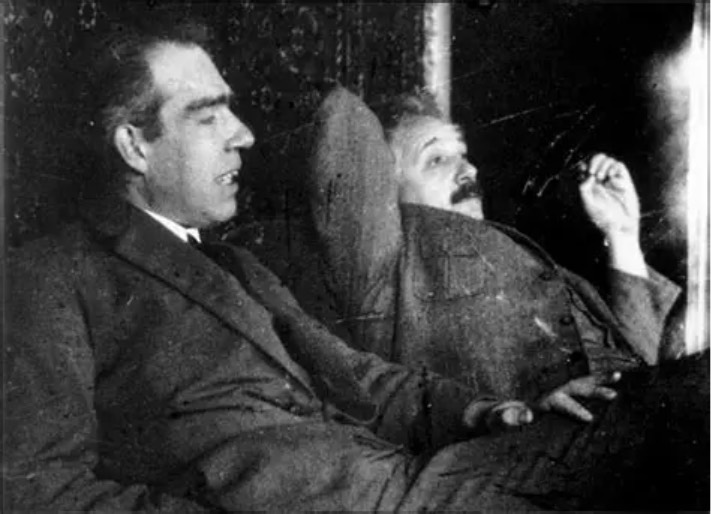
The conflict reached its sharpest expression in the Einstein-Podolsky-Rosen paper. Einstein and his colleagues proposed a thought experiment involving entangled particles and argued that quantum mechanics must be incomplete. If one particle can reveal information about another instantaneously across space, then either locality is violated, or the particles possessed hidden properties all along.
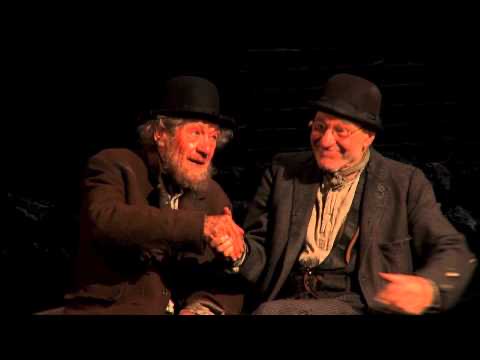
Bohr rejected the very assumptions underlying the argument. He believed Einstein was attempting to preserve a classical notion of reality no longer suitable for the quantum domain. The debate appeared unresolved. For thirty years it remained philosophy. And then Bell arrived on stage like Patrick and Ian in superposition; Waiting For Godot.
"Say I am happy."
"I am happy."
"So am I."
"So am I."
"We are happy."
"We are happy. What do we do now, now that we're happy." A first look at WAITING FOR GODOT.
Bell: The Turning Point. What Einstein and Bohr debated, John Bell transformed into experiment. Bell showed that the disagreement could be settled by measurement rather than argument. His theorem demonstrated that local hidden-variable theories must obey limits that quantum mechanics violates. Suddenly the question was no longer:
Which philosopher is right?
Now:
What does Nature choose?
Fast forward in time and the experiments of John Clauser, Alain Aspect, and Anton Zeilinger eventually provided the answer, leading to the 2022 Nobel Prize. Nature chose quantum entanglement. Nature chose non-local correlations. Nature refused to fit comfortably inside the Einsteinian picture of separate independent objects.
The deeper significance of these debates is not that Einstein lost and Bohr won. The deeper significance is that each was guarding half a picture of a larger truth. Einstein protected the intuition that reality possesses genuine depth and structure. Bohr added the insight that reality cannot be separated from the conditions through which it appears.
Bell synthesized these polar-opposite - materialist and idealistic - philosophical worldviews; revealing that both positions remain incomplete unless we also acknowledge something profoundly relational at the heart of existence. And so the spiral unfolds and continues:
Newton gave us a universe of objects.
Einstein gave us a universe of relationships in spacetime.
Bohr gave us a universe where observation matters.
Bell gave us a universe that cannot be fully local.
Bohm gave us a universe of hidden wholeness.
Zeilinger gave us a universe in which information itself may be fundamental.
Adding a Quantum Human lens - all angles, all perspectives:
What if these are not competing stories?
What if they are successive windows into an ever-deepening mystery?
Einstein looked for certainty. Bohr looked for meaning. Bell looked for proof. Bohm looked for wholeness. Quantum Human explores a paradoxical question: How can a universe appear divided yet remain profoundly connected? Indra's Net of Precious Jewels.
Yog through distinguishing the field and the knower of the field. Bhagavad Gita Chapter 13 — Kṣhetra Kṣhetrajña Vibhāg Yog | Yoga through Distinguishing the Field and the Knower of the Field Superposition. Entanglement. And this is what the ancients knew.
Hariḥ Om Tat Sat.
Bell's Fracture in Reality. 1964. John Bell transforms one of the deepest philosophical debates in science into an experimentally testable proposition. Albert Einstein had never accepted that quantum mechanics was the final word. To him, the theory's inherent uncertainty suggested incompleteness rather than fundamental randomness. Einstein suspected that beneath the statistical predictions of quantum physics lay hidden variables, undiscovered local causes that would eventually restore a commonsense picture of reality: a universe in which physical properties exist prior to observation and influences never travel faster than light. Spooky action at a distance. Einstein scratching his head like Stan Laurel.
Bell's genius was to show that this hope was not merely a matter of philosophical preference. It could be tested mathematically. He derived a set of inequalities that every local hidden-variable theory must satisfy. If experiments violated those inequalities, Einstein's dream of a fully local underlying reality could not survive. Bell later summarized the dilemma with characteristic clarity:
If [a hidden-variable theory] is local, it will not agree with quantum mechanics, and if it agrees with quantum mechanics it will not be local.
The mathematics behind Bell's argument is surprisingly elegant. Imagine two entangled particles flying apart from a common source. A local theory assumes that each particle carries a hidden set of instructions, predetermined values that dictate how it will respond when measured. Bell showed that if such local instructions exist, the statistical correlations between measurements must obey strict limits. In its most famous modern form, the CHSH inequality, those limits are expressed as:
∣S∣≤2|S| \leq 2∣S∣≤2
for any local realistic theory. Quantum mechanics predicts otherwise:
∣S∣≤22|S| \leq 2\sqrt{2}∣S∣≤22
and experiments repeatedly measure violations of Bell's local bound. The significance of this result cannot be overstated. Bell did not prove that signals travel instantaneously through space. Rather, he proved that no explanation based solely on local causes and independently existing properties can account for the observed correlations. Nature herself violates the assumptions of local realism.
What emerged from Bell's theorem was not merely a technical correction to physics; now, a profound revision of reality's architecture. The universe could no longer be conceived as a collection of self-contained objects interacting only through local exchanges across space and time. Bell himself described his theorem as revealing a profound conflict between quantum mechanics and locality. In one of his most cited observations he wrote:
The result of an observation may reasonably depend not only on the state of the system but also on the complete disposition of the apparatus.
The implication is subtle but revolutionary. The world appears less like a machine assembled from separate parts and more like a coherent whole whose relationships cannot always be decomposed into independent pieces.
Bell opened a crack in the Newtonian worldview through which an entirely different cosmos became visible: a universe where distance remains real, yet separation is not absolute; where locality governs appearances; now, reality reveals deeper patterns of connection which seem woven into the very fabric of existence. It was this fracture in the classical picture that later led Nick Herbert to conclude:
A universe that displays local phenomena but upon a non-local reality is the only sort of world consistent with known facts and Bell's proof.
In the language of Quantum Human, Bell did something remarkable: he shifted the ancient question from what is the universe made of? to a far deeper inquiry:
How is the universe connected? And the answer emerging from the quantum century is that connection, not separation, may be the more fundamental principle.
Nick Herbert's Illuminating Insight. Physicist and author Nick Herbert recognised the cultural magnitude of Bell's discovery. For centuries Western thought had been built upon the assumption that things are fundamentally separate. Bell shattered this assumption.
Herbert argued that quantum theory revealed a universe whose deepest level is woven together by relationships that transcend classical notions of space and distance. The universe had not become mystical. It had become relational.
One might say:
The atom is not the final unit.
The relationship now is.
A universe that displays local phenomena but upon a non-local reality is the only sort of world consistent with known facts and Bell's proof. Nick Herbert, Quantum Reality: Beyond the New Physics (1985), Chapter 12, "Bell's Interconnectedness Theorem"
This is arguably the best epigraph for The Universe Is Non-Local because Herbert has done the philosophical synthesis. It beautifully captures the distinction between: the world of appearances (local phenomena), and the deeper quantum domain (non-local reality).
It sounds Upanishadic, yet it is grounded in Bell's theorem. West-meets-East.
Bell's theorem says that reality must be non-local. Nick Herbert, Quantum Reality: Beyond the New Physics like Buzz Lightyear says To infinity and beyond.
Non-local influences do not diminish with distance. They are as potent at a million miles as at a millimeter. A non-local interaction links up one location with another without crossing space, without decay, and without delay. Nick Herbert, Quantum Reality.
These quotes add illuminating insights which resonate with the themes running through Quantum Human: connection without transmission, relationship without mechanism, unity without collapse into sameness. And so we return to the beginning of this spiral:
For centuries humanity asked: What is the substance of the universe?
The movement of substance is now elegant:
Ether → Matter → Quantum Fields → Non-Local Reality
In this way, this radical insight inspires the spiral architecture that Quantum Human unravels. Everything spirals, radiates, unfurls like a fern unfurling from within itself.
Bohm's Answer: The Implicate Order. Among those most profoundly influenced by Bell's work was David Bohm. Unlike many physicists, Bohm did not regard quantum theory as complete. Unlike Einstein, he accepted the lesson emerging from Bell's theorem. If nature truly violated locality, perhaps non-locality was not a flaw to be eliminated; instead, a clue to a deeper reality. Bohm had already developed a hidden-variable interpretation of quantum mechanics, now known as the Bohmian Interpretation or Pilot-Wave Theory. Remarkably, Bell himself admired this work because it accomplished something many believed impossible: it reproduced the predictions of quantum mechanics while explicitly incorporating hidden variables.
The price was clear. Bohm's theory was fundamentally non-local.
Bell's theorem had shown that locality and quantum predictions could not be simultaneously preserved. Bohm chose quantum predictions. Locality was sacrificed. This is one reason Bell viewed Bohm's theory with considerable respect. It confronted the implications of quantum mechanics honestly rather than attempting to avoid them.
Bohm's insight extended beyond mathematical physics. He began asking a more radical question:
What kind of universe naturally gives rise to non-local connections?
The Implicate and Explicate Orders. Bohm's answer emerged through his distinction between the Explicate Order and the Implicate Order. The Explicate Order is the world of ordinary perception. Objects appear separate. Events appear localized. Causes seem to travel from one place to another.
Time flows.
Space divides.
The world unfolds as multiplicity.
Bohm proposed that this visible world is not fundamental. Beneath it lies an Implicate Order; a deeper domain in which everything is enfolded within everything else.
What appears separate in the explicate world may remain internally connected within the implicate realm. To illustrate this idea, Bohm often used the hologram. Every region of a holographic plate contains information about the whole image. The whole is present within every part, though in an enfolded form. Likewise, the universe may not be assembled from independent pieces. The pieces may emerge from a deeper wholeness. Bohm wrote:
Ultimately, the entire universe has to be understood as a single undivided whole.
This vision provided a philosophical home for Bell's theorem. What Bell discovered mathematically, Bohm explained ontologically. If the universe is fundamentally whole, then non-local correlations cease to be anomalies. They become symptoms of a deeper unity. The Tao of Physics. West-meets-East. Purusha-and-Prakriti in a modern way.
The Quantum Human Perspective. Within the Quantum Human framework, Bohm's insight resonates strongly with ancient wisdom traditions. Samkhya distinguishes between the apparent multiplicity of phenomena and the deeper ground from which they arise. Vedanta speaks of one reality expressing itself through countless forms. Mystical traditions repeatedly suggest that separation is real at one level of experience but incomplete at another. Indra's Net of Precious Jewels meets Quantum, a unified-field.
Bohm offers a language that is neither religious nor reductionist. The implicate order is not spirit masquerading as science. Nor is it mechanism disguised as mystery. It is an attempt to describe a universe in which wholeness is primary and fragmentation secondary. Bell demonstrated that local separateness is insufficient. Bohm proposed that wholeness is fundamental. Together they invite a profound shift:
The defining question of reality may not be What are things?
Now:
How does the One appear as many?
A few voices across the spiral. An independent reality in the ordinary physical sense can neither be ascribed to the phenomena nor to the agencies of observation. Niels Bohr, Atomic Theory and the Description of Nature (1934), Ch. II, p. 54. The notions of 'being thus' and 'being independently real' are deeply problematic in quantum mechanics; echoing Kant.
The distinction between reality and our knowledge of reality cannot be made. Anton Zeilinger
The fundamental interconnectedness of the universe is the central insight of modern physics. A sentiment echoed repeatedly through the work of David Bohm, John Bell, Nick Herbert and Anton Zeilinger.
The Echo of Kantian Idealism through time. One can clearly observe that Niels Bohr's philosophical interpretation of quantum mechanics is one of the closest scientific descendants of Immanuel Kant's epistemology, even though Bohr rarely presented it in those terms. Kant's central insight was that we never know the thing-in-itself (das Ding an sich) directly. We know reality only as it appears through the structures of observation, cognition, space, time, and conceptual understanding. The world as experienced is a co-creation between what is "out there" and the conditions through which we encounter it.
Bohr's complementarity echoes this remarkably closely. For Bohr, quantum objects cannot be described independently of the experimental arrangements used to observe them. Properties such as position and momentum are not simply revealed by measurement as if they already existed in a fully determinate state.
Rather, what can meaningfully be said about a quantum system depends upon the conditions under which it is observed. Consider Bohr's famous statement: "Physics concerns what we can say about nature." This is Kantian in spirit. Bohr repeatedly shifted the discussion away from questions such as: What is reality in itself?
Putting on his philosophical hat, Bohr enquires: What can be meaningfully known and described? Kant will have approved. The three thinkers form an interesting triangle:
Kant: reality-in-itself exists. It is never directly available. Human knowledge is constrained by the conditions of observation and cognition.
Bohr: quantum reality exists. Physics can only describe phenomena as they appear within specific experimental contexts. Questions beyond this are often regarded as meaningless or inaccessible.
Bohm: reality exists independently. And we should attempt to describe it. The strange behaviour revealed by quantum mechanics points to a deeper ontological order, the Implicate Order, from which observable phenomena emerge.
This is one reason Bohm and Bohr diverged so dramatically. Bohr's response to Bell's theorem was essentially epistemological: We must be careful about what can meaningfully be said concerning quantum reality.
Bohm's response was ontological: No. Bell is telling us something real about the structure of reality itself. The universe is actually non-local.
Bohr was asking: What can we know?
Bohm was asking: What is?
Kant sits quietly behind both questions.
Bohr and Bohm like Patrick and Ian in Waiting for Godot.
"Say I am happy."
"I am happy."
"So am I."
"So am I."
"We are happy." "We are happy. What do we do now, now that we're happy." A first look at WAITING FOR GODOT.
Kant drew the veil. The thing-in-itself remained hidden behind appearance.
Bohr guarded the veil. Physics could speak only of phenomena.
Bell tore a hole in the veil. Non-locality appeared where locality should have been.
Bohm looked through the opening. What he saw was an undivided wholeness, an implicate order enfolding all things within all things like Neo peering through The Matrix.
And the ancient question returned:
Is separation fundamental? Or is it merely the appearance assumed by a deeper unity?
This progression, Kant → Bohr → Bell → Bohm, fits naturally into the Quantum Human narrative. It mirrors the movement from epistemology (how we know reality) to ontology (what reality is), and finally toward what Bohm called undivided wholeness in flowing movement. Everything is woven together; everything spirals, radiates, unfurls.
2022 Nobel Prize. The Death of Separation. For decades Bell's insight remained theoretical like waiting for Godot. Then came the experiments. John Clauser, Alain Aspect, and Anton Zeilinger, recipients of the 2022 Nobel Prize in Physics, repeatedly confirmed violations of Bell's inequalities through increasingly sophisticated experiments. Nature sided with quantum mechanics. Again and again. Particles separated by vast distances behaved as if some deeper connection remained intact. Not communication. Not signalling. Not hidden wires running through space. Something more subtle. Something more profound. The experiments revealed that the universe cannot be adequately described as a collection of isolated objects carrying independent properties. Relationship appears more fundamental than separation.
The Nobel Committee described their work as demonstrating the reality of quantum entanglement and its consequences for our understanding of nature. The implications continue to reverberate through physics, philosophy, and consciousness studies.
Echoes From the East. Long before Bell, the sages of India questioned whether separation was ultimate. Samkhya distinguished between Purusha, pure witnessing awareness, and Prakriti, the field of manifested phenomena. The Upanishads spoke of an underlying unity expressing itself through apparent multiplicity. Buddhist philosophy challenged the notion of independently existing entities. It is therefore intriguing that Anton Zeilinger has participated in extensive dialogues with Tibetan Buddhist scholars and with the Dalai Lama concerning knowledge, observation, and reality.
We need wisdom and compassion like two wings of a bird, to fly.
Physics does not prove Buddhism. Buddhism does not prove physics. Yet both arrive at a common threshold: the world may be less composed of separate things than we imagine.
The Quantum Human Perspective. Non-locality does not mean that signals travel instantly through space. It does not overturn Einstein's relativity. It does not provide scientific proof of telepathy, mysticism, or cosmic consciousness. It means something simultaneously more modest and more revolutionary. The universe cannot be fully understood by reducing it to independently existing local parts. At its deepest level, reality exhibits a connectedness that classical thinking cannot explain. The map of the universe has changed. The boundary between here and there is no longer absolute.
The ancient search for ether sought a hidden substance beneath reality. Quantum physics discovered something stranger. Not a substance. A relationship. Not a medium filling space. A pattern of connectedness within space itself. The universe begins to resemble less a machine assembled from separate components and more a living tapestry whose threads remain joined even when stretched across unimaginable distances. Bell opened the door. Aspect, Clauser and Zeilinger stepped through it. What lies beyond is not certainty. It is awe, mystery and wonder.
Quantum theory thus reveals a basic oneness of the universe. It shows that we cannot decompose the world into independently existing smallest units. As we penetrate into matter, nature does not show us any isolated 'building blocks,' but rather appears as a complicated web of relations between the various parts of the whole. Fritjof Capra, The Tao of Physics. Indra's Net of Precious Jewels in a modern quantum way.
Hariḥ Oṁ Tat Sat
References
John Bell, On the Einstein-Podolsky-Rosen Paradox (1964)
Anton Zeilinger, The Message of the Quantum, Nature (2005)
Nobel Prize in Physics 2022: Alain Aspect, John Clauser, Anton Zeilinger
Nick Herbert, Quantum Reality (1985)
Bernard d'Espagnat, Veiled Reality (1995)
David Bohm, Wholeness and the Implicate Order (1980), Tao of Physics (1975)
End of spiral 26
The 36th Chamber: all 32 spirals open