36th Chamber · Spiral 25
Samkhya, Quantum Physics, John Hagelin, Quantum Human
About 3 minutes to read
Samkhya philosophy begins with a distinction: Purusha and Prakriti. Purusha is pure awareness, the silent witness, consciousness itself. Prakriti is nature in motion: matter, energy, mind, emotion, sensation, memory, thought, identity. Everything that changes belongs to Prakriti.
The entire Samkhya system unfolds from this primordial polarity. From Prakriti emerge the tattvas, the building blocks of experience, cascading from subtle intelligence into mind, senses, body, and world. The journey of liberation is not the acquisition of something new; it is the recognition that Purusha was never trapped by Prakriti in the first place. This is where an intriguing dialogue with quantum physics begins.
Modern quantum theory similarly dissolves the naive assumption that reality consists of independent objects existing in isolation. At the deepest levels explored by quantum field theory, what appears as solid matter is revealed as excitation, vibration, probability, and relation. The universe becomes less a collection of things and more a dynamic field of interactions - John Archibald Wheelers’ U-shaped observer-participatory universe.1
The Quantum Human framework repeatedly seeks bridges between ancient contemplative insight and modern scientific exploration, between observer-and-observed, self-and-cosmos, mind-and-matter. This book-blog consistently emphasizes the integration of science, spirituality, philosophy, and self-enquiry into a unified developmental path.
John Hagelin and the Unified-Field
The deepest level of truth uncovered by science, & by philosophy, is the fundamental truth of unity. At that deepest subnuclear level of our reality, you & i are literally one.
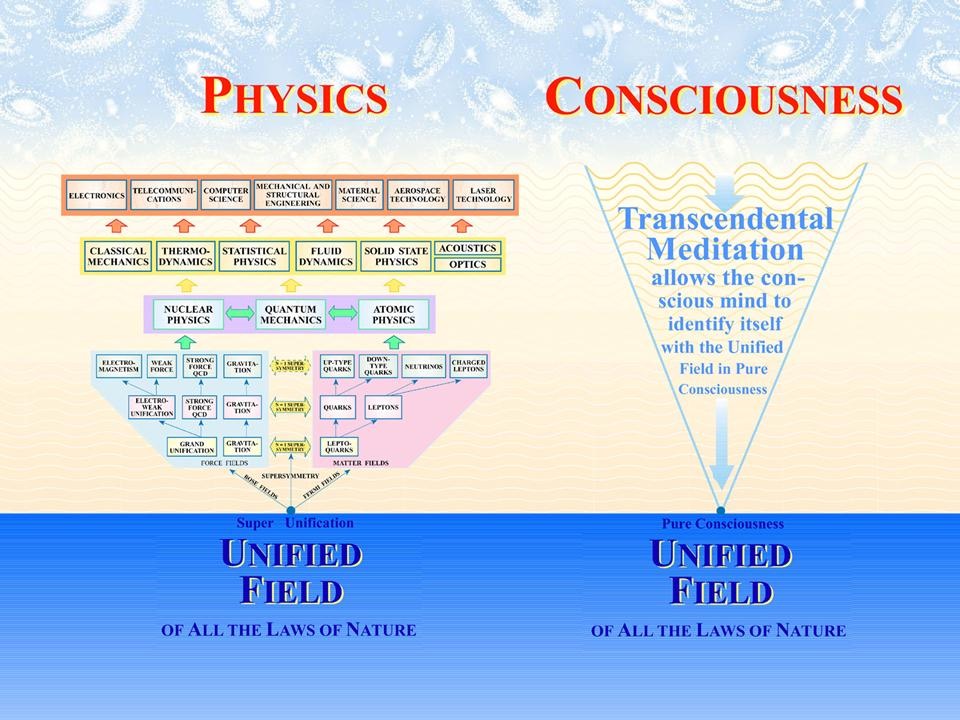
John Hagelin, a theoretical physicist known for his work in unified field theory, has argued that the search for a single unified field in physics parallels ancient contemplative descriptions of pure consciousness. He proposes that the unified field sought by physics and the state of pure awareness described in meditative traditions may ultimately be related, or even, identical. For deeper exploration: Is Consciousness the Unified Field?, John Hagelin Is Consciousness the Unified Field? A Field Theorist's Perspective
Whether one accepts this conclusion or not, the philosophical significance is profound. Samkhya describes a foundational witnessing awareness. Quantum field theory seeks a foundational field underlying physical phenomena.
Hagelin asks whether these two quests are converging upon the same reality viewed from different directions: one through introspection, the other through mathematics and experiment. [scienceand...uality.com]
The physicist moves inward through equations. The yogi moves inward through meditation. Both are seeking origin. Consciousness Quotient Squared. E=MC²
Samkhya as a Chakra Map of Consciousness
Within the Quantum Human mandala, Samkhya can be understood as a developmental map of consciousness.
The lower chakras correspond to deeper immersion in Prakriti:
Root: survival and embodiment.
Sacral: emotion and creativity.
Solar Plexus: identity and will.
As awareness ascends:
Heart reveals interconnectedness.
Throat seeks truth through dialogue.
Third Eye cultivates insight and witnessing.
At the Crown Chakra, awareness begins to recognize itself as awareness. The observer becomes conscious-of-being-the-observer. Purusha recognizes Purusha. This mirrors one of the book-blogs central themes: awareness reflecting upon itself, Consciousness Quotient Squared, meta-cognition, awareness-of-awareness-itself.
The Quantum Human Synthesis
The Quantum Human is neither exclusively scientist nor mystic. Nor does Quantum Human collapse science into spirituality or spirituality into science.
Quantum Human inhabits the fertile dialogue between them.
Samkhya contributes a phenomenology of consciousness.
Quantum physics contributes a mathematics of relationship, uncertainty, and field dynamics.
Hagelin attempts a bridge.
Whether that bridge ultimately stands or falls is less important than the invitation it offers: to investigate reality from both directions simultaneously.
Like Socrates, we question. Like Plato, we ascend. Like Hegel, we integrate contradiction into a higher coherence.
Like Samkhya, we learn to distinguish the witness from the contents of experience.
Like quantum physics, we discover that separation may be less fundamental than relationship. Who am I? Are we classical or are we quantum? Or simultaneously both?
Zen Quantum Reflection
After John Hagelin
Particles flash, mind arises,
worlds appear and disappear.
Before thought, awareness.
Before identity, presence.
Purusha watches the dance of Prakriti,
the field watching its own motion.
Between equation and meditation,
between field and feeling;
between microscope and mantra,
the witness remains indeterminate.
Observer and observed
trade places endlessly,
until the one who watches
distinguishes seer and seen.
Not choosing one over the other;
particle and presence meet
balanced at the still-point
the mirror forgets its image
one luminous inquiry remains:
Who Am I?
End of spiral 25
The 36th Chamber: all 32 spirals open