36th Chamber · Spiral 27
The Chinese Circadian Clock
About 4 minutes to read
The Chinese circadian clock, also called the Traditional Chinese Medicine (TCM) body clock, maps the flow of Qi (vital energy) through the body's organ systems across twenty-four-hours; morning-to-night and night-to-morning; yang-to-yin and yin-to-yang cycle. Each two-hour period is associated with a particular organ network, creating a rhythmic choreography between physiology, energy, consciousness, rest, and activity. In this view, the body is not a machine running continuously at the same intensity; it is a living ecosystem whose functions wax and wane in harmony with natural cycles; aligning waking and sleeping, alighting the bodies' circadian rhythms. 1
The Lung system awakens in the early hours before dawn, inviting deep breathing and renewal; the Stomach and Spleen dominate the morning, supporting digestion and nourishment; the Heart governs midday, when consciousness and relational engagement are strongest; while evening and night gradually shift toward restoration through the Kidney, Liver, and Gallbladder systems. From a Quantum Human multiple and comparative perspective, the Chinese body clock mirrors the Ayurvedic principle of living in alignment with natural intelligence. Living in harmony; inner-outer balance.
Ayurveda emphasizes dinacharya and the cyclical movement of the doshas; similarly, Traditional Chinese Medicine emphasizes the rhythmic circulation of Qi through interconnected organ networks. And this is what the ancients knew; being in inner-and-outer harmony. Ayurveda and TCM and other ancient self-healing traditions recognize that health emerges from synchronization rather than force. Breath, sleep, nutrition, movement, attention, and emotional balance become ways of co-operating with these biological and energetic tides. The body is understood not as a collection of separate parts but as a coherent field of relationships; timing matters as much as action itself.
In this sense, the Chinese circadian clock becomes a practical reminder of a central Quantum Human insight: harmony arises when we learn to flow with the rhythms of life rather than continually pushing against them. Nature is cyclical. Humans are part of nature. Breath has rhythms. Breath has patterns. Patterns create character and shape personality. Prana is abundant in sattvic food. Eat sattvic food which is abundant in universal life force energy; forming a firm foundation for optimal health and well-being.
Quantum Human explores the entire bandwidth of theory-and-embodied-practice. Key to everything is self-regulation of the mind and five senses, purification, being balanced in the five elements, the seven chakras, the three gunas, the three doshas, a unified-field-of-awareness. Many Paths. One Stream. You are the field-and-the-knower-of-the-field. The witnessing present. And this is what the ancients knew. Tat Tvam Asi. I AM.
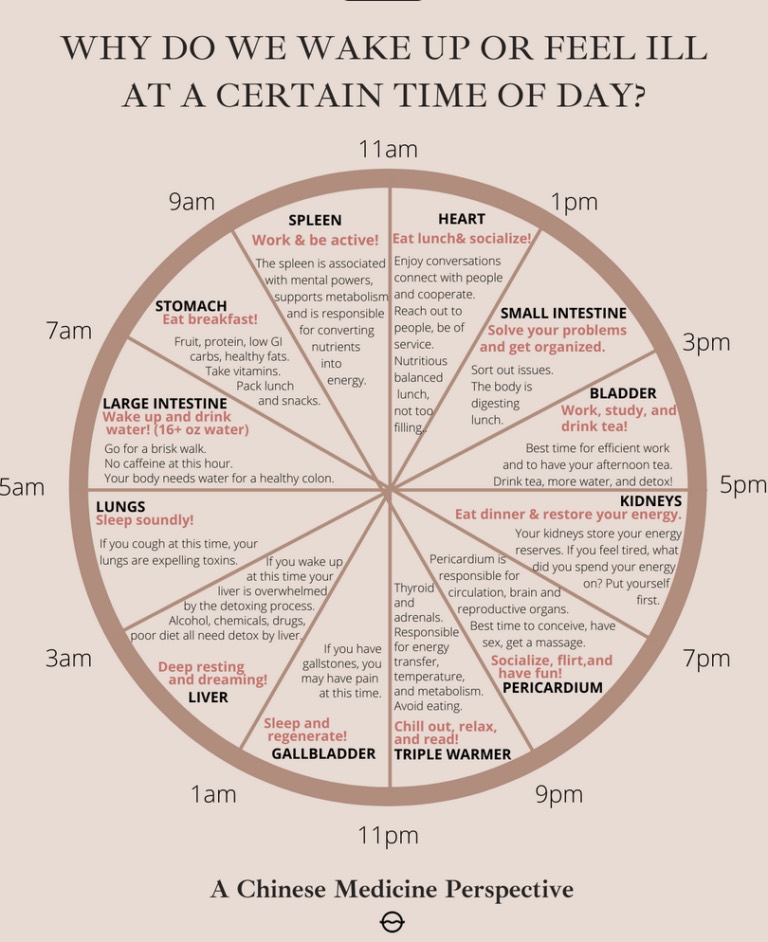
The Organ Music of Dawn. Before the alarm, the lungs, awake, are drawing darkness through their thinly veiled white branches, testing air for weather, memory; the scent of rain still travelling inland. A few hours later, the stomach unfolds its inner fire. Light spills across the table. Cells negotiate with sunlight. Proteins dismantle, are rebuilt as thought, bone, desire. The spleen gathers the scattered pieces, making order from abundance, as rivers make estuaries without consulting a map.
By noon, the heart stands at the centre of the day, its metronome precise, never mechanical. Blood circles the body as planets circle gravity. Somewhere in the brain electrical weather becomes a face, a word, a kept promise. Afternoon leans toward evening. The small intestine sorts signal from noise. The bladder clears its archives.
The kidneys count their hidden treasure, storing silence beneath activity, winter beneath summer, night inside the seed of noon like a fern unfurling from within itself.
Outside, the sun lowers its hand. Melatonin waits backstage. Cortisol loosens its tie.
Genes open and close like flowers obeying invisible tides. The liver begins its nocturne.
Waste is gathered. Memories are edited. The glymphatic rivers rise through sleeping folds within the brain, washing the day's bright graffiti from neural stone. Gallbladder follows, quiet custodian of biological patterns and decisions already made.
The body enters deeper water. Breath becomes longer, slower, smoother, deeper.
The pulse gathers and lengthens in ripples; waves undulating sensations-to-thought.
A billion cells agree to work without applause. Everything spirals, radiates, unfurls.
And so the ancient clock turns. Qi moves through meridians. Hormones move through blood. Electrical gradients ripple across membranes like moonlight across a pond.
Different languages. One rhythm. The old physicians watched shadows move across mountains. We moderns watch scanners illuminate the dark. Each discovering the same thing: nothing stands alone; a network-within-a-field-within-a-field, ad-infinitum.
At dawn, the lungs open again.
The wheel returns,
not repeating; refining.
And so the day enters the body and the body enters the day. Mind-and-body together.
And somewhere between breath and starlight - the I that I AM - the I-not-I - self-regulates and returns to baseline with stability, comfort and ease - and here - only now, re-configures coherence - fine-hones and radiates the pulse-of-being - being in inner-and-outer harmony - breath coherence - brain in hemi-sync - homeostasis-and-symbiosis - a unified-field-of-awareness - isness-beingness-suchness - radiance Tathagata:
So the whole world blooms continually
within its true and hidden element,
a sea, a beautiful and lucid sea
through which its pilots, rising without end.
Bathysphere. Don Paterson.
End of spiral 27
The 36th Chamber: all 32 spirals open