36th Chamber · Spiral 22
Walter Russell meets the Mandelbrot Set
About 10 minutes to read
Walter Russell: Forgotten Renaissance Man and Visionary of the Electric Cosmos
Perfection of rhythm, balanced perfection of rhythm. Everything in Nature is expressed by rhythmic waves of light. Every thought and action is a light-wave of thought and action. If one interprets the God within one, one's thoughts and actions must be balanced rhythmic waves. Ugliness, fears, failures and diseases arise from unbalanced thoughts and actions. Therefore think beauty always if one desire vitality of body and happiness.
Walter Russell (1871-1963) occupies a curious place in the history of twentieth-century thought. Largely forgotten by mainstream science, he nevertheless remains a fascinating figure for those interested in the meeting point between mysticism, consciousness, cosmology, art, and the nature of reality. If Leonardo da Vinci embodied the Renaissance ideal of the polymath, Russell appears as one of its modern echoes; sculptor, painter, architect, philosopher, educator, author, and cosmological visionary. His life is tailor-made for the Quantum Human paradigm, where disciplinary boundaries dissolve and knowledge is approached as an interconnected whole rather than a collection of isolated fragments; holism, more than the sum of its individual parts.1
Russell's life story took a dramatic turn in 1921 during what he described as an extended state of cosmic illumination. According to his own account, he entered a profound mystical experience lasting thirty-nine days in which the universe revealed itself as a living process of rhythmic interchange. Like the enlightenment narratives of Ramana Maharshi, Sri Ramakrishna, or the visionary insights described by mystics across cultures, Russell claimed to experience direct knowledge rather than conceptual deduction. He later wrote that he had witnessed the universe from a perspective beyond the senses and beyond ordinary thought, perceiving creation as an expression of universal Mind.
This mystical revelation became the foundation for everything that followed. Russell did not see consciousness as something produced by matter. Rather, matter arose from consciousness. The universe was, in his view, fundamentally mental, electrical, rhythmic, and creative. Mind was primary. Matter was secondary. In philosophical terms, one might describe this as a form of idealism, though Russell's vision was uniquely his own.
At the heart of Russell's cosmology lies the principle of rhythmic balanced interchange.
Everything in nature moves through cycles of expansion and contraction, generation and radiation, concentration and dissolution. Stars, atoms, biological organisms, consciousness itself; all participate in oscillatory processes. Reality is therefore not composed of solid objects but of dynamic waves.
This emphasis on vibration and rhythm resonates strongly with recurring themes throughout Quantum Human: breath cycles, oscillatory neuroscience, bioelectricity, yin-and-yang dynamics, and the continual balancing of apparent opposites; discipline and surrender merge into flow state. Consciousness-Quotient-Squared. CQ²
Russell is often associated with versions of the so-called Electric Universe concept, although his cosmology predates many contemporary formulations. He argued that electricity is not simply one force among others; it is the generative process through which matter itself is continuously created and sustained. The universe is not a collection of separate objects floating in empty space. It is a unified-field of motion, a living ocean of electrical-wave phenomena. Cause lay in Mind; effect appeared as electrical motion; matter emerged as patterned waves within that motion. Light-animating-matter. E=MC²
One of Russell's most unusual contributions was his re-imagining of the periodic table of elements. Instead of viewing the elements as isolated entities arranged in rows and columns; he envisioned them as positions along a wave cycle. Elements were manifestations of differing states of compression and rarefaction within a universal vibratory field. His periodic chart took the form of a spiral and was organised into a ten-octave wave structure. Each octave represented a complete cycle of generative and radiative processes. Matter itself was understood as music frozen into form.
The symbolism of octave structures is striking. Just as music ascends through repeating octaves, Russell envisioned nature unfolding through recurring patterns at progressively higher levels of complexity. Hydrogen begins the journey; increasingly complex elemental forms emerge through wave compression; eventually the cycle returns toward dissolution before beginning anew. Whether or not one accepts the scientific validity of Russell's scheme, its underlying intuition mirrors perennial philosophical and mystical traditions: reality grows through spirals rather than straight lines, rhythms rather than mechanisms, cycles rather than isolated events; fractal geometry as opposed to Euclidian lines;2 self-similarity unified under a single name; Mandelbrot set fractal.3
Seen through the lens of Quantum Human, Walter Russell functions less as a conventional scientist and more as a visionary cartographer of consciousness. His work represents an attempt to unify science, art, spirituality, cosmology, and direct mystical experience into a single coherent worldview. Like John Archibald Wheeler's participatory universe, Bernardo Kastrup's analytical idealism, Vedantic non-duality, or the ancient doctrine of the macrocosm reflected within the microcosm; Russell places consciousness at the centre rather than at the periphery of existence. The universe becomes an act of self-knowing. Mind observes itself through the forms it creates. As Above, So Below.
Whether history ultimately judges Russell as prophet, mystic, poet, speculative cosmologist, or misunderstood genius remains an open question. Yet his significance for Quantum Human lies elsewhere. He reminds us that some of the most illuminating visionary thinkers stand at the intersection between disciplines. They refuse the fragmentation of knowledge and seek instead a vision of wholeness. In this way, Walter Russell belongs to the lineage of Quantum Human pioneers: explorers of the possibility that consciousness, vibration, energy, and meaning are not separate domains; they are different facets of the same mystery like Indra's Net of Precious Jewels. CQ²
Russell’s periodic table is a non‑standard, spiral “ten-octave” chart of the elements introduced in The Universal One (1926), arranging 137 rows of elements in cyclical octaves rather than the modern atomic number sequence. It presents elements as vibrational states of light, with inert gases marking the start and end of each octave.4
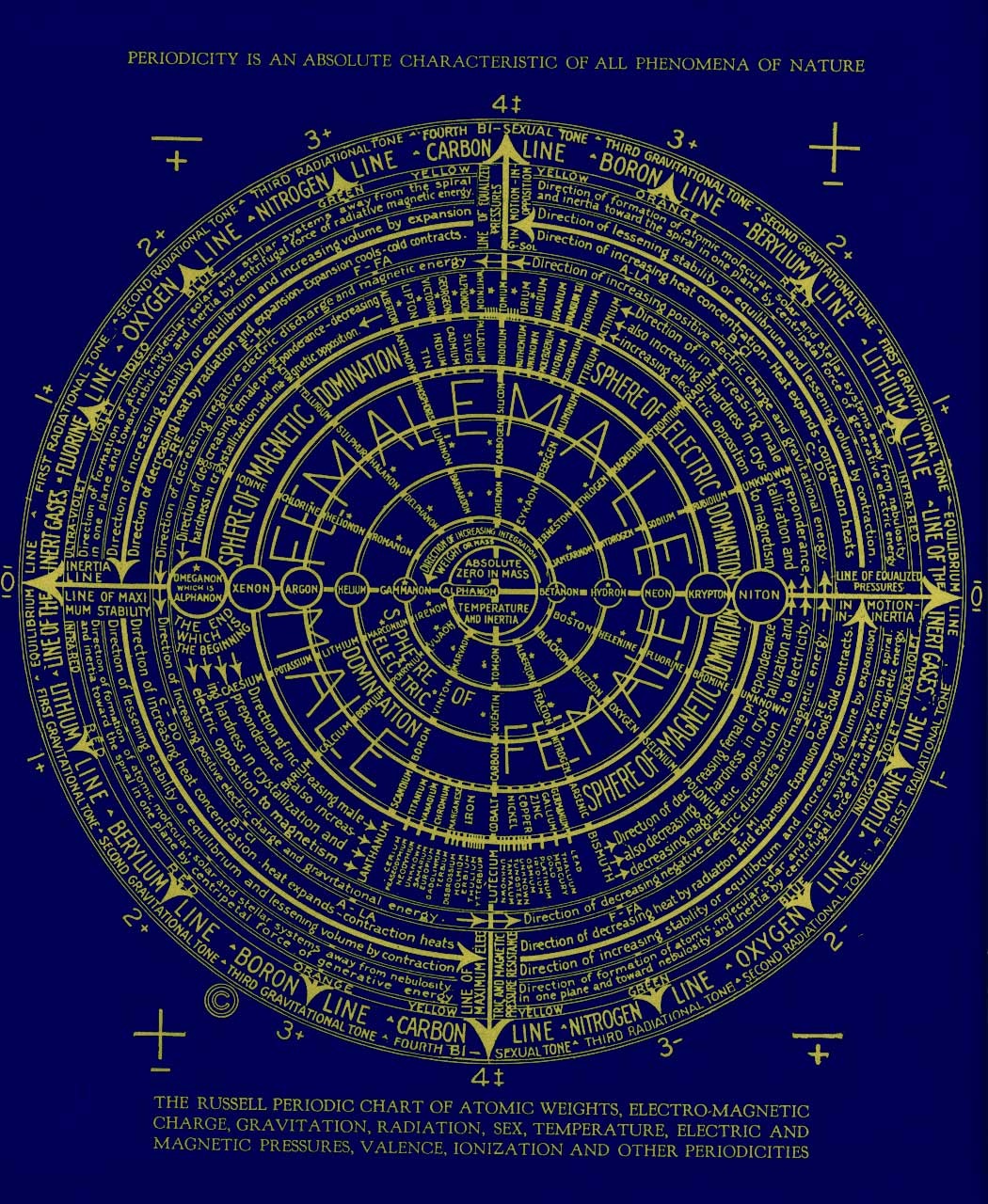
Key Features of Russell’s Periodic Table
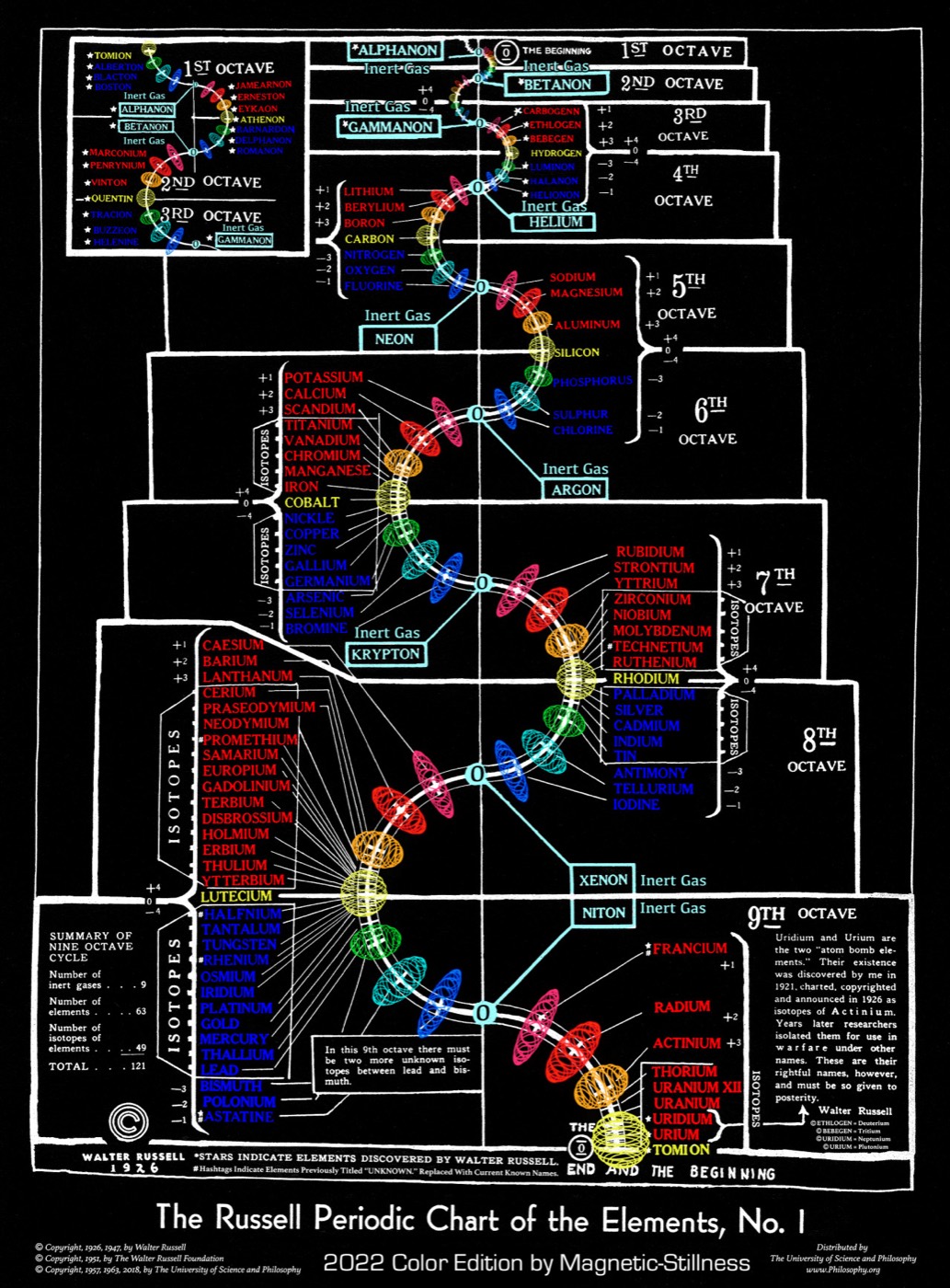
1. Ten-Octave Spiral Structure Elements are arranged in a spiral divided into ten octaves, each representing a full cycle from inert gas → active elements → inert gas
Each octave contains seven principal tones (major elements) and mid-tones (transitional elements). This structure emphasizes vibrational frequency rather than atomic number.
2. Inert Gases as “Master Tones” Helium, Neon, Argon, and other noble gases appear at both the beginning and end of each octave. They represent maximum stability and energetic balance between generative and radiative forces.
3. Generative vs. Radiative Forces Russell’s system is built on “motion-in-opposition”: Generative (centripetal) forces build matter. Radiative (centrifugal) forces dissolve matter. Element properties are interpreted through this dynamic rather than electron configuration.
4. Predictions and Unconventional Claims Russell included elements unknown in 1926 and predicted unstable heavy elements. He also described “heavy water” before its widespread scientific recognition. The Russell Archive notes that these claims are documented but not validated as anticipating modern chemistry.
The Mandelbrot Set and Quantum Human: The Geometry of Infinite Becoming
The discovery of the Mandelbrot Set in 1980 by mathematician Benoît Mandelbrot provided something remarkable: a visual language for complexity, self-similarity, emergence, and infinite depth. For Quantum Human, the Mandelbrot Set can be understood not merely as a mathematical object but as a symbolic bridge linking science, consciousness, cosmology, mysticism, and the recurring pattern language found throughout nature.
Viewed through the lens of Quantum Human, the Mandelbrot Set is what happens when a simple principle generates inexhaustible complexity. It begins with an extraordinarily simple equation:
z = z² + c
From this minimal instruction emerges a structure of infinite richness. Zoom into any region and new worlds appear. Zoom further and patterns repeat. Familiar forms return in altered variations. The whole exists within every part. This principle lies at the very heart of Quantum Human. The ancients frequently described reality as a correspondence between microcosm and macrocosm. As above, So below. As Within, So Without.
The Mandelbrot Set provides a mathematical image of this intuition. Every fragment contains echoes of the whole. Every local pattern mirrors a larger pattern. Identity becomes nested rather than separate. The thumbprint of God. Infinite iterations.
In this sense, the Mandelbrot Set sits naturally alongside Indra's Net in Buddhism, the holographic metaphor of reality, Wheeler's participatory universe, and the chakra mandala structures explored throughout Quantum Human.
Russell and Fractal Cosmology. Walter Russell envisioned the cosmos as fundamentally rhythmic. Everything moved through cycles of expansion and contraction, generation and radiation, concentration and dispersion, wave and field. Russell repeatedly described nature as spiral, cyclical, octave-based, and recursively creative.
Although fractal geometry had not yet been invented during Russell's lifetime, the Mandelbrot Set appears almost like the mathematics his cosmology was searching for like a hand, a glove. Russell saw atoms as wave structures, elements as octave positions, stars as larger expressions of the same principles, consciousness and matter as different scales of one process. The Mandelbrot Set similarly reveals that scale itself is secondary. The same geometry repeats across magnitudes. A tiny fragment resembles the whole. The whole resembles the fragment. Infinite iterations and endless variations on a theme.
From the perspective of Quantum Human, Mandelbrot mathematics and Russellian cosmology can be viewed as complementary expressions of the same intuition; nature creates through recursive self-similar processes. The universe appears less machine-like and more like a living organism. Less linear. More spiral. The artist Herman Obrist observed after his own mystical experience; everything spirals, radiates, swirls.5
Consciousness and Self-Similarity. The Mandelbrot Set also offers a powerful metaphor for consciousness. Who am I? Quantum Human repeatedly returns to this question. At first the self seems singular. Investigation reveals layers; body, sensations, feelings, emotion, thought, memory, identity, awareness-of-awareness itself, meta-cognition. The self-aware universe becoming more aware through sentient participation.
Beneath each layer another layer appears. The explorer discovers through self-enquiry that consciousness possesses something of a fractal quality. Patterns repeat across levels. Individual relationships mirror family dynamics. Family dynamics mirror cultural structures. Cultural structures mirror archetypal patterns. The personal becomes transpersonal. The observer discovers that the closer one looks, the deeper reality extends. Like zooming eternally into the Mandelbrot Set. There is no final pixel. There is no final explanation. Only increasing depth and subtlety, over and over. This mirrors the contemplative realization found in Vedanta, Buddhism, Taoism and mystical Christianity: the self is not a thing. The self is a process of unfolding awareness. Tat Tvam Asi. I AM.
The Fractal Nature of Evolution. Mechanistic models often assume progress occurs in straight lines. The Mandelbrot Set tells a different story. Growth proceeds through recursion. Patterns repeat at higher levels of complexity. Nature appears to learn by variation. The Fibonacci sequence, the golden ratio, and fractal self-similarity converge;6 a fern unfolds fractally; trees, blood vessels, lightning, river systems, neural networks, galaxies themselves display similar large-scale clustering. God's thumbprint.
Quantum Human therefore sees evolution not as a ladder but as a living fractal. Growth spirals. Learning spirals. Consciousness spirals. The hero's journey spirals. The chakra journey spirals. Life re-presents lessons at increasingly sophisticated levels of understanding until awareness integrates them. Hegel might call this dialectic. Jung might call it individuation. Russell might call it rhythmic balanced interchange. Mandelbrot called it fractal geometry. Different languages. Self-similarity and infinite iteration at every scale.
The Edge Between Order and Chaos. One of the most fascinating aspects of the Mandelbrot Set is its boundary. The centre appears stable. Far from the set lies dissolution. Yet between stability and chaos exists an infinitely rich frontier. This boundary generates endless novelty. Life itself appears to flourish in precisely such regions. Not pure order. Not pure disorder. Between them. Buddha and Goldilocks Middle-Way.
Quantum Human repeatedly returns to the middle path: yin and yang, structure and freedom, theory and practice, discipline and surrender, self and no-self. The richest creativity emerges at their intersection. The Mandelbrot Set provides a mathematical image of this principle. Infinite creation emerges from the dynamic edge between opposites. Nāgārjuna's Middle Way, the Socratic intersection rendered in mathematics.
The Universe Learning Its Own Shape. John Wheeler proposed that the universe may be participatory. The observer is not separate from reality. Reality becomes progressively disclosed through observation and participation. The Mandelbrot Set offers a curious visual companion to this idea. The deeper we explore it, the more there is to discover. Observation does not exhaust the structure. It reveals more of it. Likewise consciousness itself appears capable of endless self-discovery. The universe, through conscious beings, may be exploring its own depths. A fractal becoming aware of itself. Meta-cognition.
A wave examining the ocean. A mirror reflecting a mirror like Indra's Net of Precious jewels. A mandala unfolding from within itself. Everything-is-connected. A universe learning its own shape. An eye-star unfurling light across time and space. Now, billions of years later, light looking back at itself through the Ajna chakra like Einstein aged sixteen, imagining chasing a beam of light; an electromagnetic field at rest. E=MC²
A World in a Grain of Sand|Zhuangzi, Fermi, and the Poetry of Scale “July 16, 1945, 5:29 a.m. As the first atomic bomb in history exploded over the New Mexico desert, physicist Enrico Fermi opened his hand and let scraps of torn paper fall through the blast wave. From how far they drifted, he estimated the bomb's yield — in under a minute, close to what the instruments took weeks to confirm.
Twenty-three centuries earlier, Zhuangzi opened his book with the largest creature in literature — then cut, in a single sentence, to motes of dust drifting in the air: "all of them blown about on the same breath." (野馬也,塵埃也,生物之以息相吹也)
This video is about that one idea, found again and again across time: the whole universe is present in its smallest fragments.
A Buddhist sage placing the cosmic mountain inside a mustard seed. A physicist asking his students when the dust on the window will fall. A poet seeing a world in a grain of sand. And a thumbnail-sized chip of melted sand, quietly running a model of human civilization.”
End of spiral 22
The 36th Chamber: all 32 spirals open