36th Chamber · Spiral 31
36 Chambers² of Shaolin and Wu-Tang Clan
About 20 minutes to read
Thirty-Six Chambers: A Quantum Human Epilogue
The Thirty-Sixth Chamber - to be Quantum Human - a story about internal architecture and self-transformation. It is not concerned with narrative resolution, moral instruction, or aesthetic completion. It is concerned with training and disciplining the mind.
36 Chambers of Shaolin and Enter the Wu‑Tang (36 Chambers) are not cultural artifacts to be interpreted; they are initiatory systems and journeys-to-the-self to be entered. They do not tell the practitioner what awakening is; they alter the conditions under which awakening becomes inevitable like Bruce Lee entering a Hall-of-Mirrors.
This is why these works endure. They do not age; they are not statements; they are procedures. They operate on the nervous system, on attention, on timing, on breath.
They function as what might be called “pragmatic truths”: truths that prove themselves only in action. “Truth happens to an idea. It becomes true, is made true by events.” William James. Thirty-Six Chambers, ideas and events are experiential; numinous.
The Thirty-Sixth Chamber of Quantum Human stands in direct lineage with this tradition. It is not a summary of what came before, nor a conclusion that resolves tension. It is a threshold. It is like an Ace, the only number in a pack of cards simultaneously the highest and lowest; a quantum superposition; an in-finity loop. It is like the final chamber in Shaolin training, it does not present a new technique.
It asks a different question: has the practitioner become capable of leaving the system without losing what the system cultivated?
This question marks the difference between accumulation and integration. Absorb.
Accumulation adds techniques, concepts, identities. Integration removes dependency.
A system constantly referenced has not yet succeeded into absorption. Adapt.
A system that can be forgotten has done its work. Mimic-imitate-emulate. Integrate.
Chamber Thirty-Six acts as a microcosm of the previous thirty-five chambers.
Each earlier chapter functioned as a chamber refining a particular faculty: breath regulation, somatic intelligence, ethical discernment, dialectical thinking, contemplative inquiry, creative expression. By the time the reader reaches the final chamber, no single faculty is sufficient on its own. Everything-Everywhere-All-At-Once - Indra’s Net.
The question is no longer what is practiced - now - how everything practiced moves together. Everything ordered-and-unified, acting-as-one, a Bose-Einstein-condensate.
36 Chambers of Shaolin - expresses this through physical and mental endurance, what a person is made of; character, self-determination, cerebral calmness; limitlessness.
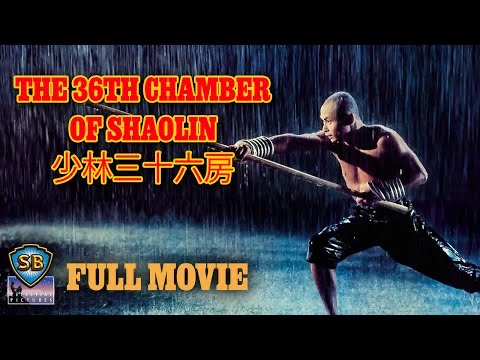
The 36th Chamber of Shaolin (1977) (少林三十六房), directed by Liu Chia-liang (劉家良), is a legendary martial arts film that follows the journey of Liu Yu-te (Gordon Liu Chia-hui), a young man driven by the need to avenge the death of his family at the hands of the Manchu oppressors. Liu, a former student of the anti-Qing patriot Ho Kuang-han, is forced to flee after his teacher and many students are killed in an attack orchestrated by the Ching authorities. Seeking vengeance and strength, Liu travels to the Shaolin Temple where he begins his arduous training in the famed 35 chambers.
After a year of sweeping floors, Liu is eventually allowed to train in the martial arts, passing each chamber's intense tests to master techniques that include fist fighting, weapons training, and agility. His training culminates in the creation of the “36th Chamber” - a new form of martial arts that will allow him to fight for justice and defeat the oppressors.
With his newfound strength and determination, Liu assembles a group of patriots, including Hung Hsi-kuan, and leads them into battle against the corrupt Manchu soldiers. The film is an inspiring tale of perseverance, skill, and the triumph of justice over tyranny, set against the backdrop of the Shaolin Temple’s storied history. Directed by: Liu Chia-liang (劉家良) Starring: Gordon Liu Chia-hui (劉家輝), Wang Yu (汪禹), Lo Lieh (羅烈), Yu Yang (于洋).
The Shaolin monk does not advance because he understands the teachings. He advances because his body has been re-organized by them. Mimic-imitate-emulate - make it your own - discipline-and-surrender - absorb-adapt-integrate - flow state.
The chambers are not symbolic tests; they are physiological constraints that force adaptation. Everything-spirals-radiates-unfurls like a fern unfurling from within itself.
ENTER - DAWN / SMOKE / GROUND
A wide tracking shot. Mist clings to earth. Feet run - bare, urgent - over stone.
A schoolyard. Ink, paper, ethics.
A lesson interrupted by boots.
A fishmonger falls.
A son runs.
The world contracts to a single vector: escape.
The 36th Chamber of Shaolin (1978) begins - directed by Lau Kar‑leung, starring Gordon Liu Chia‑hui as San Te, written by Ni Kuang, produced by Shaw Brothers Studio. No myth yet. Only consequence.
THE BODY LEARNS FIRST
Cut to temple gates.
The fishmonger's son, San Te hidden in a basket falls out.
The body waits.
The body bleeds.
The body bows.
Gordon Liu - is not acting in the modern sense. He is undergoing. He came from a genuine Hung Gar lineage, trained from childhood under Lau Cham, father of the director Lau Kar-leung. This matters. The film reveals the essence of practice; dedication, discipline and surrender; optimise self-transformation. [gordon-liu.com]
When Liu lifts water buckets, the camera stays still.
When Lui stumbles, it is not staged failure; it is aching fatigue, glistening sweat.
Documentary truth disguised as narrative.
The film feels quantum: the observer (camera) does not impose meaning - it participates.
CUT - CHAMBERS AS TIME
No montage. No shortcut.
Each chamber isolates and magnifies one variable:
balance
grip
timing
vision
breath
heat
head
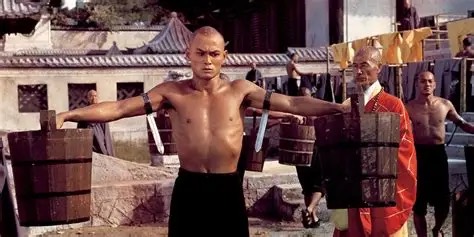
The script understands restraint. Ni Kuang writes sparingly, leaving the body to speak.
Dialogue drops away. Repetition takes over. This is not spectacle - it is training as cinema.
The editing by Geung Hing Lung and Li Yen‑hai - respects duration. Time is not compressed. It is felt.
The budget; modest by today’s standards, typical of Shaw Brothers’ 1970s efficiency - sets built once, reused endlessly, money spent on experts in their fields. What looks expansive is disciplined flow state - the Shaw Brothers yin-and-yang co-creativity.
Rapid zoom-in and pan-back - repeatedly - synth synced music - flaring and fading to the image. His eyes, did you see his eyes. Single-pointed concentration - the candle flame moves - the sound of tick-tock - faster-and-faster - cultivating cerebral calmness.
Constraint becomes clarity. Perception becomes heightened and magnified; precise and spatially aware. Everything-Everywhere-All-At-The-Same-Time. Movie as training.
ZOOM BACK - A MASTERPIECE
Halfway through, something radical happens.
The revenge plot dissolves.
We realize we are not watching a fight film. We are watching the making of a human instrument, a willpower of iron. O.G. Shaolin discipline and surrender; gritty fortitude.
Director Lau Kar-leung - a martial arts master - refused wire works. Every movement had lineage. Every chamber encoded pedagogy. This authenticity is why the film influenced The Karate Kid, The Matrix; an entire cultural movement beyond cinema.
Music by Chen Yung-Yu does not underline emotion; it punctuates breath. Silence does more work than score.
Even the antagonist (Lo Lieh) is framed not as a monster; an inevitability, physical discipline and mental willpower without heart-mind cultivation; a bird with one-wing.
THE QUANTUM TURN - THE 36TH CHAMBER
At the end, the hero does not seal himself inside mastery.
He opens it outward.
The 36th chamber is not a room.
It is a function. Training leaves the temple. Knowledge enters the street.
This is why the film never ages. It is not about victory; it is about transmission.
The camera pulls back. Villagers learn. Bodies align.
The system succeeds because it can be forgotten.
Mythical and Legendary status
Lead actor: Gordon Liu - authentic, disciplined, transparent
Director: Lau Kar‑leung - lineage over illusion
Writer: Ni Kuang - restraint as power
Studio: Shaw Brothers - industrial precision
Method: real training - real fatigue, real time
Effect: cinema that trains the viewer
This is why a generation later, Wu-Tang did not sample the film as nostalgia - Rza treated it as curriculum for his Clan; enter the Wu-Tang style. Their debut album wasn’t metaphorical; it was a literal and direct transmission of the Tao of Wu. Shaolin shadowboxing, and the Wu-Tang sword style. If what you say is true, the Shaolin and the Wu-Tang could be dangerous. Do you think your Wu-Tang sword can defeat me? En garde, I'll let you try my Wu-Tang style.
FINAL SHOT
A monk re-enters the temple.
No music swells. No lesson spoken.
The body walks - changed, charged.
A masterpiece. It does not tell you what enlightenment is -
it removes everything that is not.
And the chamber remains open.
Bruce Lee articulated his own exquisite synthesis, “Knowing is not enough; we must apply. Willing is not enough; we must do.” The Shaolin path is radical in its insistence that understanding without embodiment is irrelevant.
Enter the Wu‑Tang (36 Chambers)
Brutal, raw, effortless beauty charged with intelligence; wild, vulgar, exquisite beyond words, old-skool, nu-skool, nu-beats; abrasive, fractured, complete, incomplete; a masterpiece. Its refuses polish - it refuses narrative clarity - a raw uncut gem. Enter the Tao of Wu; multi-layered, transformational, healing, the art of complete immersion.
Listening is training and discipline in the Wu-Tang way. Repeated listening entrains the listener not through explanation; through deeper immersion. The ear must learn to attune and track multiple voices, sudden shifts, sampling vocals and beats, acting as yin-yang fusion beat-points; juxtaposed dots of interruption, coherence; confusion.
Meaning is not delivered; it is assembled. The listener must earn coherence. Music as training. Music is life. Life is music. I'll let you try my Wu-Tang style.
Wu‑Tang’s Enter The Wu-Tang - 36 Chambers - raw, warm, emotive, gritty, explicit lyrics, broken rhyme, off-beat rhythm; masterful samples of the Shaolin movie that inspired RZA’s 1993 debut masterpiece. Can it be that it was all so simple then? This album mirrors the movies' exceptional visuals, Shaolin practice, discipline and logic; captured in the ear of Rza - transformed into a wide-bandwidth of supersonic sound and frequency. Raw I'ma give it to ya, with no trivia. Raw like cocaine straight from Bolivia. My hip-hop will rock and shock the nation like the Emancipation Proclamation.
36 Chambers is exceptional because it behaves less like an “album” and more like a designed environment: a sonic dojo, a street-temple, a myth-engine. It’s raw, warm, gritty, emotional depth charge - intentionally unpolished - not because it lacks craft; it refuses cosmetic smoothing. The texture is thesis: you can hear the room tone, the edges, dust, the analogue crackle. The refusal to polish becomes aesthetic ethic - truth by abrasion - why this record feels alive - electrified. It mirrors Shaolin discipline and cinematic lineage through masterful sampling and structural motifs - transmuting visual training logic into supersonic sound collage that coheres into one-field; original face.
The album’s greatness is also physiological. Its swing, snap, and stutter are not only musical choices - attention training. Like martial drills, the record teaches timing and immersion. Bring da motherf*ckin ruckus...The roughness, yes, the rudeness, ruckus. Redrum, I verbally assault with the tongue, Murder one. Verse three, Inspectah Deck.
Wu-Tang Clan - Enter The Wu-Tang (36 Chambers) (1993) [Full Album] (FLAC) [4K] (24/96kHz)
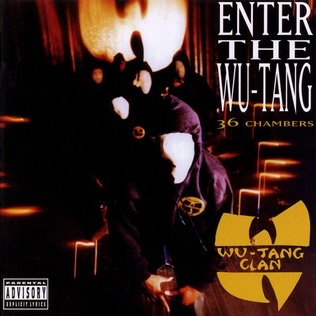
Enter the Wu-Tang (Zen Cut)
Breath counts itself in shadow.
A hand strikes; nothing struck.
Faceless masks bring da ruckus.
Stillness keeps the beat.
Each chamber stutters time.
Beats drop; body electric.
No master; temple releases.
Only method; the streets receive.
Floor unmarked; footwork circles.
Voices fracture, re-enter as one.
Blade of attention, unnamed.
Wu-Tang return empty
RZA, Shaolin, the Living Transmission of the Thirty-Six Chambers
The convergence of 36 Chambers of Shaolin, Enter the Wu-Tang (36 Chambers), and Chamber Thirty-Six of Quantum Human is not accidental, nor aesthetic. It is the result of direct lineage transmission, lived practice, disciplined study. Embodied superposition. The Body-Electrified. And martial arts is a living lineage; a living tree.
At the heart of this convergence stands RZA, producer and architect of a musical revolution - a dedicated long-term practitioner whose creative vision was explicitly shaped by Shaolin training and Chan Buddhist discipline. CQ² - E=MC²
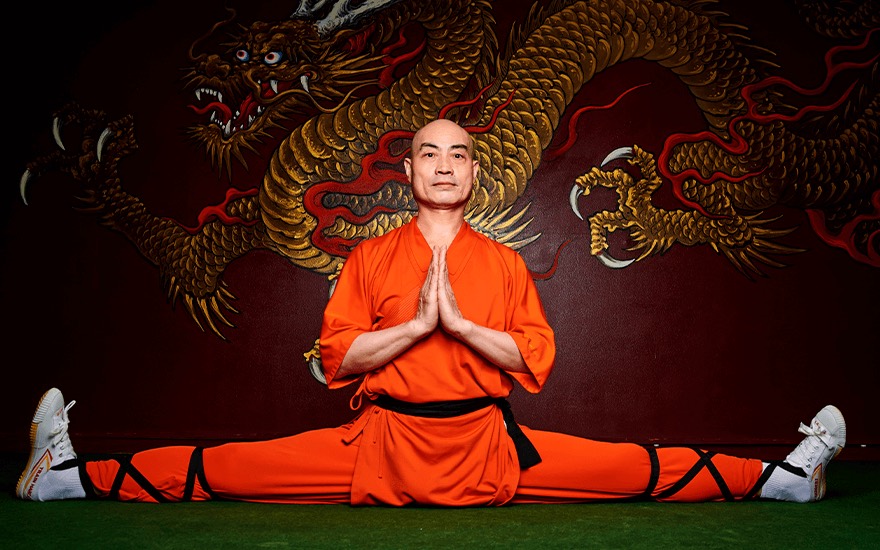
RZA’s engagement with Shaolin was not symbolic cosplay or cinematic admiration. He became self-aware and dedicated in the art of embodied learning and disciplined practice through decades of study under Shifu Shi Yan Ming, a 34th generation Shaolin Warrior Monk and founder of the USA Shaolin Temple in New York City.
Shifu Shi Yan Ming - Background and Lineage
Shifu Shi Yan Ming (born Duan Gen Shan in Henan Province, China) entered the Shaolin Temple as a child during the Cultural Revolution, a period when Buddhist practice was actively suppressed. He trained from the age of five in Shaolin Kung Fu, Chan (Zen) Buddhism; discipline, extreme hardship, scarcity, and political instability.
In 1992, he left China and eventually founded the USA Shaolin Temple in Manhattan, bringing authentic Shaolin practice to the West. His students - martial artists, artists, actors, musicians; all walks of life - RZA has repeatedly credited Shi Yan Ming as a decisive influence on his life and work. And everything like Bruce Lee entering a Hall-of-Mirrors-to-the-Self. The Tao of Wu. Know Thyself. I AM. Original face.
Shi Yan Ming’s teaching is uncompromisingly practical. He does not frame Shaolin as religion or philosophy in the abstract; he frames it as life training:
“The first discipline is to discipline yourself and help yourself. Open your heart, open your mind and study from others. Life has everything, martial arts have everything - don’t limit yourself.”
This ethos mirrors precisely the structure of the Thirty-Six Chambers: not belief, not ideology; daily refinement of body, breath, mind and action. Beginner Mind. Zen Mind. 'Great Doubt, great awakening. Small Doubt, small awakening. No Doubt, no awakening!'1 Many Paths. One Stream. Many counterbalancing ways. The path is the way. This is The Way. The Mandalorian - This is The Way Scene (HD)
RZA’s Spiritual and Creative Path
RZA’s immersion in Shaolin practice coincided with his deepening engagement with Taoism, Buddhism, and self-inquiry, most explicitly articulated in The Tao of Wu. His creative method increasingly aligned with Shaolin principles: discipline before expression, structure before freedom, repetition before originality. Everything flows.
One of RZA’s most revealing reflections on creativity describes a cosmic stillness at the centre of motion, a metaphor equally at home in Chan Buddhism, quantum physics, and mandala logic:
“I strive to be like the sun sitting in the middle of the solar system with all the planets spinning around it - millions of things going on. It’s just sitting there being the sun, but exerting gravitational effect on everything.” The self-aligned-with-the-Cosmos.
This is the centre of the mandala - not control, not force - presence with influence.
Another of RZA’s core creative axioms echoes the Shaolin emphasis on input, discipline, embodied learning:
“Through great input you get great output.” This sentence could serve as a gloss on the entire Thirty-Six Chambers system - radiance Tathāgata - and the beat goes on.
Chambers are inputs. The human being, the instrument, the vessel. Output is not cosmetic success; it is clarity of action. Purify the mind and five senses. Attune within.
RZA also speaks directly to the role of confusion, a theme central to Zen koan paradoxical practice and quantum theory - beyond right-wrong logic - now non-binary:
“Confusion is a gift from God… sit, wait. The information will become clear. The confusion is there to guide you.”
This is the pedagogical logic of the Wu-Tang album itself: fragmentation as training, disorientation as initiation. Repeated listening deepens insight and transformation.
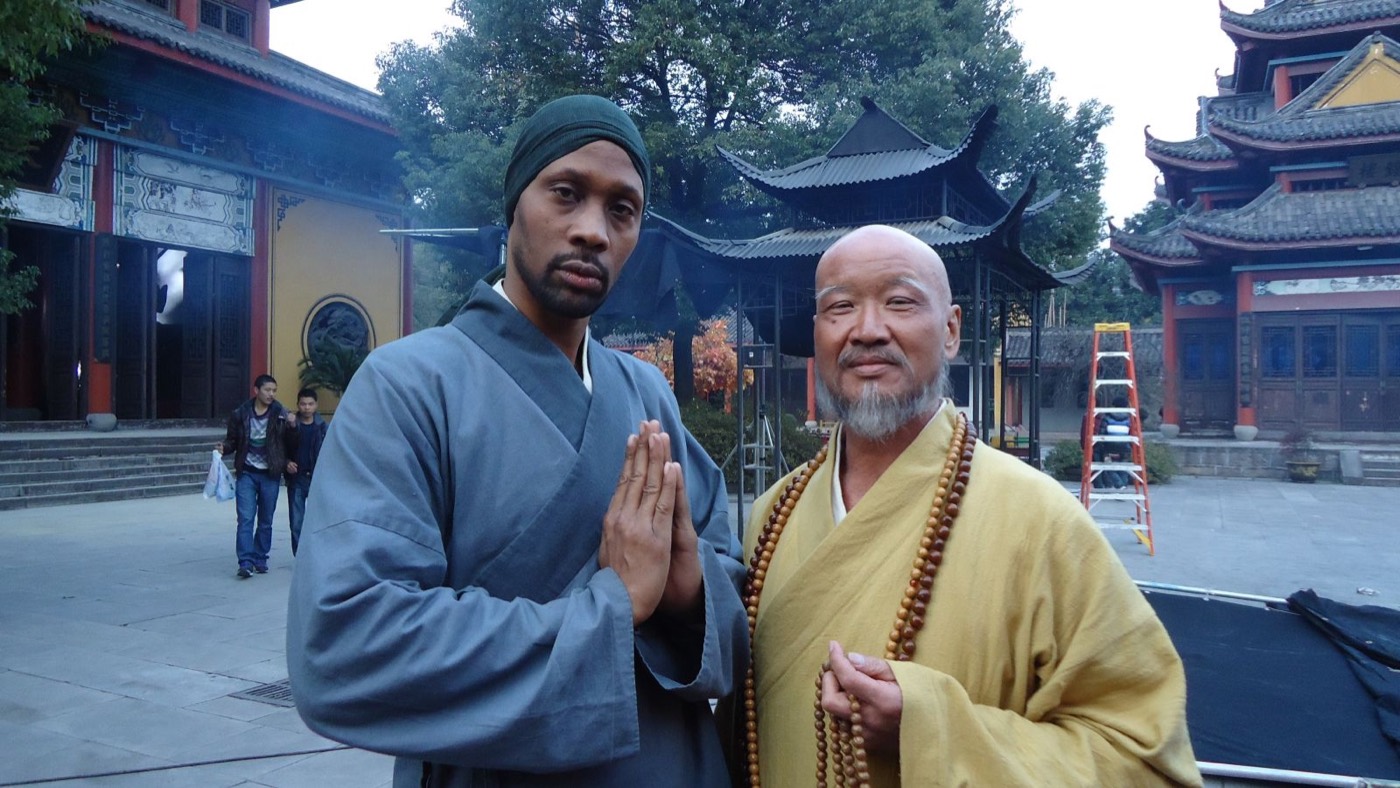
Teacher and Student - Shared Essence - Mirror and Reflection
What unites RZA and Shi Yan Ming is not style but method. Both insist that wisdom is not something to be displayed; it is something to be cultivated, re-organizing behavior. Breath has patterns. Coherent breathing shapes, refines and fine-hones character.
From the slums of Shaolin, Wu-Tang Clan strikes again
The RZA, the GZA, Ol' Dirty Bastard, Inspectah Deck
Raekwon the Chef, U-God, Ghostface Killah and the Method Man
M-E-T-H-O-D Man
M-E-T-H-O-D Man
M-E-T-H-O-D Man
M-E-T-H-O-D Man
Method Man. Enter The Wu-Tang (36 Chambers)
Shi Yan Ming summarizes Shaolin teaching with austere clarity:
“To sharpen your life, you need to practice. Every day you practice, you have life.”
Elsewhere, he emphasizes the inward direction of true strength:
“The mind is not your enemy - it is your greatest weapon, if trained correctly.”
RZA’s parallel insight frames the same truth through creative language:
“Lose yourself to improve yourself. Only when we shed all self-definition do we find who we really are.”
Teacher and student converge on the same axis: discipline dissolves ego; clarity remains. As the Zen saying says; when the student is ready, the teacher turns up.
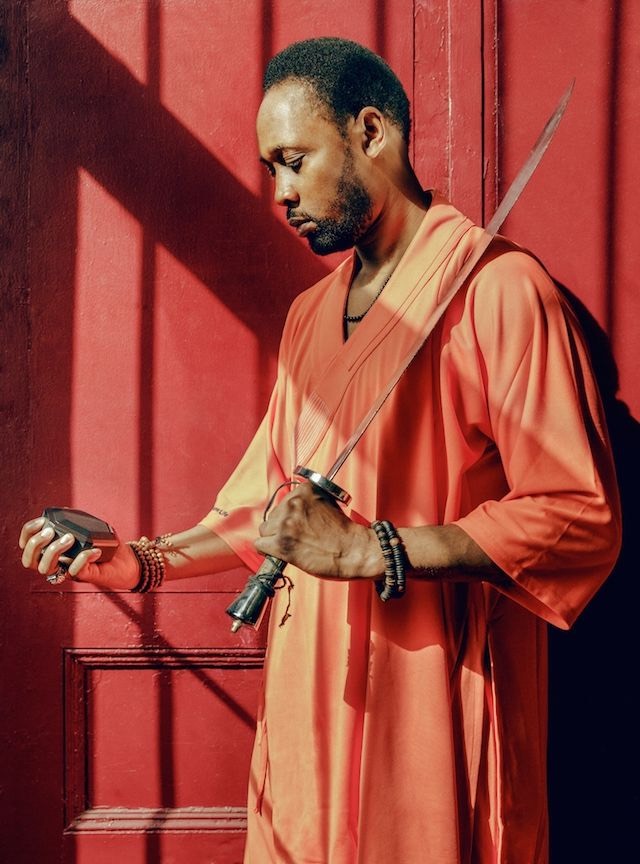
Quantum Human - 36 Chambers - mirror neuron patterning many masters
This lineage explains why Enter the Wu-Tang (36 Chambers) functions not as an album; it acts as a training manual to explore environment. Chamber Thirty-Six of Quantum Human functions not as conclusion; as a self-repeating, cosmic infinity-loop.
The Shaolin monk leaves the temple.
The Wu-Tang practitioner leaves the record.
The reader leaves the book.
Not because the system failed -
it worked - fan-dabi-dozi
The presence of a living teacher, a lived discipline, an embodied creative practice; grounds the entire 36 Chambers motif in reality, not metaphor. This is what makes it quantum human rather than merely symbolic: observation participates, training alters the system; attention becomes action. Paying attention with kindness.
The mandala closes not with an image, with capacity.
RZA did not borrow Shaolin imagery; he entered its discipline.
Shi Yan Ming did not export philosophy; he adapted and trained lives.
Together, they demonstrate the essential way of Thirty-Six Chambers:
Structure is not the opposite of freedom. Structure is the condition through which freedom becomes reliable. This is what makes the album quantum human.
In quantum physics, observation is not passive. Measurement alters the system. John Archibald Wheeler captured this insight succinctly: “We are not only observers of the universe. We are participators in it.” The Wu-Tang album does not exist fully without the listener’s active participation. It is a participatory field, not a finished object.
Know Thyself. I AM. Chan Buddhist theory and Shaolin embodiment
In Chan (Zen) Buddhism, not a metaphysical statement - direct seeing:
見性 (jian xing) - seeing one’s true nature
本來面目 (benlai mianmu) - the original face before parents were born
即心即佛 (ji xin ji fo) - mind itself is Buddha
Where “Know Thyself” points toward self-knowledge, Chan radicalizes this key move:
The “self” to be known is not the personality or narrative ego; it is the immediate, self-luminous awareness prior to thought. Where “I AM” affirms being, Chan refuses to freeze it into a concept - it points to suchness (如, ru): this, now, before naming.
Know Thyself” → 見性 (see your nature)
“I AM” → 本來面目 (your original face)
Not a doctrine, not a belief. An embodied experience, now a fact to recognize. Its-from-Bits-from-Chit. Chit - pure consciousness - see your true nature, your original face.
Shaolin Embodies Chan Buddhism
Shaolin practice is Chan Buddhism in embodied kung-fu motion. It does not begin with philosophy because philosophy can be borrowed. It begins with form, repetition, fatigue, breath, error and correction; these cannot be faked.
Shaolin does not ask, Who Am I?
It asks, Who remains when comfort, image, and reaction are stripped away?
Through stance, strike, balance, falling, rising, and repetition, the practitioner encounters a truth central to Chan:
The mind you cannot escape is the mind you must train.
Shaolin embodies 見性 (seeing one’s nature) by exhausting everything that is not it:
ego collapses under repetition
self-image fails under fatigue
thinking dissolves under timing
What remains is not a new identity; it is functioning clarity, Chan realization expressed somatically.
RZA - “I AM” Creative Stillness
RZA’s spiritual insight mirrors Chan with striking precision. He does not speak in Buddhist terminology; the structure of his insight is the same luminosity:
“Lose yourself to improve yourself. Only when we shed all self-definition do we find who we really are.”
This is 見性 expressed in creative language. The “self” that must be lost is the constructed identity; what remains is original face - one that creates, listens, acts without strain.
RZA describes creativity in terms that echo 即心即佛 (mind itself is Buddha):
“I strive to be like the sun sitting in the middle of the solar system with all the planets spinning around it…just being the sun, exerting gravitational effect on everything.”
This is I AM without assertion.
No effort. No control.
Presence; spontaneous, effortless flow state; organizing principle, original face.
Creativity - here, now - not artifice. Allowing order to arise around stillness - a quintessential Chan insight.
Shifu Shi Yan Ming - Chan Without Ornament
Shifu Shi Yan Ming, RZA’s Shaolin teacher, articulates the same realization in uncompromisingly practical terms. He does not teach belief. He teaches training until insight becomes unavoidable.
His core instruction is Chan in its most embodied form:
“The first discipline is to discipline yourself and help yourself.
Life has everything. Martial arts have everything.”
This is Chan without abstraction.
No separation between sacred and ordinary.
No special self to achieve.
Everything needed is already present - if trained.
Another of his teachings strikes directly at the heart of “I AM”:
“The mind is not your enemy. It is your greatest weapon - if trained correctly.”
Chan would say: mind deludes itself, mind liberates itself.
Shaolin adds: through the body, not through argument.
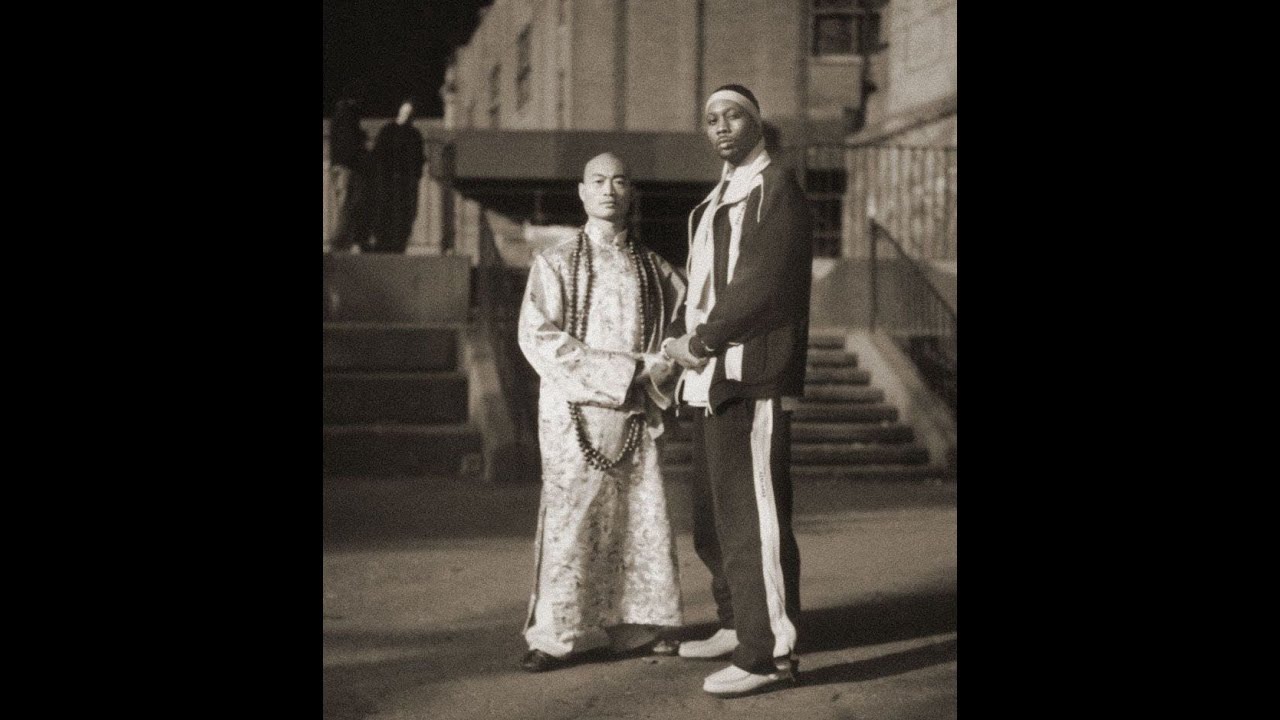
Convergence: “I AM” - Integrating Theory Embodied Practice - Trained Presence
When we place these side-by-side, the equivalence becomes clear:
| Western Phrase | Chan Expression | Shaolin Embodiment |
|---|---|---|
| Know Thyself | 見性 (see your nature) | Repetition exhausts illusion |
| I AM | 本來面目 (original face) | Presence before reaction |
| Self‑realization | 即心即佛 (mind is Buddha) | Action without egoic strain |
RZA expresses it creatively. Shi Yan Ming trains physically and unifies - the art of adaptation and flow. Chan names it sparingly. All point to the same thing:
Not a self you become, a clarity that remains when becoming ends. “Know Thyself. I AM.” Chan and Shaolin, this is not an answer. It is a test. When the body is tired, when the mind cannot hide, when the story collapses - what still stands? Shaolin trains you to meet and merge with it. Chan names it. RZA creates from it. Shared common ground.
Chamber Thirty-Six Quantum Human adopts the same stance. It does not seek to persuade. It seeks to entrain. By this point in the book, the reader has already been exposed to multiple explanatory frameworks: scientific, philosophical, poetic, mystical.
The final chamber does not privilege one. Instead, it tests whether the reader can move among them fluidly without clinging. This is done by gradual repetition and ecstatic entrainment like DJ Sasha; Universe 92. This capacity for movement is the hallmark of quantum human awareness. Allow the breath to create and envelope the movement. Breath creates patterns. Patterns create thoughts. Mind is your bestie and simultaneously your worst enemy. Breath is your best friend. Love again the stranger who was your self, whom you ignored for another, who knows you by heart.
Niels Bohr famously insisted:
“The opposite of a profound truth may well be another profound truth.” This statement is not rhetorical; it is operational. To be quantum human, one must be capable of holding contradictions without rushing to collapse them prematurely. The Shaolin monk must be soft and hard. The Wu-Tang voice must be disciplined and chaotic. The practitioner must be precise without rigidity. Everywhere engaged but not tense.
This capacity is mirrored in contemplative traditions across cultures. Nāgārjuna’s articulation of the Middle Way dismantles all fixed positions, not to replace them with a superior doctrine, to reveal the relational nature of all views. Balance-the-opposites.
“Whatever is dependently co-arisen,” he writes, “that is explained to be emptiness.” Emptiness here does not mean nothingness. It means freedom from fixation.
Thirty-Six Chambers functions as a pedagogy of emptiness in this precise sense. Each chamber removes one form of clinging: clinging to comfort, to certainty, to identity, to mastery. What remains is not an empty void - responsiveness, being and becoming.
The same insight appears in Zen poetry. Bashō’s haiku do not describe enlightenment; they enact it. The old pond - / a frog jumps in, / sound of water. Nothing explained.
Everything is present. Don Paterson, writing centuries later, articulates the same economy in a different register: The poem, in a sense, is no more or less than a little machine for remembering itself...Poetry is therefore primarily a commemorative act.
Scientists, too, arrive at this threshold when inquiry is taken far enough. Einstein famously remarked, “The most beautiful thing we can experience is the mysterious. It is the source of all true art and science.” He insisted on discipline, rigour, and clarity.
The quantum human path does not abandon reason; it completes it by placing it within lived coherence. “Logic can get you from A to B. Imagination can get you everywhere.” Einstein. The Divided Brain, and the corpus callosum; the mediator, a bridge.
Teachers across traditions converge like waves; the ocean-of-being. Ramana Maharshi’s instruction “Be As You Are” is not an invitation to passivity. It is a demand for radical honesty. When all false identifications fall away, what remains functions effortlessly. This effortless functioning is not inertia; it is precision without strain.
Chamber Thirty-Six of Quantum Human articulates this precision. By the end of the journey, the reader is no longer asked to adopt a worldview. They are asked to notice how they feel, to notice their breath, how they listen; how they engage and respond. Wisdom is not conceptual; compassion is no longer theoretical - both now embodied.
It is temporal. Breath and time dilate and synchronise. And the eyes like two pin-hole cameras. Breath and timing is central to music, martial arts, dance; everything is now contemplative and embodied practice to the symphony and beat of the breath. Boxing, jazz, meditation; training the mind in balance; effort depends less on force than on when one acts. As Heraclitus observed long before quantum theory, “Character is fate.” In modern terms, pattern of response determines the likely outcome. Breath creates patterns; patterns create character. Thirty-Six Chambers entrains response.
Chambers end without spectacle. There is no final revelation, no apotheosis. The practitioner returns to ordinary life. Ordinary life is no longer ordinary. Attention has been tested, drilled, fine-honed, each moment, day-by-day. Again. Again. Miracle. The system can now be closed because it has been internalized. This is the true meaning of self-illumination. Not light descending from above - extra-ordinary clarity arising from within action itself. The Daoist “wu wei” captures this paradox: effortless effort. Shaolin monks embody this. The Wu-Tang flow enacts it. Quantum human lives it.
The path, therefore, is not something one completes. This is The Way.
T. S. Eliot wrote in Four Quartets: “We shall not cease from exploration / And the end of all our exploring / Will be to arrive where we started / And know the place for the first time.” Chapter Thirty-Six is a return and arrival. Original face. What remains is not identity. Orientation. Not belief. Capacity. Not transcendence. Participation.
Eye-Star Mandala
Eye-Star centre symbol A single symbol where perception and cosmos are inseparable: the eye, a star, the star, an eye. Awareness is not depicted as looking at the world, awareness is the world recognising itself. Awareness-of-awareness-itself.
Earth-grounded materiality (lower field) Soil layers, roots, mineral veins, stone, and water textures anchor the mandala. These are not decorative; structural - matter as memory, gravity, continuity.
Non-local field (upper field) Light, wave-like interference patterns, soft nebulae dissolve spatial boundaries. This region suggests relation rather than location -connection without centre.
Mandala integration Sacred geometry and subtle lattice patterns unify both realms, implying that earth and cosmos are not opposites; they are expressions at different scales of the same order.
Tone and palette Warm ochres, umbers, and greens rise into indigo, violet, gold, and white - balanced, calm, contemplative. Radiant, grounded, visionary without spectacle.
Overall effect Neither purely Gaia nor purely abstract: a threshold image. It can be read as biological, spiritual, cosmological, psychological; without collapsing into any single interpretation.
Eye-Star Mandala
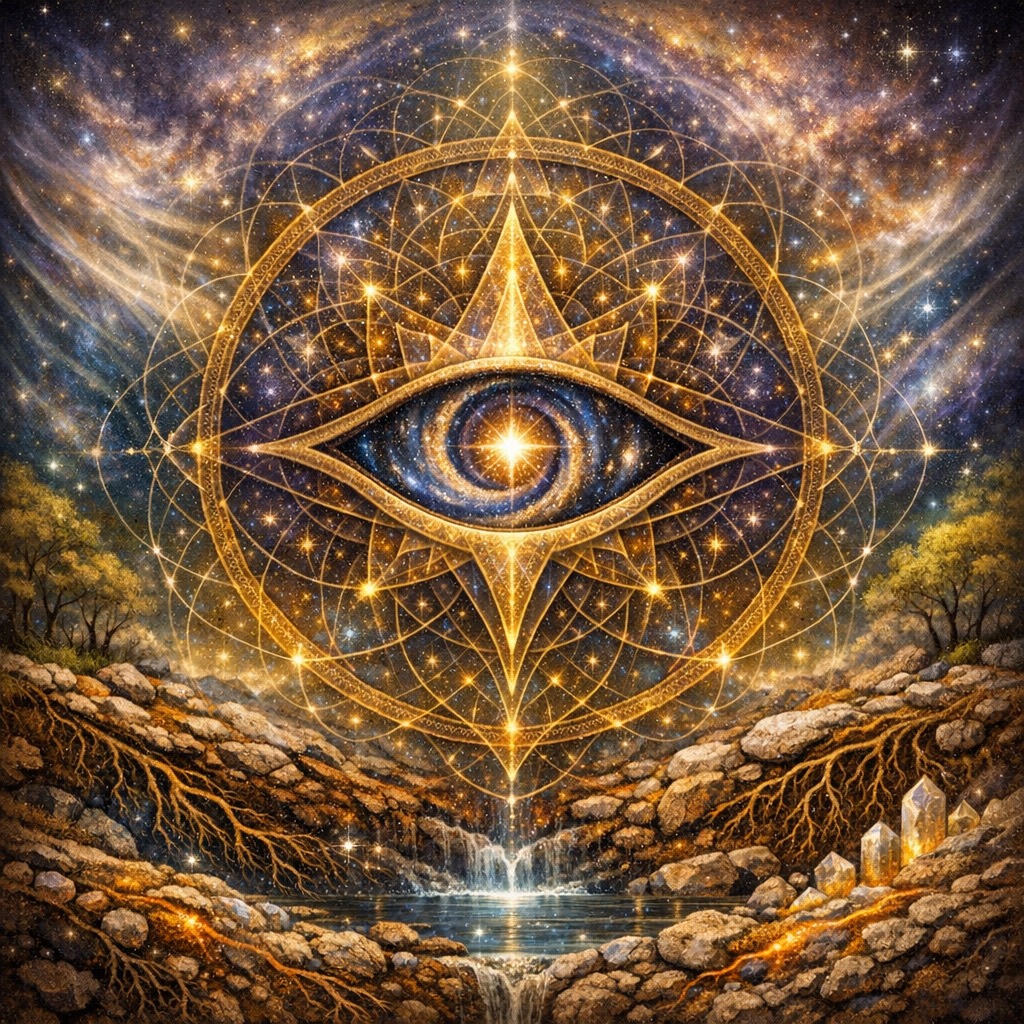
The Eye-Star
Night pond -
a star opens its eye
in muddy water.
A lotus blossoms.
The circle closes.
Light is eaten.
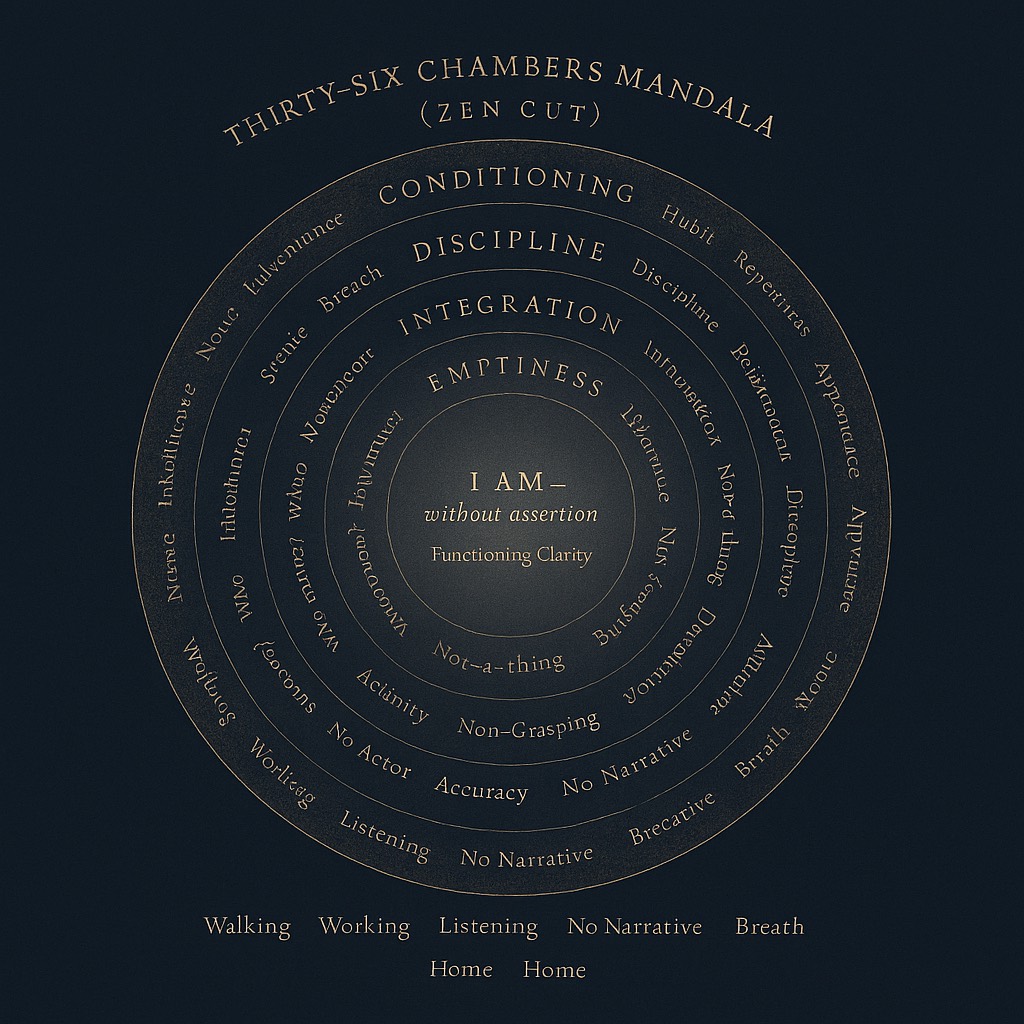
Thirty-Six Chambers Mandala (Zen Cut)
The mandala unfolds in six rings, six chambers per ring. Each ring is not surpassed but included. Each chamber is not mastered but worn thin until only function remains.
First Ring (Chambers 1-6): Conditioning
Noise.
Inheritance.
Hunger for shape.
The body learns before the mind agrees.
Habit repeats itself until repetition reveals the pattern.
Nothing is corrected.
Nothing is judged.
This is the chamber where the self first appears -
and is recognized as something that happens.
You are not wrong.
You are patterned.
Second Ring (Chambers 7-12): Discipline
Stance settles.
Breath counts itself.
Form holds.
Effort sharpens.
Discipline gathers.
Discipline is no longer punishment,
a mirror that does not flinch.
Form does not bind.
It burns away excess.
Third Ring (Chambers 13-18): Integration
Breath enters movement.
Movement enters timing.
Reaction loosens its grip.
Response appears more fluidly.
Mistake becomes information.
Strength becomes quiet.
Clarity does not arrive.
It aligns.
Fourth Ring (Chambers 19-24): Inquiry
Who moves when moving happens?
Who speaks when words arise?
Identity loosens like mist.
The self is seen as an activity,
not a thing.
This is seeing one’s nature
- not as insight - disappearance of error.
The question dissolves the questioner.
Fifth Ring (Chambers 25-30): Emptiness
Technique vanishes into action.
Action forgets the actor.
Nothing is withheld.
Nothing is grasped.
Compassion appears
as accuracy -
the exact weight of the moment.
Emptiness is not absence.
It is freedom from sticking.
Sixth Ring (Chambers 31-36): Return
Walking.
Working.
Listening.
No false narratives.
No proclamations.
The world breathes once
and breathes you back.
The path no longer needs its name.
The Centre
At the centre of the mandala
there is no image.
No doctrine.
No self.
Only this:
A spiral without a middle.
Turning without turning.
Functioning clarity.
Know Thyself
the self has burned.
I AM
without assertion.
Unsurpassed Enlightenment teaches awakening is not arrival - a remainder - what survives when explanation is exhausted. Thirty-Six Chambers enacts the same truth.
Refinement until nothing interferes. Synchronicity. Superposition. Entanglement. The mandala does not end. A Bose-Einstein condensation-of-consciousness. CQ² E=MC²
It functions.
Breathe. Only now -
the way continues.
Thirty-Six Chambers Mandala (Zen Cut)
Thirty-Six Chambers, No Centre
Bring da ruckus - breath
beats quiet pavement split
mind cuts raw fog.
Stance, steps - light settles.
Train till the body knows.
Return empty-full. Original face
End of spiral 31
The 36th Chamber: all 32 spirals open