36th Chamber · Spiral 3
Mapping In-finite Mandalas
About 3 minutes to read
Central idea: This chamber presents a personal philosophy “Quantum Human”, which seeks to integrate science, spirituality, philosophy, psychology, poetry, martial arts, meditation, and embodied practice into a unified approach to human development.
Balance the opposites: A recurring theme is the reconciliation of apparent opposites - mind/body, left-hemisphere/right-hemisphere, science/mysticism, theory/practice, self/other, discipline/surrender, yin/yang - a holistic way of living - Tao, whole-being.
Self-enquiry: The question “Who am I?” serves as a foundational practice, drawing heavily on Sri Ramana Maharshi, Advaita Vedanta, and other contemplative traditions.
Bruce Lee as a model: Bruce Lee is presented as an exemplar of “Quantum Human,” emphasizing adaptability, direct experience, self-realization, Dragon-fire vision, Jeet-Kune-Do, Way of the Intercepting Fist; be limitless, “be water, my friend.”
Learning through the art of imitation and practice: Drawing from Tools of Titans and the concept of mirror neurons, the text encourages learning from experts by observing, imitating, adapting, and eventually integrating their wisdom into one’s own life.
Seven-chakra framework: Much of the book is organized around a chakra-based model representing stages or domains of development; explore the entire bandwidth-of-consciousness, physical, feeling, emotional, thinking, wisdom, spiritual-being:
Root - grounding and ancestry. Sacral - creativity and flow. Solar Plexus - identity and willpower. Heart - compassion and connection. Throat - expression and dialogue. Third Eye - intuition and insight. Crown - unity and transcendence - CQ² - an in-finity loop.
Dialogue and dialectics: Socrates, Plato, and Hegel are used to explore how consciousness evolves through questioning, contradiction, insight, and synthesis.
The author examines consciousness through Eastern and Western philosophy; Advaita Vedanta, Analytic Idealism (Bernardo Kastrup), meditation traditions, and discussions of quantum theory; Orchestrated Objective Reduction (Penrose and Hameroff.)1
Spiritual cartography: Poetry is not merely art; it is a vehicle for exploring transcendence, non-duality, consciousness, and spiritual realization. Rumi, Basho, The Poem and the Journey, Poetry for the Spirit, and original poems are interwoven throughout the text.
Sri Ramakrishna and pluralism: Different religions and spiritual paths are presented as converging toward a shared underlying reality, emphasizing love, compassion, wisdom, and direct experience over dogma. Many rivers; all flow towards the ocean.
Nāgārjuna and the Middle Way: This spiral highlights emptiness, interdependence, and the avoidance of rigid positions as key philosophical principles.
East-West synthesis: The work repeatedly compares Eastern philosophy - Patanjali and Buddha - Western philosophy and modern science, quantum biology; especially regarding the nature of consciousness, self, interdependence; seeing reality as-it-is.
Quantum biology and neuroscience: The text discusses theories involving microtubules, fascia, structured water, breath, brain function and coherence, positioning them within a broader exploration of consciousness; the body-electric, bioelectricity, chi, ki, prana.
Internal disciplines such as yoga, Tai Chi, Qigong, boxing, martial arts, breathwork, mobility training, and meditation are essential complements to counterbalance intellectual understanding. Mixed-Internal-Arts² - theory-and-embodied-practice - harness mind-body energy - the I-not-I goes missing in action - flow state - M.I.A²
The “36 Chambers” metaphor: Inspired by 36 Chambers of Shaolin and Enter the Wu-Tang, the final section frames personal growth as a series of training chambers that cultivate awareness, discipline, inquiry, integration, and transformation. CQ²
This chamber includes autobiographical reflections involving family, twinhood, travel, yoga study, teachers, creative influences; formative life experiences that shaped the author’s worldview; objective-subjective; unified. Consciousness-Quotient-Squared.
Growth is portrayed as an ongoing process rather than a destination. To be “Quantum Human;” one who continually integrates wisdom, compassion, self-awareness, creativity, embodied-practice, and openness to learning. The Path is the Way. E=MC²
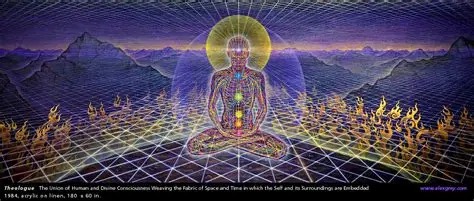
“The union of Human and Divine Consciousness weaving the fabric of Space and Time in which the Self and its surroundings are embedded.” Alex Grey, Theologue.
End of spiral 3
The 36th Chamber: all 32 spirals open