Ring III · Integration · Chamber 14
Bruce Lee, Jeet Kune Do
About 13 minutes to read
“With Wing Chun at the core of his system, Bruce Lee incorporated a modification of various techniques from Northern Praying Mantis, Southern Praying Mantis, Choy Li Fut, Eagle Claw, Western Boxing, Wrestling, Fencing, Judo, Jiu Jitsu, and some of the more refined kicks of the Northern & Southern Chinese styles. Innovative and radically ahead of his time in his training and teaching methodology, Bruce Lee developed a martial system and fighting strategy that has lost none of its effectiveness over time.
Emphasizing the “ranges of combat”. Students are taught to confidently and with ease “flow” from long distance, “kicking-range”, to middle distance, “hand-range”, to close quarter, “trapping & grappling range”.
The movements are crisp, and efficient, utilizing the most direct lines and angles. JKD affords the practitioner a means by which to effectively pursue the most direct line of attack. And once an attack has been launched, there are no breaks or interruptions. As one technique nears completion, it starts to blend into the next and so forth: one continuous flowing motion until the conflict is resolved.” Dan Insanto. Father of mixed martial arts. Curriculum – Inosanto Academy As the Zen saying says: When the student is ready, the teacher appears.
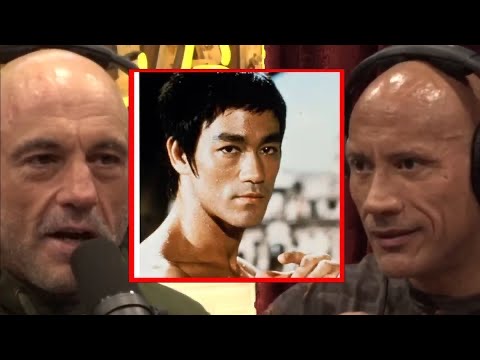
“There's a great - you probably know it - Bruce Lee quote from Enter the Dragon. Do you remember - when he was like - it was one of his students, and he told the kid - it's like a finger pointing to the Moon - and he slapped him on the head - don't concentrate on the finger; you're going to lose all that Heavenly Glory around you, you know; yeah, so back to being present.” Dwayne “The Rock” Johnson. Professional WWE wrestler, businessman, comedy and action movie star; all-round phenomenal guy.
“Yeah, Bruce Lee was a bad mutha f’ing. He was such a bad-mutha-f'ker. People really don't appreciate what he did - because what he did was introduce martial arts in an exciting way to the whole world. Everybody was wearing Kung Fu outfits. And everybody was f’ing taking martial arts classes. Everybody wanted to be like Bruce Lee. He was the f’king coolest guy that ever existed in movies. All of a sudden, you’ve got this little ripped Chinese guy who's f’king everybody up.” Joe Rogan; podcast king, UFC commentator, mixed martial artist, actor, TV host and stand-up comedian of the highest calibre; turning up and being prepared physically, emotionally, mentally, and spiritually in every endeavor. Explore the entire-bandwidth of yin-and-yang and balance being at-one-with-the-Tao. Consciousness Quotient Squared.
“And everyone thought they were Bruce Lee. By the way, I remember getting my first pair of nun-chucks but I f’kced myself up with the real ones - enough times that I was like - oh they make rubber ones that you're supposed to learn with dude. I did that. And what did he do - I feel like he was groundbreaking when he came over here. There was something about what he was teaching; was it Jeet Kune Do? Right, so he was the first, or he was taking a version of it and...”
“Well he was the first to combine...the thing was there was a thing about loyalty in martial arts like if you were a judo practitioner and you started training at a kickboxing gym people would frown upon that like...why are you training Muay Thai when you're a judo practitioner. Judo is the way, and the same thing was...I had a very open-minded Taekwondo coach who actually encouraged me to start boxing and doing some other things...yeah...but most of the time that's not the case. A lot of Kung Fu practitioners, they don't want you practicing karate. They only want you going to a Kung Fu place.
What Bruce Lee said is use everything that's useful - everything that's useful - and he put together a system of martial arts that incorporated everything that he learned; from grappling from Jean Label and karate from Chuck Norris and Tang Sudo and you know Kung Fu from Ip Man, from Wing Chun. He put it all together with Western boxing and wrestling. He realized like there's so many different ways to fight and the style is having no style. The way is no way like figuring out...”
And so Bruce was a fission-and-fusion master who wok-fried together many different ways - the no way of martial arts and other movement modalities - putting what Bruce had learnt in theory about Eastern and Western philosophy and quantum physics into experiential and embodied practice; what it means to be quantum human. CQ² M.M.A
Align body-breath-and-mind-in-union, everything-acting-as-one - a unified-whole - now everything-is-interdependent-and-interconnected and not-one-thing-in-the-universe-is-separate-from-another like Bruce Lee entering a Hall-of-Mirrors-to-the-Self. DON’T THINK! FEEEELL!
“He said that then didn’t he...”
“Yes, yes. Yeah, figuring out how to adapt and move to every situation to be like water.”
“That's right.”
“And be formless.” Joe hitting the nail on the crown.
“Yeah. That's right.” The Rock sounding like Eddie Murphy’s barber in Coming To America saying Dat’s right. Dat’s right.
“And he taught that philosophy and that philosophy eventually became mixed martial arts. Bruce Lee was the first true mixed martial artist.” Joe Rogan & The Rock on Bruce Lee | JRE CLIPS
Explore the entire-bandwidth of yin-and-yang and counterbalance the opposites. CQ²
Global Gung Fu movie star - Dragon-Fire energy radiating like Halley’s comet - bursting into kinetic flames on the movie screen. Enter The Dragon. Icon. Legend.
“I mean here is the natural instinct and here is control. You are to combine the two in harmony. Not...if you have one to the extreme, you'll be very unscientific. If you have another to the extreme, you become, all of a sudden, a mechanical man...no longer a human being. So, it is a successful combination of both, so therefore, it's not pure naturalness, or unnaturalness. The ideal is unnatural naturalness, or natural unnaturalness.” Bruce Lee Philosophy - YouTube Quantum Human in my eyes.
“I have not invented a "new style," composite, modified or otherwise that is set within distinct form as apart from "this" method or "that" method. On the contrary, I hope to free my followers from clinging to styles, patterns, or molds. Remember that Jeet Kune Do is merely a name used, a mirror in which to see "ourselves"...Jeet Kune Do is not an organized institution that one can be a member of...There is no mystery about my style. My movements are simple, direct, and non-classical. The extraordinary part of it lies in its simplicity. Every movement in Jeet Kune Do is being so of itself. There is nothing artificial about it. I always believe that the easy way is the right way. Jeet Kune Do is simply the direct expression of one's feelings with the minimum of movements and energy. The closer to the true way of Kung Fu, the less wastage of expression there is. Finally, a Jeet Kune Do man who says Jeet Kune Do is exclusively Jeet Kune Do is simply not with it. He is still hung up on his self-closing resistance, in this case, anchored down to a reactionary pattern, and naturally is still bound by another modified pattern and can move within its limits. He has not digested the simple fact that truth exists outside all molds; pattern and awareness is never exclusive. Again, let me remind you Jeet Kune Do is just a name used, a boat to get one across, and once across it is to be discarded and not to be carried on one's back.”
Bruce Lee: Quantum Human in Action
Self-Enquiry and Multiplicity
Bruce Lee’s journey began with relentless self-enquiry - constantly asking “Who am I?” and “What is my true nature?” This mirrors the Quantum Human’s embrace of multiplicity and paradox: Lee was not content with a single identity or tradition. He was simultaneously a martial artist, philosopher, actor, and seeker.
All knowledge leads to self-knowledge. Tao of Jeet Kune Do.
His practice of self-enquiry led him to peel away layers of self-image, seeking authentic actualization rather than imitation - a theme echoed in the poem Zen Lee - emphasis on “peeling your own image from the mirror” and living for authentic self-actualization.
Integration of Eastern and Western Philosophy
Lee’s philosophy was a synthesis of East and West. He drew from Taoism, Zen Buddhism, Confucianism, and Western thinkers like Emerson and Alan Watts. This integration is at the heart of the Quantum Human - bridging opposites, dissolving boundaries, and creating new wholes; everything wok-fried together, taste-and-refine.
Absorb what is useful, discard what is not, add what is uniquely your own.
Scholars note that Lee’s approach was “perfectionist,” blending character-building and self-actualization from Confucian and Aristotelian traditions. His work on Longstreet and his writings exemplify this ethos of integration and continual evolution.
Quantum Physics: Superposition and Transformation
Lee’s interest in quantum physics inspired him to embrace paradox, uncertainty, fission-and-fusion, wok-frying together what is useful...add what is uniquely your own, the art and discipline of self-transformation. Quantum theory’s wave-particle duality and the idea that observation collapses possibility into presence resonated with his martial arts philosophy. He saw the practitioner as both observer and participant, embodying superposition and choice - holding multiple possibilities and actualizing them through intention.
Empty your mind, be formless, shapeless - like water. You put water into a cup; it becomes the cup. You put water into a bottle; it becomes the bottle. You put it in a teapot; it becomes the teapot. Now, water can flow or it can crash. Be water, my friend.
“Be water” is a living philosophy and embodied metaphor for quantum being - fluid, adaptable; always in transformation.
Jeet Kune Do: The Living Mandala
Jeet Kune Do (“Way of the Intercepting Fist”) was Lee’s answer to the limitations of traditional martial arts. He fused techniques from Wing Chun, boxing, fencing, judo, and more, discarding what was not practical and keeping what worked. This was not just a technical innovation but a philosophical one:
No Style as Style: “Using no way as way, having no limitation as limitation.”
Lee’s approach anticipated modern mixed martial arts and embodied the quantum human ideal - multiplicity, integration, and the collapse of potential into presence.
A fully developed individual goes beyond any style or system. Jeet Kune Do is not a fixed system but a dynamic, evolving field - much like a quantum field of awareness.
Perspectives from Students and Scholars
Bruce Lee’s students, such as James Coburn and Kareem Abdul-Jabbar, and scholars like John Little and Bruce Thomas, emphasize Lee’s continual evolution and his impact as a teacher of transformation. Metal-fire Dragon, Quantum Human pioneer.
Coburn noted, “Each time I came back, I was astonished to observe how Bruce had evolved even further. The steps he had taken were really giant steps.”
Bruce Thomas observed, “Bruce Lee taught in the language of his culture and tradition - Taoism. But he was also a modern man and didn’t believe in tradition for its own sake - he often included ideas from the emerging science of quantum physics in his lessons and essays.”
Steve McQueen reflected, “Bruce taught me that true strength comes from adaptability and self-awareness. His lessons weren’t just about fighting - they were about living.”
“Bruce always said, ‘Research your own experience. Absorb what is useful, reject what is useless, add what is essentially your own.’ He wanted us to be explorers, not followers. Jeet Kune Do was never about imitation - it was about honest self-expression.” Dan Insanto; who went on to become one of the fathers of M.M.A. CQ²
Bruce Lee as Quantum Human
Bruce Lee’s legacy is a living mandala of quantum human principles - multiplicity, integration, superposition, and transformation. His teachings, writings, and martial art are a dynamic field where theory collapses into presence, and the practitioner becomes a bridge between worlds. Lee anticipated the Quantum Human paradigm by living as a field of infinite potential - aware, compassionate, and entangled with the cosmos.
Beginnings - The Divided Brain - Bruce Lees Hemispheric traits
In my beginning is my end. In succession
Houses rise and fall, crumble, are extended,
Are removed, destroyed, restored, or in their place
Is an open field, or a factory, or a by-pass.
T. S. Eliot. Four Quartets. Beginning of East Coker.1
Beginnings
Superimposing a neuroscientific lens; Iain McGilchrist's The Divided Brain - Mince represents the logical and precise left-hemisphere ala Dr. Spock and Sherlock - the rational, scientific and empirical, disembodied mind; I represent the spatially aware and intuitive right-hemisphere ala Captain Kirk and Dr. Watson, empathetic, non-rational, and embodied heart-mind. And it is the corpus callosum which acts as a bridge and mediator between the divided-hemispheres.
The divided brain is a mirror of me-and-Mince. Your left-and-right-hemispheres be like the twin clay stop-motion comedy animations Morph and Chaz,2 arguing non-stop ever since birth, and only the guiding hand of their creator mediates their quarrelling, Tony Hart creating a bridge and acting as the corpus callosum.3 This dialogue between these three archetypes represents a microcosm of the triune brain; left-brain, right-brain, hemi-sync - coherent breathing cultivates brain coherence - this the way of the undivided-brain - a unified-field of pure awareness like Einstein observed - Logic can get you from A to B. Imagination can get you everywhere. We are made of star stuff. Are we classical, or are we quantum? Differences are not absolute, but even small differences get to be amplified. Always in yang-is-a-dot-of-yin, and vice-versa.
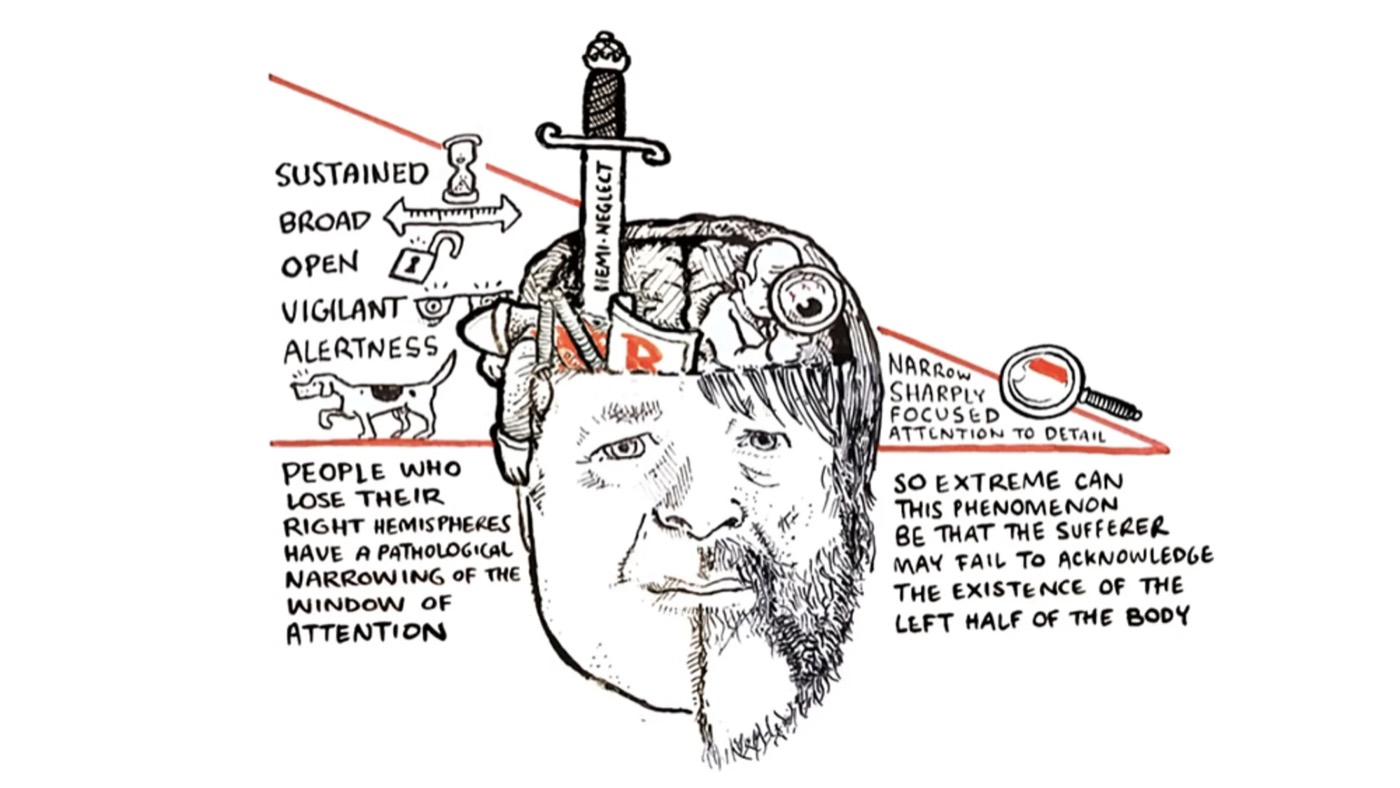
Bruce Lee is a fascinating archetype for the triune-brain model (Left Hemisphere, Right Hemisphere, Balanced/Hemi-Sync) his philosophy informed his self-practice - exploring embodied integration - counter-balancing yin-and-yang-opposites. CQ²
Bruce Lee’s Hemispheric Traits
Left-Hemispheric (Analytical, Logical, Structured):
Rigorous training, discipline, and methodical practice.
Deep study of martial arts techniques, biomechanics, and philosophy.
Analytical approach to combat - breaking down opponents’ movements and strategies.
Right-Hemispheric (Intuitive, Creative, Holistic):
Emphasis on flow and adaptability: “Be water, my friend.”
Creative synthesis of martial arts styles into Jeet Kune Do.
Intuitive movement, improvisation, and emotional expression in both fighting and film.
Balanced / Hemi-Sync (Integration of Both):
Bruce Lee explicitly taught the importance of balancing structure with freedom. He rejected rigid systems (pure left-brain) but also warned against chaos without discipline (pure right-brain). His philosophy was about whole-brain integration: rational training and intuitive execution. Discipline-and-surrender merge to create effortless-effort; flow state.
Bruce Lee belongs firmly in the Balanced / Hemi-Sync category.
He is not just a martial artist but a philosopher who embodied mind-body integration.
His famous maxim “Absorb what is useful, discard what is not, add what is uniquely your own” reflects both analytical discernment (left) and creative intuition (right).
Comparison
Left Hemisphere Archetypes: Sherlock Holmes, Dr. Spock, Agent Smith; Gum.
Right Hemisphere Archetypes: Morpheus, Winne-the-Pooh, Wall-E, Willy Wonka; Bop.
Balanced/Hemi-Sync Archetypes: Yoda, Gandalf, Neo, H. H 14th Dalai Lama, Swami Savapriyananda, Mingyur Rinpoche, Dr. Yogrishi Vishvketu, Akong Rinpoche, Bruce Lee.
Bruce Lee stands alongside Yoda and Gandalf as a cultural symbol of wisdom through integration - disciplined yet fluid, logical, yet intuitive - CQ², M.I.A², E=MC²
The Master and His Emissary McGilchrist, a psychiatrist and literary scholar, draws on neuroscience, philosophy, and history to argue that the two hemispheres of the brain - right (the “Master”) and left (the “Emissary”) - offer fundamentally different ways of engaging with the world. McGilchrist’s central thesis is that Western civilization has gradually privileged the left hemisphere’s mode of attention - emphasizing logic, categorization, and mechanistic thinking - at the expense of the right hemisphere’s capacity for integration, empathy, and presence. This imbalance has led to a narrowing of perception, a loss of meaning, and a disconnection from the living world.
“If the detached, highly focused attention of the left hemisphere is brought to bear on living things, and not later resolved into the whole picture by right-hemisphere attention, which yields depth and context, it is destructive.” What we have done in the modern world is make the servant (the left-hemisphere) the master, and the master (the right-hemisphere) sub-servient, since it is the left-hemisphere that seeks to control, manipulate and dominate.
“...particularly over the last 500 years or so. Why I believe so, forms the subject of this book. I hold that, like the Master and his emissary in the story, though the cerebral hemispheres should co-operate, they have for some time been in a state of conflict. The subsequent battles between them are recorded in the history of philosophy, and played out in the seismic shifts that characterise the history of Western culture.”
This is not to denigrate modernism. It is to seek balance in the microcosm of the brain.
“Our talent for division, for seeing the parts, is of staggering importance - second only to our capacity to transcend it, in order to see the whole. These gifts of the left hemisphere have helped us achieve nothing less than civilisation itself, with all that that means. Even if we could abandon them, which of course we can't, we would be fools to do so, and would come off infinitely the poorer. There are siren voices that call us to do exactly that, certainly to abandon clarity and precision (which, in any case, importantly depend on both hemispheres), and I want to emphasise that I am passionately opposed to them. We need the ability to make fine discriminations, and to use reason appropriately. But these contributions need to be made in the service of something else, that only the right hemisphere can bring. Alone they are destructive. And right now they may be bringing us close to forfeiting the civilisation they helped to create.”
End of chamber 14
Chambers 1 to 35: all 35 chambers open