Ring III · Integration · Chamber 15
The Science and Art of Breathing
About 22 minutes to read
“We might have to revise the superior assumption that we understand the world better than our ancestors and adopt a more realistic view that we just see it differently - and may indeed be seeing less than they did.” Iain McGilchrist, The Master and His Emissary: The Divided Brain and the Making of the Western World.
"All shall be well, and all shall be well, and all manner of things shall be well." Dame Julian of Norwich. English mystic and anchoress of the Middle Ages.
Edinburgh University, 1992. I walk up a small flight of wooden stairs and open the door to the boxing gym which has a small ring in the middle and three beaten-up punch bags towards the back. The air smells stale, damp, and musty. Twenty or so students are lined-up for a four-week winter intake, and Coach - I forget his name - think Gordon Ramsey as a Scottish boxing coach; six-foot-six, twenty stone, muscle solid like an oak tree and built like a proverbial brick shithouse; my heart, pounding.
Over four weeks; Coach sieved through the students much like the TV Series SAS: Who Dares Wins. Four weeks of the most intense all-round training anyone can endure. Survive the one-month cut and you come out of it much more disciplined and mentally tougher; broken down physically, ready to be built into a boxer. Each session lasted one-and-a-half hours; ten-minute warm-up; stretching, running- on-the-spot with knees high, arms up-and-down like pistons; non-stop squats, sit-ups, press-ups, star-jumps, burpees; 3x1 min. Skipping 3x3 mins. Shadowboxing 3x3 mins; fine-honing basic drills of jab, jab-cross, jab-slip-hook, bob-and-weave -all-the-while - imagining your shoelaces tied together to maintain good footwork, balance and technique. An hour-in and we split up into pairs. Pad work 3x3 mins, followed by three rounds on the light, medium and heavy bags. The class ends with 3x3 mins lying down with legs one-inch-off-the-floor; stomach-on-fire, sweat dripping from the roof. Four-weeks flew by like Maverick in Top Gun doing a flyby.1
After four weeks of sweat, blood and vomit and building peak physical and mental toughness; ten remained. Coach like an alchemist began molding us into fighters, and only now allowed light sparring. Being nine-stone, I was the lightest in the gym; the next lightest was ten-and-a-half stone. We were the first two to get inside the ropes as the other students eagerly looked on from outside the ring. Coach gave minimal instruction. Listen to my instructions. Protect yourself at all times. Touch gloves. Now BOX. Adrenalin floods my body. My heart beats fast-and-the-furious - everything-becomes-hyper-kinetic; thirty-seconds in; we are both hyper-ventilating.
“STOP BOXING! Come closer. Stay in punching distance. BREATHEEE!! NOW BOX!” To this day, this is one of the most eureka flow states that I have ever viscerally encountered. I took a long-deep breath-in, and everything slowed down like Neo in Matrix-Bullet-Time. My mind became calmer and more focused. I anticipated my opponent much more quickly and dominated the sparring session.
There are times in life - as in the ring - when you need to find strong yang-determination and uncover hidden inner reserves of mental fortitude and the dark art of boxing taught me the yang discipline of concentration and balancing yang-with-yin; to be physically determined and mentally focused, and yet remain calm and centred whilst breathing inside the whirlwind; arriving at the still point within the turning world, and their the dance is like Ali who mastered yin-and-yang inside the ring - and more importantly in life - a man who has no imagination has no wings - who could dance like a butterfly and sting like a bee; who shook up the world.
James Nestor in Breath has written a comprehensive survey on the lost art and science of breathing. Breathing fell through the gaps of the scientific branches, not quite physics nor biology nor chemistry, and got lost through the ages and has only recently been re-discovered and re-examined and the evidence that James Nestor compiles be like Sherlock Holmes. And the elementary evidence is astonishing.
The foundation for optimal breathing is to stop breathing through the mouth - sub-optimal shallow chest breathing - and start breathing slower through the nostrils and breathe into the belly which cultivates deeper diaphragmatic breathing. This one change dramatically improves health and wellbeing and optimises brain functioning on so many levels, and this is what the ancients knew. This has been echoed throughout the ages by the saints, sages, prophets and mystic-poet-seers; Know Thyself, All-Is-One. Self-enquiry is a path of purification of the body-mind-and-senses. And it is the breath which connects everything-to-everything-else; Chi, Ki, Prana, universal lifeforce energy by any other name, inter-being, inter-be. Breathe for you are alive.
Patañjali’s Eight Limbs of Aṣṭāṅga Yoga can be viewed as branches and so the fourth limb of prāṇāyāma - breath regulation - can be seen as the central trunk, and it is the breath which is central to yoga practice, since it is the breath which is the carrier of prāṇā which gives vital life-force energy to the body like sap to a tree.
Prāṇā, Chi, Ki, to name but a few, a word used to describe universal lifeforce energy, and this is what the ancients knew. In this way, yoga and other ancestral and indigenous wisdom is a living oral tradition of ancient teachings and sacred practices passed down between teacher-and-student; an Avatar-lit tree connecting self-to-the-Self; a living Tree of ancestral wisdom, interconnection and inter-being - homeostasis-and-symbiosis - being-in-synchrony - inter-be - The Tree of Life.
"Diaphragmatic breathing uses our diaphragms, a dome-shaped muscle under our lungs, to help get more air in our lungs and more oxygen to our bodies and brains. Also known as deep breathing, belly breathing, stomach breathing, and abdominal breathing, diaphragmatic breathing can have a variety of benefits for people who practice it regularly. Diaphragmatic breathing has an impact on the brain and cardiovascular, respiratory, and gastrointestinal systems through the modulation of the autonomic nervous function." Wikipedia. The free encyclopedia.
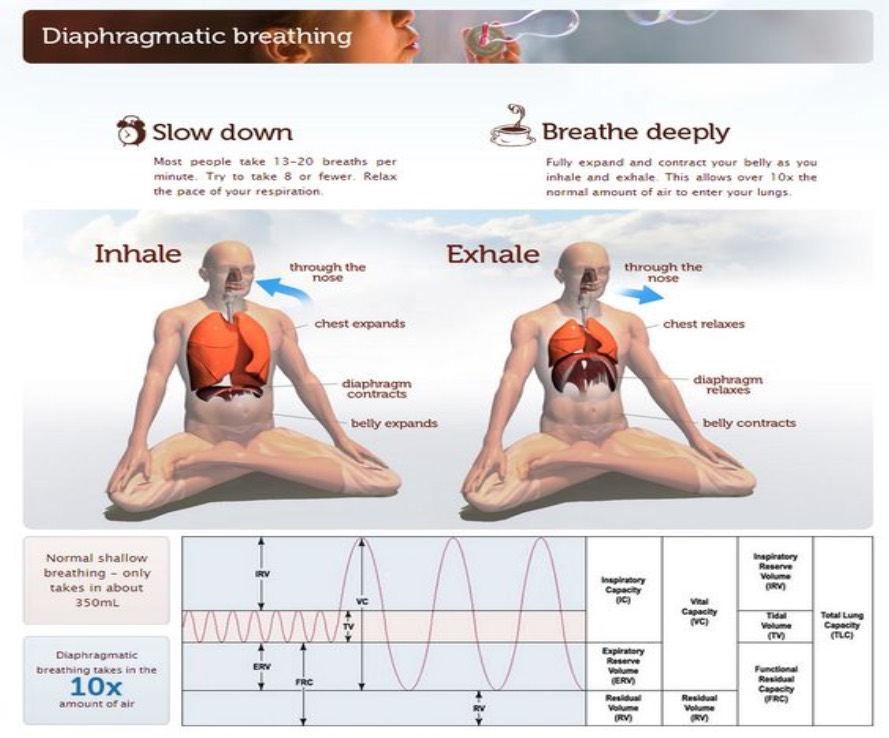
3-part diaphragmatic breathing practice
Sit in a comfortable, easy pose on a chair or sitting. With eyes closed; inhale, expand the belly like a balloon. Exhale, gently contract navel towards the spine and soften stomach and lower back. Six slow, smooth, long deep breaths; for about a minute. Cultivate focus, concentration, stability, and calmness.
Now place your hands on either ribcage to get biofeedback from body-to-brain.
Inhale and expand the ribcage front, sides and back. Exhale, gently contract ribcage and soften heart, lungs and diaphragm. Exhale into the tension-point.
Observe how the diaphragm acts as the primary muscle for respiration and feel how the breath feels when it connects to the heart and lungs. Healing breathing. Six breaths for about a minute. Eyes closed. Seed of a smile transforms practice.
Place hands on collar bones for upper chest breathing. Breathe into the palms and expand your upper chest. Exhale, soften upper back, neck and shoulders. Inhale, expand. Exhale, soften. Explore unifying stability and comfort. Everywhere engaged but not tense. Six breaths for about a minute. Eyes closed - inner-worlds lit-up.
Combine all three ways of breathing. Place right-hand at navel and left-hand at heart-centre. Inhale, expand upper chest, ribcage, belly. Exhale navel to spine gently and melt away tension with ease. Six full yogic breaths for about a minute.
Hands resting on knees. Just sitting. Breathe. Feel. Connect. Just be aware.
Experience the benefits of nostril breathing and breathing deeper into the diaphragm, "a key skill, a foundation for good breathing which will take you less than fifteen minutes." Breathe with your abdomen | Dr. Ganesh Mohan | Svastha.net - YouTube Let Ganesh Mohan expertly guide you to zoom-in on the art of breathing. And as the 16th Century proverb says, the proof is in the pudding.
In many ways, the breath can be seen to act as the neutral monist's third substance which connects body-and-mind via the CNS which connects-everything-to-everything-else. And all things shall be well, and all manner of things shall be well.
Nostril breathing and deep belly diaphragmatic breathing dramatically improves health and wellbeing on so many metrics; reducing snoring and sleep apnea (disrupted breathing) and cultivating longer and more restful Delta wave deep sleep; and sleep is a vital foundation for a happier, healthier and longer life. Poor sleep equals grumpy monkey. Good sleep be like Magic Monkey flying on his Monkey Magic cloud. Monkey (TV Series) Opening Song (Monkey Magic) - YouTube
Another key benefit of nasal breathing is that it increases nitric oxide by up to six times, and carbon dioxide (CO2) in the blood. Both chemicals are vasodilators; they widen capillaries, relax blood vessels and muscles and increase oxygenation to the cells. This is vital for a healthy immune system and helps fight or reduce symptoms for viruses responsible for flu and COVID-19.
“Yoga is a psycho-somatic approach that increases physical, mental, emotional and spiritual strength, and connection. Yoga practice enhances innate immunity and mental health, so it can be used as complementary therapy in the COVID-19 treatment, namely the post-COVID-19 condition. In this article, we conducted a literature review on yoga and COVID-19, finding that an intervention comprising asana, pranayama, and meditation may be a strategy of choice for these patients’ recovery. However, further studies are needed to show its effectiveness in this, still unknown, context.” Yoga for COVID-19: An ancient practice for a new condition - A literature review - PMC
Slowing down the breath to around 6 breathes per minute - consciously modulating and regulating the CNS to maintain a steady state of equilibrium - builds optimal tolerance and sensitivity to CO2 which determines bioavailability of oxygen to the tissues and cells. Nostril and coherent diaphragmatic breathing act as a foundation to maintain a steady state of homeostasis and supercharges overall health and emotional and mental wellbeing; cultivating optimal peak brain performance.
The essence of James Nestors decade long journey into the breath led him to some key insights drawn from ancient wisdom and verified by modern science: breathe through the nose and learn optimal diaphragmatic breathing, cultivate a calming and soothing parasympathetic response by focusing on longer exhale, breathing slower, breathing deeper, breathing less; counterbalance this by breathing in many different ways, fast, slow, not at all, explore the entire bandwidth of sensations-to-mind-states, and mindfully chew since "ninety percent of the obstruction in the airways occurs around the tongue, soft palette, and tissues around the mouth."
Patrick McKeown has extensively explored the art and science of breathing and describes optimal nasal breathing from the perspective of three dimensions for functional breath training: "Biochemical, Breathe Light; Cadence, Breath Slow; Biomechanical, Breath Deep. This is easy to remember if you use the acronym LSD." The Breathing Cure. Breathe - endogenous LSD - a natural heightening.
“The Yoga Sutra (II.50) emphasizes breath regulation in the form of long (dīrgha) and smooth or subtle (sūkṣma) breathing. These are key instructions on the practice of pranayama. This is also why we find breath regulation emphasized in asana practice itself in the teachings of Krishnamacharya. We do ujjayi breathing in asana to develop the skill of regulating the breath - making it longer and smoother. Breath regulation is a key to balance body, mind, and senses.” A. G. Mohan. One of a handful of long-term students of Krishnamacharya - entwining the third-and-fourth limbs-together - asanas (postures) with pranayama (breathe regulation) - yoga is now a multidimensional practice within the same timeframe - the practice of moving into stillness.
The benefits of nasal breathing when combined with deeper and slower diaphragmatic breathing are synergistic in cultivating beneficial conditions - optimal biofeedback and neurofeedback - forming CNS connections between the body-breath-and-mind-continuum and balancing the nervous system, and so the autonomic nervous system can now be self-regulated through the breath. In this way, yoga is a self-healing holistic therapy, yoga as an embodied and interconnected way of life.
"By various means, in various ways, in various eras of human history, all these pulmonauts discovered the same thing. They discovered that the optimum amount of air we should take in at rest per minute is 5.5 litres. The optimum breathing rate is about 5.5 breaths per minute. That's 5.5-second inhales and 5.5-second exhales. This is the perfect breath. Asthmatics, emphysemics, Olympians, and almost anyone, anywhere, can benefit from breathing this way for even a few minutes a day, much longer if possible: to inhale and exhale in a way that feeds our bodies just the right amount of air, at just the right time, to perform at peak capacity. To just keep breathing, less." James Nestor, Breath. The New Science of a Lost Art.
Similarly, Patrick McKeown observes "Countless studies have demonstrated that reducing the cadence of breathing to 6 bpm optimizes oxygenation, stimulates blood pressure receptors, reduces dead space in the lungs, curbs the onset of inflammation, increases Heart Rate Variability, and builds vagal tone." The Breathing Cure. The scientifically proven benefits of breathing are breathtaking.
In 2012, during my yoga teacher training in Rishikesh at Anand Prakash Ashram, I pondered a few key questions before asking Vishva-ji: "About how long should each breath last?" Vishva-ji wobbles his head from side-to-side before calmly replying, "Umm, around ten seconds for each breath. About six breaths per minute."
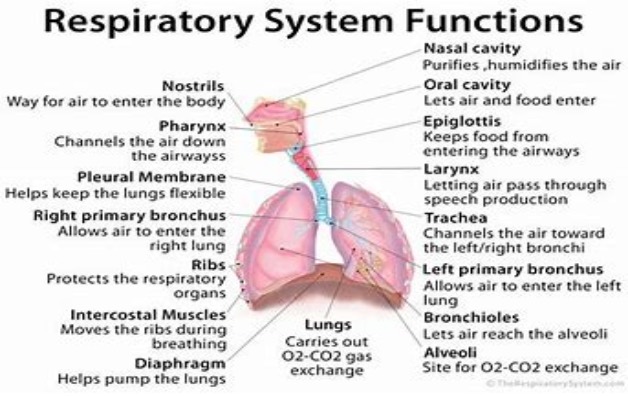
“The diaphragm is a thin skeletal muscle that sits at the base of the chest and separates the abdomen from the chest. It contracts and flattens when you inhale. This creates a vacuum effect that pulls air into the lungs. When you exhale, the diaphragm relaxes and the air is pushed out of the lungs. It also has some non-respiratory functions as well.” Diaphragm: Anatomy, Function, Diagram, Conditions, and Symptoms (healthline.com)
“In this Yoga for lungs Yoga class, we bring you an effective yoga practice aimed at cleansing and strengthening your lungs amidst the challenges of our modern environment. With the ever-increasing pollution, dust, and chemicals in our surroundings, it's essential to prioritize the health of our lungs. Our specially designed daily yoga routine for lung health will help you breathe easier, clear out toxins, and promote overall well-being.” Yoga for Healthy Lungs | Clean & Strengthen Your Lungs Daily - YouTube
“Anxiety is an issue that seems overwhelming but can be overcome. Ease your body and nervous system into a state of calm and surrender with the guidance of Himalayan Yoga Master Yogrishi Vishvketu. This practice would be ideal for a stressful portion of your day or near bedtime. Allow the movement, Vishva-ji’s words, and the sound of the Ganges River to soothe your body and mind.” Yoga to Help Anxiety | Ease Away from Anxiety | Relax Your Nervous System We are making here - three gentle honeybees.
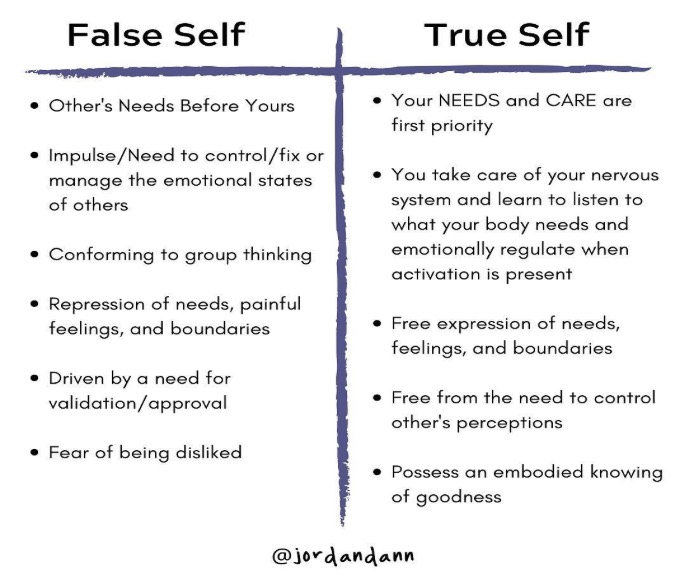
Pause. Notice your bodily posture. If comfortable, close your eyes and observe inward. Observe your body like an internal heat-map and become aware of the breath, spine and sensations. Make a mental note of any noticeable tension points and tender hotspots. Breathe and be mindfully aware for one-minute.
Now open your eyes. And as Mingyur Rinpoche says, “and the essence of meditation is...awareness.” Now you have awareness. Now you can be more mindful of cultivating beneficial habits and letting go of afflictive patterns and being like an embodied psychologist and turning temporary states into longer lasting traits.
Modern lifestyles tend to cause repetitive and habitual patterns such as slumping in couch potato and lying-in sedentary poses which causes weight-bearing on the lower back, spine, neck and shoulders like a cascade of dominoes. Similarly, tech-neck and neck and shoulder tension are caused by gazing down and staring too long at computer screens, laptops, mobile phones and tablets, creating a curved and slumped spine, causing thoracic spinal compression and neck and shoulder pain. These modern habitual patterns can lead to long-term pain and herniated - also known as slipped, ruptured or bulging discs - and sciatica which are becoming more and more common modern aliments - a heatmap of inflammation and pain.
Morning NECK MOBILITY DRILL That's Life Changing! Dr. Mandell - YouTube “These neck mobility drill exercises are very beneficial for your neck health. They are designed to restore motion back into the joints of the neck so proper function and healing can be restored.” Dr. Mandell has a masterful ability to zoom-in and dissect anatomical problems and sequence movement patterns to explore pain-free range-of-motion. Using visual imagery of the spine magnifies visual learning and illuminates interoception and deepening practice with more mindful awareness and paying attention with kindness. The art and science of exploring movement.
3 Exercises to Alleviate Arm Nerve Pain (youtube.com) “Today' video covers rehab exercises for pain related to the three primary peripheral nerves that start in the neck and run down the arm.” Zooming-in on the median nerve, the ulnar nerve, and the radial nerve; Dr. Tom Walters, DPT expertly dissects neck and arm nerve pain to alleviate numbness, tingling and pain sensations that run through the arms. Nerve mobilizations are also great for a deeper, restful sleep; waking up fully recharged.
Fix your neck with neurology - YouTube Let Elice De Giovanni guide you to explore the lymphatic and glymphatic system, and release tension from the neck and shoulders; brain changing movement. Her skillset - a wide range of movement patterns to enable the lymphatic system to flow; improving overall wellness, flexibility, and pain relief.
We can add Eastern insights into syncing breath with movement in yoga practice.
Now exit the material Matrix of your room and teleportal to the banks of Rishikesh and practice beside Vishva-ji on the shores of Ma Ganga and connect to the healing power of yogic breathing and prāṇa. “Use imagination.” And be like Neo and download happy-neck-and-shoulders and let Vishva-ji guide you like Morpheus.
“Eyes closed. Lift crown. Shoulders back and just healing breathing. Your able to heal, your able to recharge yourself, with breathing, with movement.” Yogrishi Vishvketu. “Neck and shoulder pain can be a result of stress or bad posture. Release tension with this gentle yoga class guiding you into a series of poses that will deeply stretch the muscles. Your neck and shoulders will feel wonderful after you're done.” Yoga for Neck and Shoulders tension release - YouTube. (45 mins).
“If you know what this is because you have it or have had it, this video serves as a safe, effective self-administered therapy. And if you are not familiar with Thoracic Outlet Syndrome, this practice serves as a great preventative and can also help to keep you from getting the "Old Age Posture" (aka kyphosis with head forward). If you are looking for more movement for the thoracic spine, try last week's video "Thoracic Spine Mobility".” Thoracic Outlet Syndrome Therapy with Nerve Gliding & Somatic Yoga - YouTube A 32-minute somatic masterclass leaving your neck feeling pain-free and feeling elongated like ET. Megan MacCarthy, nerve flossing the neck; feel embodied.
Synthesis, blending Western scientific insights with Eastern wisdom. E = MC²
"Japanese, African, Hawaiian, Native American, Buddhist, Taoist, Christian - these cultures and religions all had somehow developed the same prayer techniques, requiring the same breathing patterns. And they all benefited from the same calming effect...prayer heals, especially when it's practiced at 5.5 breaths a minute." James Nestor, Breath. Slow coherent breathing maintains homeostasis which cultivates optimal conditions for healing. And the art of breathing is to feel how the breath feels and connect to prāṇa and the practices of prāṇāyāma, “healing breathing,” the art of connecting to the breath and being sensitive to the flow and healing power of prāṇa - vital lifeforce energy - purifying the mind-and-senses - nadis - the electric-light-body.
Many ancient and indigenous cultures came up with a word to describe what they felt through the currents of their bloodstream - an interoceptive sensitivity to this flow of universal energy - giving rise to ways of practicing harnessing this energy - yoga, Tai-Chi, Rei-ki - practices designed to explore this healing lifeforce energy carried within the breath - Chi in China, Ki in Japan, Prāṇa in India, Mana in Polynesia, Ruach in Hebrew, Baraka in Islamic countries, to name but a few.
Beyond the physical senses and beneath the material level, there exists the level of excitation, vibration, frequency and energy within the physical form; this universal lifeforce energy interpenetrates and interconnects everything-to-everything-else. In Shamanic traditions, this lifeforce energy within the plant medicine acts as an antenna beam to connect to the God-Goddess who communicates from within the plant and guides the receptive Shaman on their healing path and journey to seek plant allies, and the forest becomes alive like an Avatar-lit world; Mother Earth, the universal mother waking, healing and nurturing, and the path is the way.
“In truth, ayahuasca is the television of the forest...According to Eliade, the shamanic ladder is the earliest version of the idea of an axis of the world, which connects the different levels of the cosmos, and is found in numerous creation myths in the form of a tree.” Jeremy Narby, The Cosmic Serpent: DNA and the Origins of Knowledge. A beautiful exploration of Shamanism and plant medicine.
Māori culture, “Mauri is an energy which binds and animates all things in the physical world. Without mauri, mana cannot flow into a person or object. The idea that mana can flow into the world through tapu and mauri underpinned most of Māori daily life. For example, sacred stones possessing mauri were placed in fishing nets, where they were able to attract fish.” And this is what the ancients knew; inner-lit pathways back to the stars - non-dual communion with the ultimate source of divine-light - singularity - be the still point within the outer whirlwind.
One of my all-time favorite movies is Whale Rider, a 2002 New Zealand movie exploring what it is to live in a Māori culture within the modern world. The film stars Keisha Castle-Hughes as Kahu Paikea Apirana, a twelve-year-old Māori girl whose ambition is to become the chief of the tribe. Her koro Apirana believes that this is a role reserved for males only. Upon its release, the film received critical acclaim. At age 13, Keisha Castle-Hughes became - at the time - the youngest nominee for the Academy Award for Best Actress. Her performance is electric and filled with mauri and mana, as is the movie from beginning to end.
And so, when I read James Nestors' and Patrick McKeown’s words about the scientific effects and benefits of diaphragmatic and nostril breathing in 2022; they felt visceral and numinous like mana from Heaven; neon-lit and synchronistic, time-dilated and transmitted from a higher source. Re-planting the foundation of the breath in the West using modern science to verify what the ancients knew; it is the breath and lifeforce energy which interconnects-and-interpenetrates-everything.
Nostril breathing - as opposed to mouth breathing - goes through the nasal passage which performs at least thirty functions; this has many benefits including oxygenating the blood, organs, and cells; filtering and purification of the air we breathe-in and regulates heat, pressure and inflammation. How we breathe affects every system within the body, heartbeat, circulation, digestion, how your brain operates. Post-2020 and the rise of the global COVID-19 pandemic and subsequent lockdowns and health measures; breathing, inflammation, circulation, and CNS regulation are now even more vital. This one fundamental change can dramatically transform your life.
“I found that almost everything that the ancients had figured out thousands of years ago in regard to breathing and especially breathing through the mouth or nose is now supported by modern science." James Nestor. At this point, can I say I love James Nestor like Jerry Maguire says, "I LOVE BLACK PEOPLE!"
5 Ways To Improve Your Breathing with James Nestor - YouTube; Optimize your breathing: BREATH by James Nestor | Core Message - YouTube, or visit MRJAMESNESTOR or read his beautifully written deep dive into Breath, The New Science of a Lost Art. It reads like a compelling adventure-mystery novel meets detective sci-fi and like Craig Revel Horwood exclaims “UN-BE-LIEV-AB-LE!”
Patrick McKeown meets James Nestor, author of Breath The new science of a lost art - YouTube (53 mins) Two experts in the field of breath discuss their shared passion for the science and art of breathing, and why the breath should be considered a vital foundation - alongside diet and exercise - for a self-sustainable, happier, healthier and longer life, nurturing oneself from within; connecting to the breath and consciously up-and-down-regulating and balancing the CNS to maintain homeostasis and optimal brain functioning, modern science now verifying what the ancients knew. And me be like Stan Laurel, “I couldn’t have said it better myself.”
The Breathing Cure, Patrick McKeown An essential guide to the science and practice - the ‘how’ and the ‘why’ - of functional breathing. "Breathing impacts every aspect of health - sleep, digestion, movement, mental wellbeing, disease and recovery...it's an extraordinary resource with life changing potential, and it's simple, free and available to everyone." The Breathing Cure - Oxygen Advantage.
The Influence of Breathing on the Central Nervous System - PMC (nih.gov) “Abstract: The functions of the diaphragm do not stop locally in its anatomy but affect the whole-body system. The respiratory rhythm, directly and indirectly, affects the central nervous system (CNS). This article describes and reviews these influences, containing, for the first time, information on this subject in a single text. The ability of breath to move the brain mass and determine patterns of neural oscillation will be discussed. The role of the diaphragm in influencing motor expression and its effect on intracranial blood shifts in respiratory activity will also be discussed. It is known that the diaphragm can have multiple uses in improving the symptomatological picture of chronic diseases, but there is no current, concrete data on the effects that the rehabilitative training or manual approaches could have on the patient; in particular, on his/her cognitive and cerebral aspects in general.”
Spoiler Alert. “Conclusions. In its contractions, the diaphragm muscle has systemic functional reflexes that are not only related to changes in tissue oxygen. In this article, we reviewed some functions not yet well explored, such as the neural oscillations, the movement of the brain mass, the influences that the breath has on motor activities, and the electrical responses of the brain at low voltage (the latter through variations of blood intracranial pressures). The diaphragm still has many mysteries to be unveiled, not only on the functions it exerts in the body system but also on the usefulness that a manual approach can have on the patient. Resuming the work of Morgado-Valle (in the bibliography), we can conclude with this reflection: Breath has patterns. Schemes create behavior. Breath is a behavior. Behavior represents the person. Breath reveals the person.” A scientific meta-review exploring all things related to the diaphragm, breathing and the CNS and its measurable and immeasurable benefits.
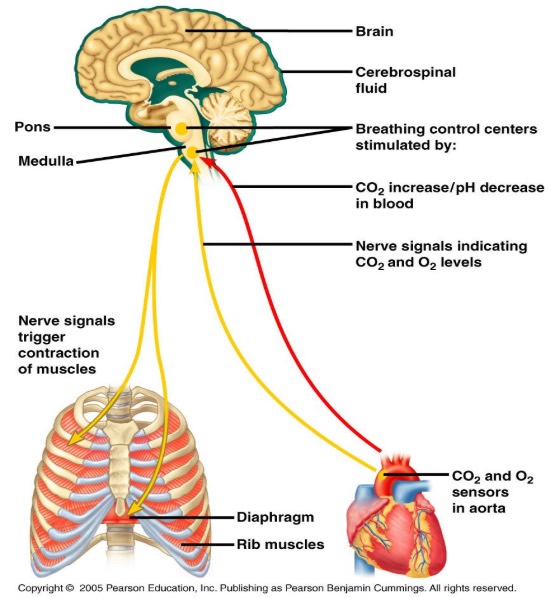
Coherent breathing and CNS regulation are E=MC² superpowers for physical, emotional, mental and overall health and wellbeing; which science is only now beginning to explore; revealing both its measurable and immeasurable placebo categorized benefits; that which is beyond the measure of science. Without the capacity to sufficiently breathe, there can be no sustainable life. Breath, lifeforce giving energy and the sustainer of life. Two entwined images come to mind; a materialist's brain exploding like a watermelon in Scanners and cognitive dissonance on a par with Nicolas Cages’ face being eviscerated in Face/Off. Breath has patterns.
Chi, Ki, Prāṇā by any other name; “woo-woo” to a materialist since it is beyond the external gazing five senses and beyond the discursive mind. Interoception; turn the five senses inward and entwine-the-five-senses-together; become subtle and sensitive to see-feel-sense-taste-and-touch the inner-world of sensations-and-feelings and become embodied and comfortable in your own skin. And remember, as Bruce Lee teaches, “Don’t THINKK! FeeEEELL!” And as Obi-One echoes, “Feel the Force, Luke.” And this is what the ancients knew that we are only now rediscovering; unbounded universal lifeforce energy; being reborn anew like a phoenix into the fire; psychological death, purification and re-birth, Know Thyself. Schemes create behavior.
The key benefit of coherent breathing is that the autonomic nervous system is no longer automatic. It can now be consciously self-regulated by the breath which connects body-and-mind in biofeedback-and-neurofeedback mechanisms; mind-and-body are now akin to a two-way entangled-superposition-mirror. Breath is a behavior.
Coherent breathing is a vital skill as seen in the central trunk of prāṇāyāma and the many names given by ancient and indigenous cultures to describe universal lifeforce (non-local) energy. And this is what we have somehow forgotten like a species with amnesia - and are only now beginning to re-discover and re-explore like a deep diver exploring the self within. Behavior represents the person. Breath reveals the person.
“There is a text called 'Mindfulness of Breathing' in which the Buddha proposes 16 exercises on mindful breathing. It's very practical. And everyone can do it. Not complicated. You can already notice the effect of the practice after one or two hours. The first exercise is so simple. To be aware of your in-breath and out-breath.” Thich Nhat Hanh. Vietnamese Zen Buddhist master who was nominated for the Nobel Peace Prize in 1967 by Martin Luther King; teaching the essence of mindfulness and paying attention with kindness; everything engaged but not tense. The First 8 Exercises of Mindful Breathing | Teaching by Thich Nhat Hanh | #mindfulness A Zen masterclass.
“This is the long version (36 minutes) of the popular Calm - Ease meditation guided by Zen Master Thich Nhat Hanh. “Breathing in, I know I am breathing in.* *Breathing out, I know I am breathing out.* *In* *Out* Calm - Ease (long version) | Meditation Guided by Thich Nhat Hanh - YouTube Thay, a calm and serene voice - guiding with Zen minimal cues - mind calm like a still lake, breath, breathing itself. In. Out. In. Out.
And so the ancients knew the immense benefits of coherent breathing and regulation of the breath and CNS; integrating theoretical and empirical maps of self-knowledge, practiced alongside experiential first-person embodied-practice - CQ² - the entire bandwidth of human experience - E=MC² - diligently practicing the internal arts and disciplining and training the plasticity of body-breath-and-mind in Tai Chi, yoga, movement and meditation; balancing left-and-right-cerebral-hemispheres, awareness-of-awareness itself; hemi-sync, quantum effects in the breath and brain coherence.
End of chamber 15
Chambers 1 to 35: all 35 chambers open