Ring VI · Return · Chamber 33
DJ Shadow and Neuroplasticity
About 31 minutes to read
“Mirror neurons make human empathy possible.” Nick Morgan.
Neuroplasticity is the brains’ ability to change, adapt and re-organise itself; by strengthening or pruning existing connections, or by growing new neural networks based upon experience. Repetition is vital; it binds neurons together, and neurons that bind together - wire together and become stronger together. Be like an inner-gardener and plant, grow and blossom beneficial states, and uproot and let go of afflictive habits. Maintain coherent breathing and optimise brain coherence. Neuroplasticity is CQ²
Tell them what you are going to tell them. Tell them. Tell them what you have told them. I first learned this lesson during a presentation skills workshop. I apply this triplicate way to pretty much everything in relation to the art of communication.
Mirror-neuron pattern the counter-balancing opposite - unify the divided brain. CQ²
Yogis named the highest state-of-mind Samadhi, complete absorption, total integration between subject-and-object - proprioception, interoception, nociception, exteroception - awareness-of-awareness-itself. Essence of Quantum Human; Tathāgata - beingness-isness-suchness - a unified-field-of-awareness - experiencing reality-as-it-is. E=MC²
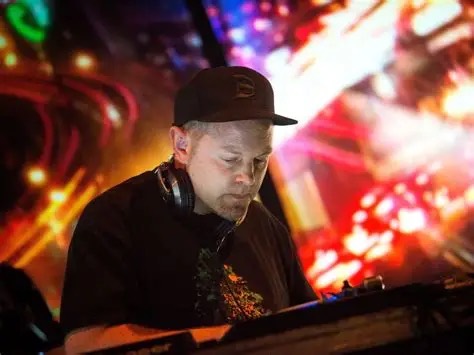
And me being inspired and mirror-neuron patterning DJ Shadow; Endtroducing, his eponymous debut studio album. An American music producer with a prodigious skillset; unparalleled sampling skills - merging beats-upon-beats - fine-honing his rapid-fire scratching and layer-upon-layering techniques, unveiling the layers of musical self-expression on the wheels-of-steel - a fission-and-fusion vinyl master - showcasing his finger flickering dexterity and alchemical turntablism - aligned with creative improvisation - building steam with a grain of sand - conjuring up architectural soundscapes of Zen-like wizardry; being in the groove on the 1’s-and-2's, creativity
flowing and being fluid-in the mix before transitioning to the next interconnected beat -becoming one with the drum; a master of enigmatic melancholy, merging drumbeats of haunting and resonant intensity with the scalpel precision of a neurosurgeon; I’m a student of the drums and I’m also a teacher of the drums too, alchemically transmuting an auditory cathedral in the air, viscerally vibrating inside every living cell, feeling whole-and-complete - feeling alive-and-electrified - explore the inner-realms of Endtroducing - sound vibration - sonoluminescence - sonic-ecstasis - Know Thyself.
“The beauty of DJ Shadow’s creation lies not just in its intricate layering but in the philosophical quandaries it stirs within the soul. In this track, punctuated by samples and a rich, engaging beat, Shadow lays down more than just a musical composition; it’s a journey through the process of artistic creation, the tenacity of life, and the struggle of self-expression...The Universal Human Connection: Shadow’s use of an astrological reference to cancer and its association with the moon opens up a cryptic layer of meaning. By personifying cancer as capable of feeding its astral plane, Shadow potentially speaks to the insidious nature of life’s struggles that slowly assimilate into the very fabric of our being.” Building Steam With a Grain of Salt by DJ Shadow Lyrics Meaning - Unveiling the Layers of Musical Self-Expression - Song Meanings and Facts And me be like Stan Laurel, “I couldn’t have said it better myself.”
Endtroducing; released by Mo Wax in Sept 1996. A landmark in instrumental hip-hop, enabling the listener to mirror-neuron pattern and mimic, imitate and emulate the art of sampling techniques and exquisite arrangements. An enigmatic landmark; cornerstone and timeless benchmark. And this is why I mirror-neuron pattern DJ Shadow.
Dj Shadow Live @ La Route Du Rock 2002 (youtube.com) A fission-and-fusion master of the beat of the drum, sublimely merging Endtroducing with Private Press.
Pure vinyl wizardry and alchemical artistry on multiple decks and like single malt whisky, it keeps getting better with age. "I apologise if I have my head down, I'm gonna be up here concentrating." Concentration, discipline, surrender to the drum; surrender to the immersive flow state. Many Paths. One Stream. Music is life. And life is music.
Quantum jump - mimic, imitate and emulate expert teachers across the entire bandwidth of yin-and-yang and creative self-expression, self-mastery and expressing flow state. And a high-level teacher is one who embodies the qualities of integrating theoretical maps into experiential self-practice; focus, discipline, experimentation, faith, humility, devotion and surrendering to in-finite creative flow states in fine-honing their art and craft. E=MC². In plain English, one who walks-the-walk and talks-the-talk.
Ask yourself, who do you want to mimic, imitate and emulate? What is most vital?
Know Thyself as connected to the cosmos by an in-visible-umbilical-cord connecting a mother, her child. Explore the entire bandwidth of yin-and-yang and counterbalance the opposites like an endless back-and-forth ping-pong game. And world transforms like Bruce Lee entering a Hall-of-Mirrors-to-the-Self. And the Journey is the Way.
“I am a communication theorist and coach and a speaker on storytelling, body language, persuasion and influence. A passionate teacher, I am committed to helping people find clarity in their thinking and ideas - and then delivering them with panache. I have been commissioned by Fortune 50 companies to write for many CEOs and presidents. I have coached people to give Congressional testimony, to prepare TED talks, and to take on the investment community. I have worked widely with political and educational leaders. And I have spoken, led conferences and moderated panels at venues around the world. I am the author of several books including Power Cues.” Are Mirror Neurons A Myth - And What Are They, Anyway? (forbes.com) Nick Morgan. An exquisite short article on why mirror-neurons matter; masterful storytelling aligned with illuminating explanations. E=MC²
“The instantaneous understanding of the emotions of others, rendered possible by the emotional mirror-neuron system, is a necessary condition for the empathy which lies at the root of most of our more complex inter-individual relationships.” What Rizzolatti is saying is that complex human emotions and relationships would not be possible without mirror neurons, because we wouldn’t be able to understand our fellow humans. And understanding is a first step in most human interaction.” Nick Morgan telling the intricate and fascinating story of how Rizzolatti discovered mirror neurons and their explanatory power; sieving myth from truth like Gordon Ramsay with a knife through butter. And at the heart of the matter; what it means to be human; to be emotionally connected and doing the theoretical work and embodying the practice to master your own emotions and mirror neuron pattern empathy and compassion, and any other beneficial sensations-to-mind-states. Consciousness-Quotient-Squared. E=MC²
Mirror neuron pattern mind-body synchrony and brain coherence, feel mirror neuron excitation states, vibration, frequency and resonance; embody through mirror neuron patterning and “mimic, imitate and emulate” the outer-teacher; absorb-adapt-and-integrate. And world like Neo breaking free from the Matrix of self-limiting mental constructs. Merge discipline-and-surrender; explore and optimise flow state. Experience the healing effects of a unified-state-of-mind; ever evolving, empathy and connection.
“Neuroplasticity is the brain's ability to change and adapt due to experience. It is an umbrella term referring to the brain's ability to change, reorganize, or grow neural networks. This can involve functional changes due to brain damage or structural changes due to learning. Plasticity refers to the brain's malleability or ability to change; it does not imply that the brain is plastic. Neuro refers to neurons, the nerve cells that are the building blocks of the brain and nervous system. Thus, neuroplasticity allows nerve cells to change or adjust.” Neuroplasticity: How Experience Changes the Brain (verywellmind.com)
Kendra Cherry, MS, is a psychosocial rehabilitation specialist, psychology educator, and author of the "Everything Psychology Book.” An exemplary and content rich article covering types of neuroplasticity - functional and structural - benefits and characteristics of neuroplasticity, ongoing process, limitations; ways to improve neuroplasticity, learn a new language, creative pursuits, travelling and exploring, exercise regularly, practice mindfulness, play games; so many ways neuroplasticity can be cultivated and optimised - use it or lose it - improve brain functioning; plasticity is an innate superpower, muscle-brain-training. Malleability; balance the opposites and be like Morph and Chaz; or any other counterbalancing double act. E=MC²
“The relationship between learning and neuroplasticity is twofold. Learning new things enhances brain plasticity, and because of the brain’s ability to adapt to change, you’re able to learn.” Neuroplasticity: How to Rewire Your Brain to Change Old Patterns (psychcentral.com) Another content rich article. And repetition is vital. As the neuroscientist saying says; neurons that bind together become stronger together.
Teach & Learn Better With A "Neuroplasticity Super Protocol" - Huberman Lab - Huberman Lab Andrew Huberman provides a comprehensive and scientific roadmap to optimise neuroplasticity. Get alert. Get focused. Generate repetitions. Expect & embrace errors. Insert micro-rest intervals (at random), use random intermittent reward, limit learning sessions to 90 mins, after a learning bout, do a NSDR (non-sleep deep rest) protocol, get quality and long deep sleep. This article; laser beam precise.
Quantum Human - merge mirror neuron patterning with neuroplasticity and optimise peak performance and flow state. Self-mastery begins with self-regulation. And it is the breath which bi-directionally connects body-and-mind via the CNS; non-dual, not two.
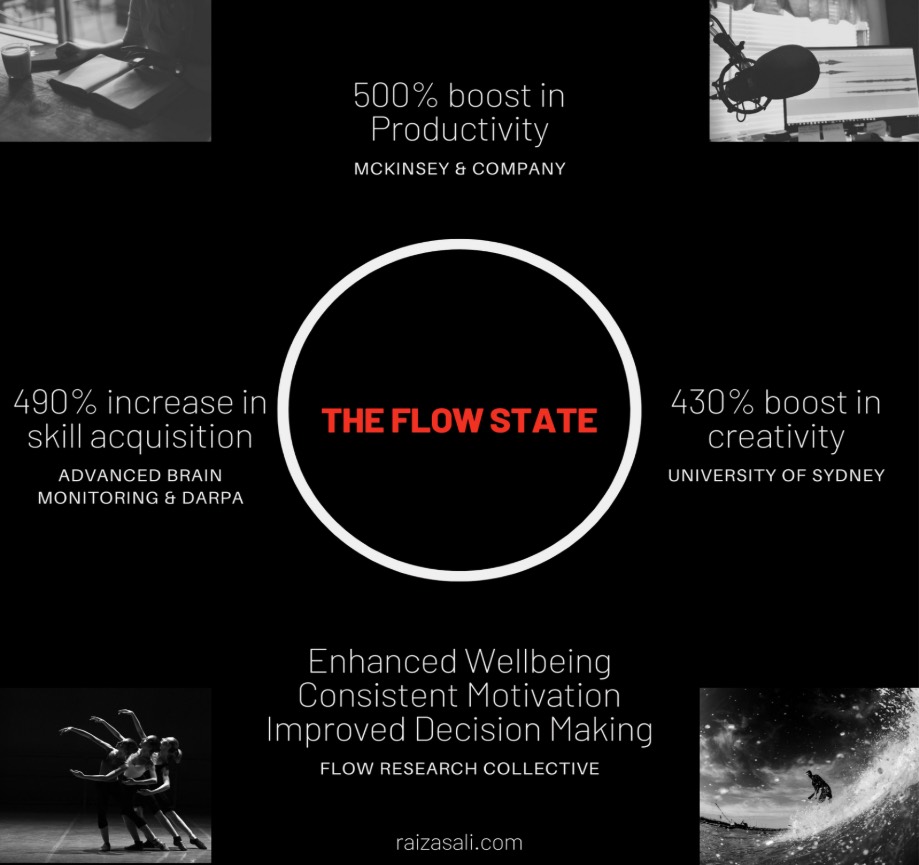
“The flow state is ubiquitous, meaning, it can show up for anyone, at any time, provided certain preconditions are met. The spectrum experience of flow can range from micro to macro flow for both the individual and the group. Mihaly Csikszentmihalyi, often referred to as the “Godfather of Flow Psychology”, described flow as follows:
"In the flow state, action follows upon action according to an internal logic that seems to need no conscious intervention by the actor. He experiences it as a unified flowing from one moment to the next, in which he is in control of his actions, and in which there is little distinction between self and environment, between stimulus and response, or between past, present, and future" The Flow State: Exponential Human (raizasali.com) A masterful overview of what flow state is and how flow state feels; selfless, timeless, effortless, richness. Echoing SAT-CHIT-ANANDA. Existence-Consciousness-Bliss.
“In the bestselling Flow: The Psychology of Optimal Experience, psychologist Mihaly Csikszentmihalyi introduced a radical new theory of happiness. Through years of systematic research, he discovered that what makes people truly satisfied is to be actively involved in a difficult enterprise - a task that stretches physical or mental abilities. Whether it involves climbing a mountain, reading, or solving a complicated business problem, such activities lead to flow, a rare state of consciousness that focuses the energies of those who experience it and helps lift them above everyday anxieties.
Flow concluded with a vision of transforming life into a unified flow experience, and it is both that possibility and the development of the necessary faith that underlies it that are the subject of its sequel, The Evolving Self. But where, Csikszentmihalyi asks, do we find such faith at the twilight of the second millennium, when traditional religions have lost much of their force and relevance, when the prospects of genetic engineering and atomic annihilation present us with profound moral dilemmas? The answer, he believes, is in evolution, for only by understanding our evolutionary heritage - the genetic and cultural forces that have formed us - can we overcome it and achieve "the good life" by giving purpose and order to our futures.
The key to this process is learning to develop complexity in our consciousness - to acquire many interests, abilities, and goals and to use them in such a way that they harmonize with and enhance one another. It is flow experiences, in fact, that are the source of complexity, not only for individuals, but ideally for society as a whole, for flow has provided the energy and direction for some of our most significant historical advances, from religious systems to technology.
Ideally, flow can even guide us to transcendence, in which we not only live by the enriching principles of an evolutionary faith, but also learn to foster the potential inherent in the cosmos. The Evolving Self is, like its predecessor, Flow, a book as profound as it is practical, a genuinely inspiring and provocative challenge to its readers to reconsider their role in creating not only themselves, but also the future of the species.” The Evolving Self. Mihaly Csikszentmihalyi.1 Know Thyself. I AM.
“We know the nature of the self (atma) is conscious existence because existence is only recognized as such due to consciousness of it - and consciousness is self-evidently existent.
We know that conscious existence is limitless because all objective phenomena are only recognizable due to their existence within a “field” of conscious existence.
Even time and space (the fundamental parameters by which objects are defined) are objects whose existence is only recognizable due to their appearance within a “field” of conscious existence.
Thus that “field” of conscious existence itself must be beyond (i.e., not subject to) all limiting parameters and, thus, limitless.
This “field” of limitless conscious existence is referred to as the self (ātmā) - because it is the fundamental reality, or essential aspect, of all things.
And since there can be only ONE fundamental reality - thus the fundamental reality of the total must be the fundamental reality of the apparent individual. Since the apparent individual is a part of the total.” Sat Chit Ananda Meaning (yesvedanta.com) Andre Vas, Acharya Andre, teaching and language usage based on Swami Dayananda (Arsha Vidya) lineage; connecting-to-the-Self like a wave-to-the-Ocean-of-Existence.
“Jackson and Csikszentmihalyi conducted the initial research and proposed that the altered state of consciousness that characterises flow has certain experiential dimensions. However, research led by Jamie Wheal and Steven Kotler, argues that the “Flow Triggers'' are causal to flow and not merely experiential. There are 22 flow triggers that have been identified and more are currently being researched. These are broadly categorised under the following: Individual Flow Triggers, and Group Flow Triggers. The clever use of these triggers can help your brain to release the right set of neurochemicals that prime your system for flow.” 22 Flow Triggers: The Ultimate Peak Performance Toolkit For Hacking Flow (raizasali.com) Raiza Sali, Neuro Somatic Practitioner. Science. Creativity. Humanity. CQ² - 22 Flow Triggers - E=MC²
“What does it take to be your best when it matters most? Author of 7 bestselling books, Pulitzer Prize nominee, and Director of Research at the Flow Genome Project, Steven Kotler studies ultimate human performance, what is actually possible for our species, and where - if anywhere - our limits lie. Steven Kotler is a New York Times-bestselling author, an award-winning journalist and cofounder and director of research for the Flow Genome Project. He is one of the world’s leading experts on ultimate human performance.” How to open up the next level of human performance | Steven Kotler | TEDxABQ (youtube.com) Steven Kotler; self-mastery, dedicated to his art and craft.
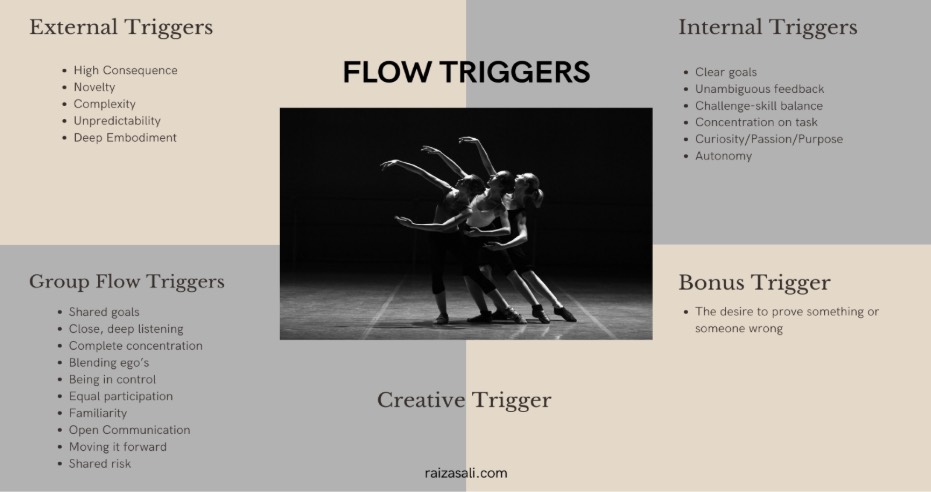
Quantum Human; mirror neurons, neuroplasticity, flow state
Mirror neuron pattern high-level teachers and masters of creative expression, explore the entire bandwidth and cultivate the counterbalancing opposite - become ordered-and-unified - body-breath-and-mind in synchrony; breath coherence and returning to baseline and homeostasis with comfort and ease, maintaining optimal peak brain performance; Samadhi, complete absorption, being in the zone, merging discipline and surrender, effortless-effort; flow state like a surfer surrendering to the wave, everything-acting-as-one like a Bose-Einstein condensate; feel a unified-field-of-pure-awareness -
embodied wholeness like gazing from a mountain summit and observing a clear and unbounded sky. Be like an inner-gardener and plant grown and blossom beneficial states and uproot and let go of afflictive habits. And to do this, balance the divided brain by mirror neuron patterning the counterbalancing opposite; mirror neuron pattern teachers who exhibit beneficial qualities and traits; masters of self-regulation and brain coherence like DJ Shadow is to the beat of the drum. And repetition is vital. E=MC²
“Just feel what the wave is doing. Then accept its energy, then sync with it, then charge with it...It’s a state of mind. It’s that place where you lose yourself and find yourself.” Patrick Swayze as Bodhi teaching the Tao of Surfing - experiential kenosis - self-emptying - flow state. Point Break (1991) - State of Mind (youtube.com)
Quantum Human - in yogic terms, samadhi, complete absorption between subject- and-object; shifting from single-pointed concentration upon the object, (dharana) and becoming more-and-more deeply absorbed; merging inside-and-outside in homeostasis-and-symbiosis; integrating subject-and-object in deepening meditation like a deep diver exploring the ocean within, merging discipline-and-surrender like a surfer riding the crest of a wave, Samadhi - at one with the wave - limitless-fullness.
Self-mastery begins. “The humility and dedication of continuously being both a student and a teacher reflect a commitment to mastery that resonates with anyone keen on perfecting an art form. The drums, symbolic of the heartbeat of his music, echo the core of his sustained, ever-evolving rhythm.” Building Steam With a Grain of Salt by DJ Shadow Lyrics Meaning - Unveiling the Layers of Musical Self-Expression - Song Meanings and Facts And The Path Is The Way. Many paths. One Stream. What my Zen Buddhist Quaker Faith Healer friend, Jim Pym, taught me. May you rest in peace.
10 Best Neuroplasticity Techniques to Transform Your Brain | My Brain Rewired Mindfulness, meditation techniques and their benefits, physical exercise, cognitive training and brain games, brain apps, learning new skills, diet and nutrition, social interaction, sleep and rest, stress management, creative activities, visualization and mental rehearsal, neurofeedback and biofeedback, nature and outdoors, gratitude and positive thinking, music and dance, reading and mental stimulation, technology and apps, habit formation. An exceptional content rich article. So many ways to train your brain. A little bit every day is better than a longer practice less frequently.
Neuroplasticity - Benefits for Physical and Mental Health and Wellbeing
“Who looks outside, dreams; who looks inside, awakes.” Carl Gustav Jung, Swiss psychiatrist and psychoanalyst; founder of analytical psychology.
The implications of neuroplasticity are far-reaching and can potentially transform our understanding of the brain and its role in our overall health and wellbeing. By harnessing the power of neuroplasticity, we can:
Enhance cognitive function: engaging in mentally stimulating activities, such as learning a new language or playing a musical instrument, can help strengthen neural connections and improve memory, attention, and problem-solving skills.
Promote emotional well-being: practices like mindfulness meditation and cognitive-behavioral therapy can help rewire the brain to manage stress, anxiety, and depression better.
Support recovery from brain injury and disease: neuroplasticity plays a crucial role in the brain’s ability to recover from stroke, traumatic brain injury, and neurodegenerative diseases like Alzheimer’s and Parkinson’s.
Maintain brain health throughout life: By adopting lifestyle habits that promote neuroplasticity, such as regular exercise, a healthy diet, and social engagement, we can help keep our brains sharp and resilient as we age.
In this section, we’ll delve deeper into the science behind neuroplasticity and explore specific techniques and strategies for optimizing brain health and function.
Neuroplasticity Techniques: As we reflect on the journey we’ve undertaken, let’s revisit some of the key neuroplasticity techniques and their benefits:
Mindfulness and Meditation: These practices promote increased focus, emotional regulation, and self-awareness while enhancing brain connectivity and neurogenesis.
Physical Exercise: Regular physical activity, including aerobic exercise, strength training, and coordination activities, supports neurogenesis, increases blood flow and oxygenation to the brain, and promotes the release of neurotrophic factors.
Cognitive Training and Brain Games: Engaging in structured cognitive exercises and brain games can improve specific cognitive abilities, such as memory, attention, and problem-solving skills, while promoting the formation of new neural connections.
Learning New Skills: Acquiring new skills, whether it’s a language, musical instrument, or artistic pursuit, challenges the brain to form new neural pathways and integrate various cognitive processes.
Diet and Nutrition: Consuming a brain-healthy diet rich in nutrients like omega-3 fatty acids, antioxidants, and B vitamins can support neuroplasticity and protect against cognitive decline.
Social Interaction and Positive Thinking: Building strong social connections and cultivating a mindset of gratitude and optimism can enhance emotional well-being, reduce stress, and create a conducive environment for neuroplasticity.
Creative Activities and Visualization: Engaging in creative hobbies, such as art, writing, or music, and practicing visualization techniques can stimulate the growth of new neural connections and promote cognitive flexibility.
Nature and the Outdoors: Spending time in natural environments can reduce stress, improve mood and attention, and stimulate creativity and problem-solving abilities, all of which support neuroplasticity.
Technology and Apps: While moderation is key, leveraging technology and apps for cognitive training, mindfulness practices, and neurofeedback can provide valuable tools for enhancing neuroplasticity.
Habit Formation: Consistently implementing these neuroplasticity-enhancing practices and creating positive habits is crucial for sustaining long-term brain health and cognitive vitality.”
My Brain Rewired | Rewire your brain with the power of Neuroplasticity
Identify. Replace. Succeed. Mimic. Imitate. Emulate. In this way, fission-and-fuse mirror neuron patterning experts in their fields; mimic, imitate and emulate experts in a wide bandwidth of spheres - counterbalance the opposites - exponentially optimise coherent breathing and brain coherence - mirror neurons, neuroplasticity, flow state, Samadhi - Absorb-Adapt-Integrate - a unified-field-of-awareness - E=MC²
Neuroplasticity. Use it or lose it. Be like Morph and Chaz. Tell them what you are going to tell them. Tell them. Recap. Tell them what you told them. And repetition is vital.
Rewind and sampling back to Nick Morgan and DJ Shadow.
“Memorable Lines: The Essence of Artistic Vulnerability ‘And I would like to able to continue / To let what is inside of me / Which is, which comes from all the music that I hear / I would like for that to come out / And it’s like, it’s not really me that’s coming / The music’s coming through me.’
These lines encapsulate Shadow’s emotional honesty and the crux of his aspirational journey. There’s a raw vulnerability here, a longing for pure expression that is at once personal and universal. The disarming candor becomes a memorable moment, etching in listeners a sense of kinship with the artist’s quest.” Building Steam With a Grain of Salt by DJ Shadow Lyrics Meaning - Unveiling the Layers of Musical Self-Expression - Song Meanings and Facts Connection between musician-and-listener and building kinship with the artists individual and universal quest - creative essence - being at one with the beat of the drum and the written word, sustaining an ever-evolving flow state.
Why try to change the outer-world? Why not try the far easier task of transforming yourself first and begin the journey of self-mastery and exploring and cultivating flow state, and to do this safely and navigate new neural pathways; mirror neuron pattern expert teachers; those who have mastered their own states-of-mind. CQ²
DJ Shadow’s Groove
At the temple of vinyl, a needle descends
a grain of sound; a universe swirls
beats building steam with a grain of salt,
layer on layer upon memories’ vault.
The record spins finger flickering dexterity,
music flows through his electric body.
A shadow moves at a quarter past midnight,
reverberating silence and nocturnal prayer.
A master of sampling connected fragments,
flowing architecture to the beat of the drum,
forging unified order within a chaotic field.
Dogen ‘A Painting of a Rice Cake’ - Painting Unsurpassed Enlightenment
This book-blog morphs and spirals into poetic prose - painting heightened snapshots -rapid-fire eye-blinks - words-and-images fused together - painting numinous reflections - building steam by layer-upon-layering - painting a steady stream along the path and way of enlightenment - all is non-linear, non-rational, spiralling and tangential - a poetic vein with the aim of triggering the saccades - painting in words a multidimensional reality - a self-reflective world - interdependent and mutually arising like Dogen’s Zen poem, ‘A Painting of a Rice Cake’ - painting unsurpassed enlightenment.
“The notion of Emptiness engenders Compassion.
Milarepa.
An ancient Buddha said “A painted rice cake does not satisfy hunger.”
Dogen comments:
“There are few who have ever seen this ‘painting of a rice cake’ and
none of them has thoroughly understood it.
“The paints for painting rice cakes are the same as those used for
painting mountains and waters.
“If you say the painting is not real, then the material phenomenal
world is not real, the Dharma is not real.
“Unsurpassed enlightenment is a painting. The entire phenomenal
universe and the empty sky are nothing but a painting.
“Since this is so, there is no remedy for satisfying hunger other
than a painted rice cake. Without painted hunger you never
become a true person.”
Dogen, “Painting of a Rice Cake”
(Translation by Gary Snyder)
Dōgen Zenji (January 19th, 1200 – September 22nd, 1253). After training under Rujing, a Master of the Chinese Caodong lineage, Dogen returned to Japan, and in later life transmitted the Sōtō school of Zen from China, into the hearts and fertile minds of Japan. Known for his mind provoking Zen Buddhist poems and extensive writings, his key text, the Treasury of the Eye of the True Dharma or Shōbōgenzō is a collection of ninety-five fascicles - Zen Buddhist enlightenment and Dharma practice in poetic form.
Dogen is saying in this poem that the image of the truth and the truth itself are completely interpenetrated, interdependent, mutually arising and non-hindering. All his teachings manifest this level of appreciation of the nature of dualities and oneness.
These words from a Zen master act as a central axis; bringing the reader back again and again to contemplating the nature of ultimate reality as unsurpassed enlightenment. And from this centre - from the still-point of this poem - a centrifugal force unravels all the other interconnected themes - perception, purification, compassion, mind training, self-practice, merging discipline-and-surrender, flow state.
And so, when Dogen is saying that the image of the truth and truth itself are one and the same, this way-of-seeing reality superimposes itself into this interconnected book-blog - facets in Indra’s Net of Precious Jewels - Everything-Everywhere-All-At-Once.
This translation is by Gary Snyder, an American Poet, who in his early years was associated with the Beat Poets. In later life, Snyder took Refuge in the Three Jewels - the Buddha, the Dharma, the Sangha - becoming a Buddhist practitioner of Japanese Zen.
In 2004, after receiving “the Masaoka Shiki International Haiku Grand Prize, Snyder highlighted traditional ballads and folk songs, Native American songs and poems, William Blake, Walt Whitman, Jeffers, Ezra Pound, Noh drama, Zen aphorisms, Federico Garcia Lorca, and Robert Duncan as significant influences on his poetry, but added, "the influence from haiku and from the Chinese is, I think, the deepest."
Wikipedia, the free encyclopedia. When Snyder states his many key influences, he himself is referring to this way-of-seeing the dependent-origination-of-all-things - that-everything-depends-upon-everything-else like Indra’s Net of Precious Jewels - from the most physical to the most subtle - seeing infinity in a grain of sand; building steam with a grain of salt. And not-one-thing-in-the-universe-is-separate-from-another. Inter-be.
“Dogen’s Teachings:
Dogen’s teachings are centered around the practice of Zen Buddhism and the realization of the true nature of reality. He believed the key to spiritual awakening was the direct experience of reality, which could be achieved through zazen (seated meditation).
One of the core teachings in Dogen’s Zen philosophy is the concept of shikantaza, which translates to “just sitting.” This practice involves meditation without any particular goal or object of focus. Instead, the practitioner simply observes their thoughts and experiences as they arise, without judgment or attachment.
Dogen also emphasized the importance of mindfulness and awareness in daily life. He believed that the practice of Zen was not limited to meditation but should be integrated into all aspects of life. This included being mindful of one’s thoughts, words, and actions and cultivating a deep awareness of the interconnectedness of all things.
Another key teaching in Dogen’s philosophy is the concept of non-duality. He saw the world as fundamentally interconnected and believed the separation between self and other was an illusion. He taught that one could better understand reality’s nature by letting go of the ego and embracing the oneness of all things.
Dogen’s teachings also emphasized the importance of community and support in the practice of Zen. He believed that spiritual awakening was not an individual pursuit, but something achieved through the support and guidance of a community of practitioners.
Dogen’s teachings emphasize the practice of mindfulness, meditation, awareness, and the realization of the true nature of reality. They continue to be studied and practiced by Zen practitioners worldwide. They have had a profound impact on the development of Zen Buddhism.” Who is Dogen Zenji? | Zen-Buddhism.net Unsurpassed Zen.
This book-blog is nothing but a painting in words of unsurpassed enlightenment - using a holistic framework by mirror neuron patterning authentic teachers and experts in their spheres - a wide bandwidth-of-fields - voices of poets, mystics, artists, scientists, philosophers, polymaths, genius-level thinkers, poet-mystic-seers; all interpenetrating, reflecting and unfurling layer-upon-layers - an interconnected web-of-being - an ever-evolving flow state - homeostasis-and-symbiosis - being-in-sync-within-and-without and merging-in synchronistic superposition like a separate wave connecting to the ocean-of-Cosmic-Being. This The Tree of Life and its sub-branch, The Tree of Being Human. Who Am I? TAT TVAM ASI. I AM THAT. THAT ART THOU. Know Thyself.
Two of my favorite movies which encapsulate this way of seeing interconnected reality like Indra’s Net of Precious Jewels:
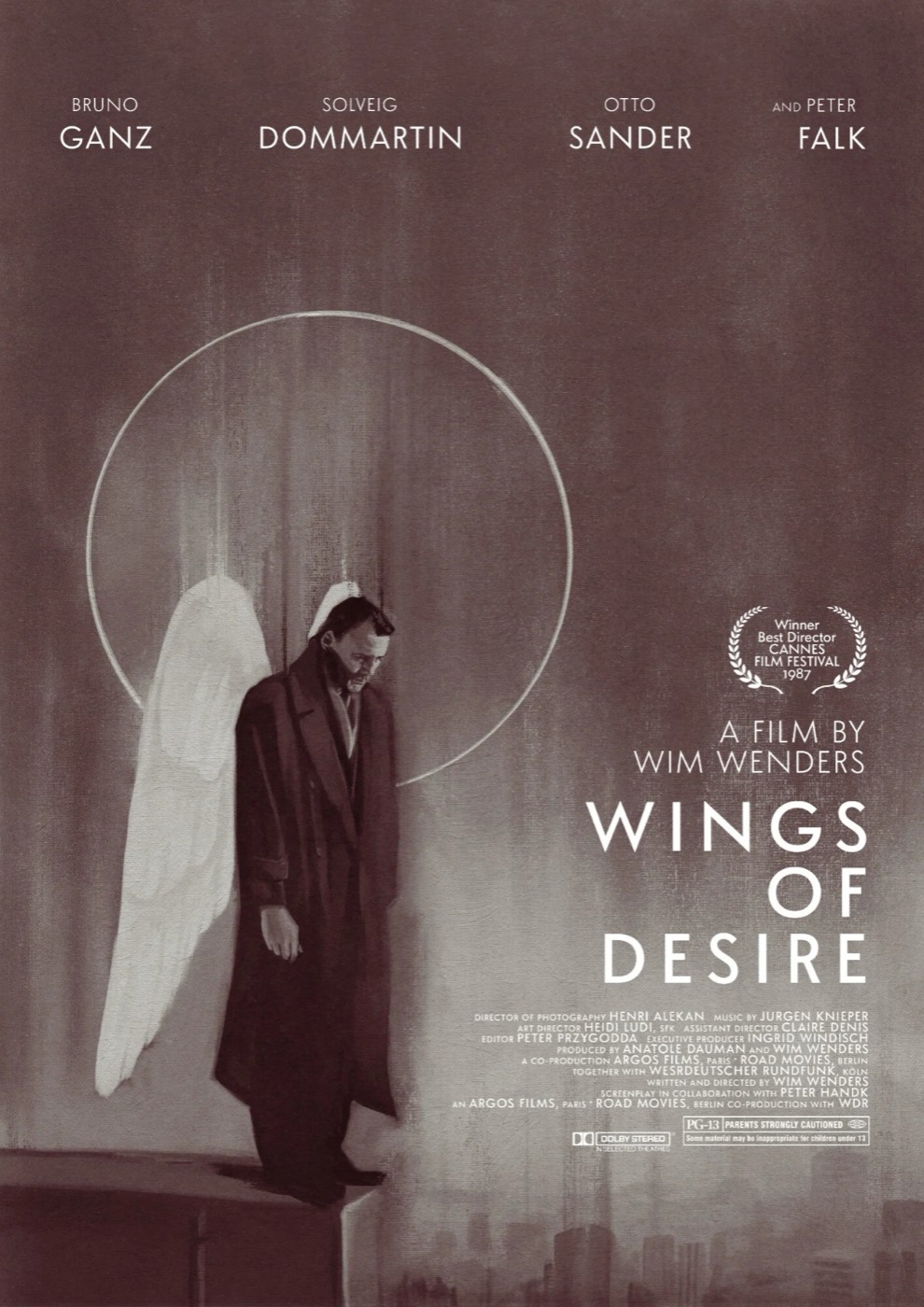
Wings of Desire where angels are witness-observers - seeing the world in black-and-white - acting as a bridge between the finite-and-the-in-finite - a sublime masterpiece.
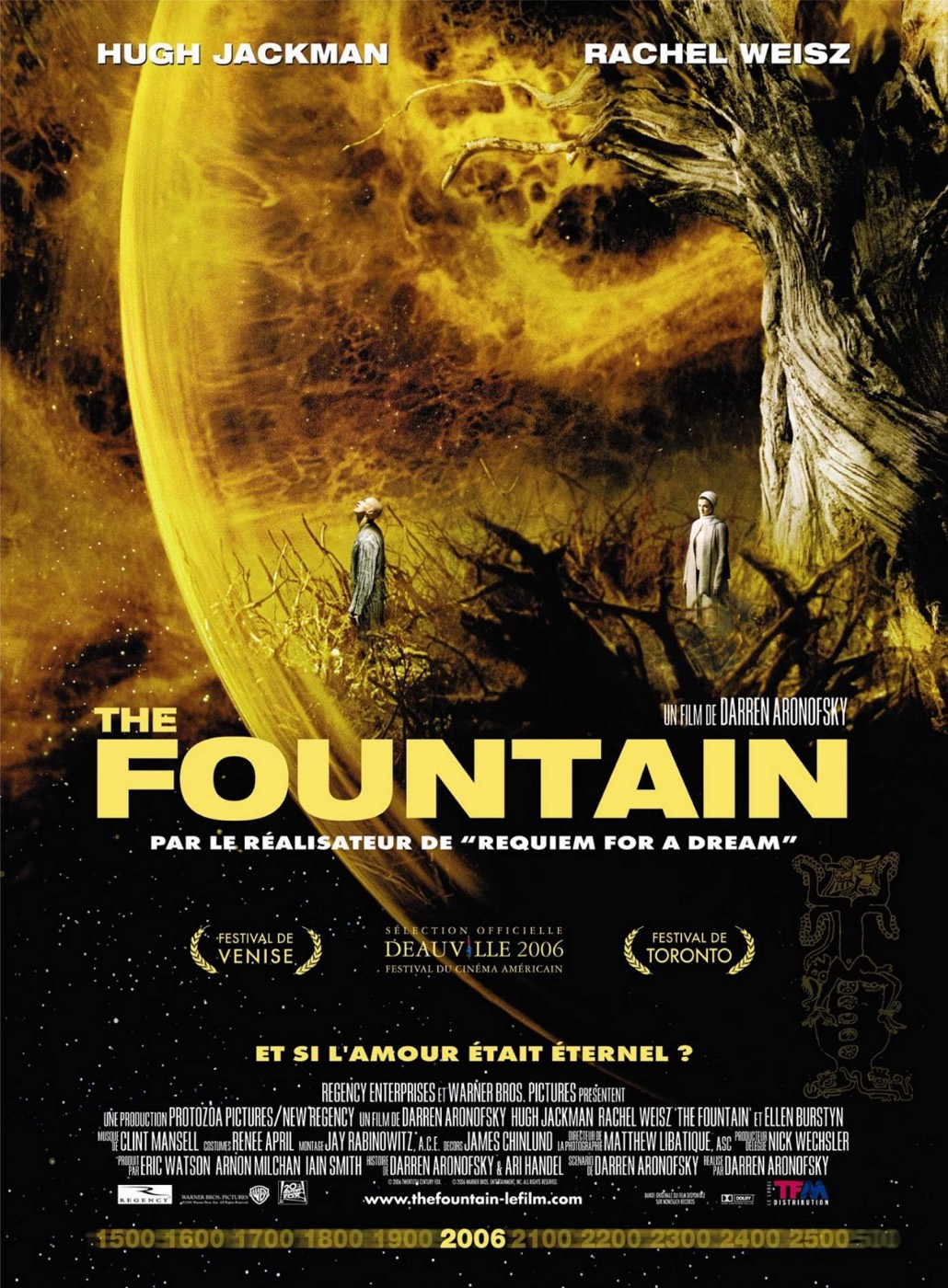
The Fountain, three interweaving timelines from the 16th Century to the space age, the central symbol of The Tree of Life, a spiralling narrative like a fern unfurling from within itself; visually stunning, multidimensional layering and profound depth.
Wim Wenders’ Wings of Desire (1987) a luminous meditation on existence, perception, and the longing to be fully human. Set in a divided Berlin, the film follows two angels - Damiel and Cassiel - who wander the city as invisible witnesses - observing, recording, and empathizing with the thoughts and emotions of its inhabitants. Their presence is gentle, compassionate, and non-interfering: they are the ultimate “witness-observers,” a motif that resonates deeply with quantum philosophy and spiritual traditions.
In the Quantum Human paradigm, the observer is not a passive bystander but a participant whose awareness shapes reality. The angels in Wings of Desire embody this principle: they are present, attentive, deeply empathetic; they do not intervene.
Their witnessing is a form of quantum participation - by observing, they honour the lived experience of each person, echoing the quantum idea that observation collapses possibility into presence.
This mirrors the role of the “Quantum Human,” who lives in a state of superposition -both observer-and-observed, both finite-and-in-finite. The angels’ longing to experience human sensation, pain and love is a yearning to collapse the infinite possibilities of spirit into the embodied presence of a single, lived life. Their journey is a metaphor for the quantum leap from pure awareness into incarnation, from the field of potential into the particularity of being human. Who Am I? TAT TVAM ASI. Know Thyself. I AM.
The crown chakra (Sahasrara) in yogic philosophy is the gateway to higher consciousness, the point where the individual self merges with the universal. In Wings of Desire, the angels are depicted as beings of pure awareness - resonant with an open, radiant and luminous quality - the crown chakra’s halo-of-light. Not bound by time nor space; they move through the city like electrical currents of consciousness, attuned to the suffering and beauty of the world.
Spoiler Alert. Plot twist to be revealed. Put down the book and watch the movie! NOW!
Dear reader; Wings of Desire is to movies what Dogen is to mystical Zen poetry; painting unsurpassed enlightenment. Involution-and-Evolution. And then, by all means, please read on and continue. Many Paths. One Stream.
When Damiel chooses to become human, it is a descent from the crown - an act of incarnation, bringing the in-finite-into-the-finite. This, the journey of Quantum Human: a numinous bridge between the worlds of spirit and matter like an etheric umbilical-cord connecting a mother, her child; to embody wisdom and compassion, to become a “living mandala” where the divine and human meet; light-beings entangled in the flesh.
The film’s central question - what does it mean to be human? - is explored through the angels’ longing for sensation, emotion, and connection. To be human, in Wenders’ exquisite vision is to embrace paradox: to feel pain and joy, to love and lose, to be limited and limitless. The angels’ journey is a metaphor for the quantum human path to attain self-realization: to move from the abstract to being embodied, from witness to becoming an a-participatory observer, from separation to entanglement.
The film’s poetic voiceovers, its black-and-white-to-colour transitions, and its focus on small, everyday moments; all serve to highlight the miracle of embodied existence. The angels’ desire to feel a weight within is the desire to collapse the wave of possibility into the particle of presence; to become, fully, here and now in the here-and-now-to-stay. Spoiler Alert Two on the next page. Quantum Plot Twist Giveaway.
Peter Falk’s appearance as himself - a former angel who has chosen to become human - serves as a quantum catalyst within the film. Falk is both a guide and a mirror: he recognizes Damiel as an angel and encourages him to make the leap and become human. Falk’s character is a living example of the quantum observer who has chosen to participate; to taste the fullness of life, to accept the risks and rewards of incarnation, and to be all the wiser for having experienced human existence and being entangled in the flesh; what it feels like to feel, to be happy, to be sad; everything in-between.
Falk’s warmth, humour, and grounded-beingness contrasts with the ethereal detachment of the angels. He embodies the “collapse” of infinite possibility into lived experience, showing that to be human is to be both witness and participant, both observer and actor in the unfolding drama of the rollercoaster of life and existence.
The Fountain (2006), directed by Darren Aronofsky; a cinematic odyssey that fuses science fiction, myth, and spiritual inquiry into a single, spiralling narrative. The film’s journey to the screen was itself a saga; taking nearly ten years to realize, weathering setbacks, rewrites, and a complete re-casting after the original production collapsed. Aronofsky’s perseverance is a testament to the film’s central theme: the quest for transcendence through the act of surrender; the refusal to accept the finality of death.
Aronofsky began developing The Fountain in the late 1990s, inspired by his own experiences with loss and the search for meaning. The project was initially envisioned as a grand, $70 million epic starring Brad Pitt and Cate Blanchett. When that version fell apart, Aronofsky re-imagined the film on a more intimate scale, casting Hugh Jackman and Rachel Weisz. Making the movie itself became a synchronistic mirror of letting go - of ego, of control, of the need for answers. This is encapsulated in the films' central theme; surrendering to the unknown, and finding beauty in the mystery.
Each morning before filming, Aronofsky and the cast would gather and chant OM together; a practice drawn from yogic and Buddhist traditions. This ritual was more than a warm-up; it was a way to attune the cast and crew to the film’s spiritual frequency. It was a way to connect, to ground and embody, and open up to the experience. It set the tone for the day. It reminded everyone that they were making something sacred, something that was about the deepest questions of existence. It is fascinating to note that Hugh Jackman found a kindred creative project; since he himself has deeply explored the spiritual path; God, meditation, non-dualism. Hugh Jackman sharing his insight about Spirituality - YouTube The universe attuned.
Rejecting the era’s reliance on CGI, Aronofsky and his team turned to the microcosm to evoke the macrocosm. The film’s cosmic vistas - nebulae, fields of stars, the luminous “bubble” that carries the Tree of Life through space - created by filming chemical reactions in petri dishes under a microscope. Aronofsky explained he wanted the universe to feel organic, alive. By filming real chemical reactions, he captured patterns and forms that echo the structures of galaxies, cells, and the human mind.2 The microcosm reflects the macrocosm - the smallest things contain the largest mysteries. As Above, So Below. As Within, So Without. As the Universe, So the Soul. Aronofsky, a modern-day alchemist following in the footsteps of Hermes Trismegistus.
This approach is a visual metaphor for the film’s core idea: the journey inward is also a journey outward, the search for immortality is a search for awakening; the in-finite-within-the-finite, the finite-within-the-in-finite like an ouroboric snake; an in-finity loop.
At the heart of The Fountain is the Tree of Life - a symbol that appears in every timeline, connecting the conquistador’s quest, the scientist’s struggle, the mystic’s surrender. The Tree is literal and metaphorical: it is the axis-mundi, the bridge between worlds and at the still-point of the turning world, there is only the dance, the source of life and the promise of renewal like a Phoenix into the fire. There the dance is.
The film’s imagery is saturated with references to the Ajna-Chakra, “Third Eye” - the centre of in-tuition, vision, and spiritual awakening in yogic philosophy. The recurring le-motif of light shining through the forehead, luminous orbs, the merging of self-and- Cosmos all evoke the opening of the Ajna-Chakra. Seek-thine-eye-within-the-eyes.
Other key themes: death and surrender, light, witnessing a cinematic re-enactment of awakening: the realization that life and death are not opposites - phases of a single, infinite process; a unified-field-of-awareness bridging the finite-within-the-in-finite.
The Fountain, at its core, a quantum mystical meditation on what it means to be human. The film’s structure - three interwoven timelines, each echoing and entangling with the others - mirrors the quantum principle of superposition. The protagonist is simultaneously a conquistador, a scientist, a mystic; his journey is both personal and universal, finite-and-in-finite. Consciousness-Quotient-Squared, exploring the entire bandwidth of experience from a Hermetic ouroboric perspective; As Above, So Below.
It seems we struggle for a lifetime to become whole. Few of us ever do … Most of us end up going out the same way we came in — kicking and screaming. Most of us don’t have the strength — or the conviction. Most of us don’t want to face our fears. Darren Aronofsky.3 A masterful mystical storyteller re-kindling the alchemical fire and the extra-ordinary power of mythos and the art of storytelling. “An experience. A piece of abstract art. Life affirming.”4 This movie mirrors the essence of Quantum Human: to recognize that we are not isolated particles; we are waves in a cosmic ocean, entangled with every other being, every star, every tree; this the Wheel-of-Return, the cycle of life-death-and-re-birth; as exquisitely sung by Elton John in The Lion King:
In the circle of life
It's the wheel of fortune
It's the leap of faith
It's the band of hope
'Til we find our place
On the path unwinding
In the circle
The circle of life.5
And so The Fountain is a film that rewards contemplation and repeated viewing. Its decade-long creation, its spiritual rituals, its innovative visual effects, and its profound symbolism all serve a single coherent purpose: to invite the viewer into a state of wonder, humility, faith, devotion, surrender, awakening. A cinematic mandala - the Tree of Life for modern seekers; a visual OM that resonates long after the final frame.
Individual flow, collective group flow; shifting from separate and divided mechanistic parts into an interconnected and interdependent and unified-whole; everything-acting-as-one, so the whole world blooms continually/ within its true and hidden element. OM
Prana, Chi, Ki, flowing universal lifeforce energy, and this is what the ancients knew.
An evolutionary cosmic-impulse akin to Wheeler’s U-shaped a-participatory universe where observers observe an a-participatory universe; a universe discovering itself through each observer interaction like a wave-connected-to-the-ocean-of-existence - consciousness - limitless-fullness - a multidimensional reality without-beginning-nor-end - a-participatory observers are brought into being by the universe - simultaneously a-participatory observers bring into being the universe though the act of observation.
Consciousness is fundamental. This, the ever-evolving cosmic impulse and creative flow state flowing towards the perfection-of-the-finite-within-the-in-finite - everything-ordered-and-unified - a Bose-Einstein condensation-of-consciousness. E=MC²
Mountains and Rivers Without End
Gary Snyder stands as one of the most influential American poets of the late 20th and early 21st centuries, renowned for his deep ecological vision, engagement with Zen Buddhism; a poetic voice that bridges the wildness of nature with the intricacies of human experience. His magnum opus, Mountains and Rivers Without End, is a sweeping, decades-in-the-making sequence that embodies his lifelong devotion to landscape, myth, and the interconnectedness-of-all-beings. Gary Snyder - Gary Snyder Poems | Best Poems
First published in 1996 after forty years of composition, Mountains and Rivers Without End is structured as a long, unfolding poem-cycle. It draws inspiration from the ancient Chinese landscape scrolls and the Buddhist concept of endlessness, inviting readers to travel through mountains, rivers, forests, and cities; cross continents and centuries.
Snyder’s language is Zen minimal yet vivid, rooted in direct observation and a reverence for the natural world. The collection is not merely descriptive; it is experiential, immersing the reader in the rhythms of walking, chanting, working, and being.
The collection is divided into four parts, each exploring different facets of the journey - geographical, spiritual, and existential. Snyder weaves together personal narrative, mythic allusion, and ecological insight, creating a tapestry where the boundaries between self and world dissolve. The poems move fluidly between the microcosm and macrocosm, from the details of a stone or a bird’s call to the vastness of geological time and cosmic cycles. Central themes include:
Interconnectedness: Snyder’s poetry dissolves the separation between human and non-human, self and landscape. “Walking up and around the long ride of Tamalpais, “Bay Mountain,” circling and climbing - chanting - to show respect and to clarify the mind. Phillip Whalen, Allen Ginsberg, and I learned this practice in Asia. So we opened a route around Tam. It takes a day.” The Circumambulation of Mt. Tamalpais. Buddhist non-duality and ecological interdependence, the practice of mindful walking and paying attention with kindness. And peace is every step. Many Paths. One Stream.
Pilgrimage and Practice: The act of journeying - on foot, in mind, or through artistic creation - is literal and metaphorical. The poems are meditations on movement, impermanence, and the search for meaning. Lose your way in the bamboo brush on Hiei-zan in winter/ Step on a bug by mistake. Things to Do Around Kyoto. Extract from Three Worlds, Three Realms, Six Roads
Art and Nature: Snyder draws on the tradition of Chinese and Japanese landscape painting, seeing poetry as a form of brushwork that captures the living energy of the world, a web of water streaming over rocks, Endless Streams and Mountains.
Snyder’s style is marked by clarity, humility, a deep listening to the world, seeing reality-as-it-is. He employs open forms, subtle repetition, and a musicality that reflects both the spoken word and the silence of wilderness. His voice is that of a witness and participant; never above or apart from the world he describes, entangled within.
Mountains and Rivers Without End is more than a collection of poems; it is a spiritual and ecological map for living with awareness and compassion. Snyder’s work invites readers to slow down, to be mindful of their body-speech-and-mind and recognize the extra-ordinary and sacred qualities in the act of slowing down and seeing clearly the nature of existence. A celebration of the earth’s beauty and resilience, a call to honour our place within the great unfolding of life; the Tree of Being Human. In the lineage of Whitman, Pound, and the ancient poets of Asia, Gary Snyder offers poetry that is both timeless and urgently contemporary; a reminder that, like mountains and rivers, the journey of the spirit and the world is truly without end.
Beingness
after Gary Snyder
Morning light
strikes the ridge—
electrons jump,
pine needles hum.
Breath moves in,
breath moves out:
cells listen to electric impulses
vibrating the old instructions.
Hands remember
what the tongue forgets—
lift, set down, repeat.
Time thins
to the width of a step;
weather beyond.
No self apart
from creek, stone, hand—
the work goes on.
Foot on soil,
mind clear as water,
nothing extra.
End of chamber 33
Chambers 1 to 35: all 35 chambers open