Ring IV · Inquiry · Chamber 22
Materialist Quantum Physicists
About 16 minutes to read
In order to understand quantum physics, we need to build a firm foundation starting with a classical materialist interpretation from a wide-bandwidth of notable quantum physicists. This list breaks down from beginner accessible levels; easy, intermediate, Mission-Impossible; the math alone, and mind be like a brain exploding in Scanners.
Materialist physicists generally hold that consciousness and reality are fundamentally physical, and that quantum phenomena can be explained without invoking mind or non-material principles. The opposite idealist camp is labelled New Age woo woo.
Superimposing a neuroscientific lens: materialists are experts in left-hemisphere observation and analysis - zoom-in laser-beam precision, rigorously applying the scientific method, detail, reductionist, logical empiricism. And remember; always in yang is a dot of yin and vice-versa. Many on this materialist left-hemisphere list are exceptionally creative and embody right-hemispheric learning; using visual aids, poetry and metaphors. And Brian Cox is a former organist in the dance band D-Ream. And the path and journey to learning quantum physics - and things can only get better.1
Brian Cox A phenomenal communicator and popularizer of quantum mechanics who emphasizes probabilistic, physicalist interpretations. “The universe is not required to be in perfect harmony with human ambition.” His dream and ambition to appear on Top Of The Pop’s and play live at Glastonbury became manifest; June 28th, 2024.2 E=MC²
Night With The Stars (BBC TV one-hour special).3 In this spectacular TV event, Cox uses live demonstrations and engaging visuals to explain quantum mechanics, the nature of atoms, and the fundamental laws of the universe. He makes the complex stuff of quantum reality come alive, real and tangible through expert guidance, lucid storytelling and creative use of visual aids - including celebrity stars selected from the audience - learn how quantum phenomena are paradoxical, quirky, fuzzy and fascinating - and how they underpin everyday reality - where anything that can happen does happen. A beautiful, inquisitive, mind-bending, engaging and creative mind. Are we classical or are we quantum? That is the question.
This program is a masterclass in science communication, lighting up the wonder and relevance of quantum physics for a broad audience. It distills quantum concepts into vivid and memorable experiences, inspiring curiosity, and understanding in viewers of all backgrounds. In my eyes; this one-hour is the nearest thing to being like Neo downloading from the Matrix and saying: “I know quantum.” And I shall name this one-hour, the-perfection-of-the-finite-within-the-infinite; echoing Octavio Paz, Nobel poet.
Wonders of the Universe (BBC TV Series).4 Acclaimed series, hosted by Brian Cox, bringing quantum physics and cosmology to a broad audience. Cox’s clear explanations and visual storytelling make complex ideas like quantum mechanics, entropy, and the nature of reality accessible. A brilliant showcase of his commitment to scientific realism and public science education. And things can only get better²
Sean Carroll A theoretical physicist and philosopher renowned for his clear, engaging communication of complex quantum concepts to both academic and popular audiences. Carroll is a leading advocate of “poetic naturalism” and is well known for supporting the Many Worlds interpretation (MWI) of quantum mechanics, which posits that all possible outcomes of quantum measurements actually occur in branching, parallel universes.
In his influential book, Something Deeply Hidden, Carroll explores the philosophical implications of quantum theory, arguing for a physicalist and naturalistic view of reality that does not require consciousness to explain quantum phenomena. He is also recognized for his public lectures, podcasts, and essays, which make advanced topics in cosmology and quantum foundations accessible and thought-provoking. Carroll’s work emphasizes that the universe is not a story about us, but about itself, and he encourages a rigorous, open-minded approach to the mysteries of quantum mechanics. Many Worlds like the movie Everything-Everywhere-All-At-Once; a cosmic-interconnected-web, mind-bending like Uri Geller with a spoon.5 Cosmic mic-drop.
Steven Weinberg A Nobel Prize-winning physicist celebrated for his foundational contributions in particle physics and cosmology, including the unification of the weak force and electromagnetic interaction. Weinberg was a staunch reductionist and a vocal critic of mystical or non-materialist interpretations of quantum mechanics. “The more the universe seems comprehensible, the more it also seems pointless.”
The First Three Minutes, he provides a lucid account of the origins of the universe from a reductionist, physicalist perspective, making the early universe’s quantum processes understandable to non-specialists. Weinberg’s writing and lectures are marked by their clarity, precision, and logical brilliance, often emphasizing that the more comprehensible the universe becomes, the more it seems devoid of inherent purpose. “In complexity, it is only simplicity that can be interesting.” He championed scientific realism and was influential in shaping the modern understanding of quantum theory, always insisting on empirical rigour and skepticism toward metaphysical speculation. “Our job in physics is to see things simply, to understand a great many complicated phenomena in a unified way, in terms of a few simple principles.”
Richard Feynman Developed path integral formulation, a pragmatic materialist. A master with words and explaining complex subjects so a child could begin to fathom in awe and wonder. “I think I can safely say that nobody understands quantum mechanics.” And “Shut up and calculate” which became the materialist mantra (and dogma) - sticking firmly within the confines and specialization of scientific enquiry - forgetting any notion about philosophy and meta-physical speculation. A phenomenal mind, playful curiosity, a brilliant teacher; a mesmerizing and captivating orator.
The Feynman Lectures on Physics (Book Series & Online Resource)6. Legendary lectures distilling Feynman’s pragmatic, skeptical approach to quantum mechanics and physics in general. They’re foundational for generations of physicists who became inspired by mathematical, logical and empirical rigour; exemplifying his “shut up and calculate” philosophy. Let “The Great Explainer” elucidate. Brilliant in every way.
Niels Bohr Copenhagen interpretation can be interpreted as metaphysical, since Bohr left open his definition of what is an observer - generally anti-metaphysical in his views. “Everything we call real is made of things that cannot be regarded as real.” Bohr deliberately left the definition of “observer” open and somewhat ambiguous. In his view, the act of measurement was fundamental to quantum phenomena, but he did not specify whether the observer had to be a conscious being or could be any macroscopic measuring device. Bohr emphasized the inseparability of the observed system and the measuring apparatus - in doing so, avoiding any metaphysical claims about consciousness itself - sticking firmly within the parameters of physics - no meta. Over the passage of time; this ambiguity led to ongoing debates about what exactly constitutes an “observation” in quantum mechanics. This debate lies at the crux-of-the-matter between materialist and non-materialist interpretations of what is the nature of consciousness - if any - in the role of observation; which is reflected by the Divided Brain, the materialist left-hemisphere and the non-materialist right-hemisphere.
Bohr's most important philosophical contribution to quantum mechanics was complementarity: the insight that seemingly contradictory descriptions can both be necessary for understanding reality. Light behaves as both wave and particle. Neither description alone is sufficient; together they reveal a deeper truth; wave-particle, wavicle.
For Bohr, this was not merely a feature of physics; it was a principle of knowledge itself. Reality often exceeds any single perspective. This insight resonated so deeply with Bohr that when he was ennobled by the Danish Crown in 1947, he placed the Yin-Yang symbol on his coat of arms, accompanied by the motto: Contraria Sunt Complementa.
Opposites are Complementary.
Bohr recognized in Yin and Yang a vision remarkably similar to what quantum physics had uncovered. Opposites need not be enemies. They may be mutually dependent expressions of a larger whole.
From a Quantum Human perspective, this principle extends beyond wave and particle to many of our deepest polarities: matter and consciousness, objectivity and subjectivity, science and spirituality, observer and observed.
Bohr's complementarity also parallels Iain McGilchrist's divided-brain model. The left hemisphere seeks certainty, analysis, and measurement; the right hemisphere apprehends relationship, context, and living wholeness. Neither is complete in isolation.
Bohr and Heisenberg's famous debates can therefore be seen as a living enactment of complementarity itself. One continually emphasized what could be measured and communicated; the other remained drawn toward what lay beyond description. Together they embodied two indispensable ways of approaching reality.
Bohr's Yin-Yang becomes a guiding symbol. Kant's phenomena and noumena, wave and particle, subject and object, left and right hemisphere all point toward the same possibility: reality may be fundamentally whole, while our descriptions divide it into opposites.
The deeper task is not to choose one side, instead, now, to discover the larger unity that holds both. As Bohr's motto reminds us: opposites are complementary.
“In 1947, the King of Denmark knighted Niels Bohr, the father of quantum physics, into the Order of the Elephant. Tradition required a coat of arms. Bohr's family had none, so he designed his own.
In the center, where European crests put lions and eagles, he placed the yin-yang. Underneath, a Latin motto he wrote himself: CONTRARIA SUNT COMPLEMENTA — "opposites are complementary."
In this episode:
The scandal of light: wave or particle? The most studied thing in physics refused to fill out the form
Why this broke the West's oldest rule of thought — Aristotle's either/or
Complementarity, 1927: two faces of one thing, and where you stand decides which one you see
The 1947 coat of arms, still hanging in Frederiksborg Castle — and why it might be the most honest shield in that church
Bohr vs Einstein: "God does not play dice" / "Stop telling God what to do"
And the 2023 photo of entangled photons that viewers kept sending me — the one where the physics drew the symbol back” Why the Father of Quantum Physics Put the Yin-Yang on His Coat of Arms - YouTube
Copenhagen (Play by Michael Frayn, available as a BBC film) This play dramatizes the famous 1941 meeting between Niels Bohr - played by Stephen Rea - and Werner Heisenberg - a pre-Bond Daniel Craig - exploring the philosophical and ethical implications of the Copenhagen interpretation and nuclear energy during WWII. The event became the stuff of modern scientific mythology. It captures Bohr’s anti-metaphysical and instrumentalist stance, and his influence on quantum theory. It makes the oft-times dry nature of academic texts - become real and alive before the viewers’ eyes. In order to begin to fathom quantum reality, the Copenhagen interpretation and Heisenberg’s Uncertainty principle - see below - the seemingly dual-nature of light particles observed as both wave-and-particle - wavicles - and understanding the nature and quantum properties of light is central-to-everything.
Werner Heisenberg’s Uncertainty principle formalized the idea that certain pairs of physical properties (like position and momentum) cannot be simultaneously known to arbitrary precision. This principle highlighted the limits of knowledge and the active role of measurement in determining the state of a quantum system. Heisenberg’s work set off a profound debate about the nature of reality and the role of the observer. Some physicists and philosophers interpret the uncertainty principle as implying that consciousness might play a role in the “collapse” of the wavefunction - the process by which a quantum system transitions from a superposition of possibilities to a single, definite outcome - like fuzzy sensations and feelings collapsing into a single thought.
“Not only is the Universe stranger than we think, it is stranger than we can think.” The Uncertainty principle is central to begin fathoming quantum mechanics much like Alice going down the quantum rabbit w-hole. And his surname, now made infamous and synonymous with the TV series, Breaking Bad.
Physics and Philosophy: The Revolution in Modern Science. In this book, Heisenberg reflects upon the uncertainty principle and the philosophical implications of quantum mechanics. It’s a direct window into his instrumentalist approach and his engagement with Kantian philosophy and the key distinction between the observer and the observed, which Kant named phenomena and noumena. Fascinating stuff; Gromit.
Phenomena are objects as we experience them - things as they appear to us - shaped by our senses and cognitive faculties and filtering biases. This is the “object” in the sense of what is perceived. Noumena (sometimes called the “thing-in-itself” or Ding an sich) is the reality that exists independent of our perception - the “object” as it is, apart from any observer. Kant argued that while we can know phenomena, noumena are ultimately inaccessible to direct experience. Kant’s “thing-in-itself” (noumenon) is, by definition, unknowable; quantum mechanics echoes this by making the unmeasured state fundamentally inaccessible. Curiouser-and-curiouser like Alice in Wonderland.
Who experiences the-thing-in-themselves? Does the “tree-in-itself," a photon, an electron; does anything exist independently of any observer? That is the crux of the matter, and this debate has raged between materialists and idealists and non-dualists ever since. Bohr’s Copenhagen interpretation left the definition of “observer” a bit fuzzy and was subsequently debated and later interpreted by Heisenberg.
This book acts as a vital bridge and exquisite synthesis exploring the philosophy of physics; applied to the Copenhagen interpretation. Am I right, Sir? Mr. Memory. The 39 Steps. Superimpose Iain McGilchrist’s Divided Brain - Bohr and Heisenberg’s back-and-forth ping pong debate acts as a microcosmic mirror of the opposites of the left-hemispheres materialist lens opposing the right-hemispheres idealistic embodiment.
Neither movement from nor towards,
Neither ascent nor decline.
Except for the point, the still point,
There would be no dance, and there is only the dance.
Quatrain from Burnt Norton. Four Quartets. T.S. Eliot.7
Consciousness and Wave-Function Collapse
Bohr’s Position: Bohr maintained that quantum mechanics does not require consciousness for wavefunction collapse; the key is the interaction with a classical measuring device. However, because he left the observer undefined, later thinkers speculated about the possible role of consciousness. Materialist, how. Idealist; why?
Heisenberg’s Influence: Heisenberg’s uncertainty principle and his writings on the observer’s role inspired further debate. Some, like Eugene Wigner and John von Neumann, later argued that consciousness is necessary for collapse; while others (including Bohr’s followers) rejected this view. To be, or not to be; a wave-function.
The “measurement problem” in quantum mechanics - what counts as a measurement, and whether consciousness is required - continues to inspire and infuriate in equal measure both scientific and philosophical inquiry. The ambiguity left by Bohr, and the foundational questions raised by Heisenberg remain at the heart of why quantum mechanics is as hotly debated nowadays - in relation to mystery and paradox - as it was right at the beginning between two long-standing friends. Left-hemisphere versus right-hemisphere; materialism versus idealism. There would be no dance. What is the role of consciousness in wave-function collapse? Is consciousness classical, or quantum? These debates remain unresolved. And there is only the dance. E=MC²
Paul Dirac Mathematical formalism, a phenomenally gifted mathematical mind with materialist leanings. “The fundamental laws necessary for the mathematical treatment of a large part of physics and the whole of chemistry are thus completely known.”
The Principles of Quantum Mechanics (Book) This, the seminal textbook by Dirac, layed the mathematical foundations of quantum mechanics. It is revered for its clarity and for introducing the Dirac equation, a cornerstone of modern physics since it merged quantum mechanics and relativity, predicted anti-matter; gave a framework for understanding the intrinsic spin of particles. This book is Mission Impossible for the lay reader, since this text requires degree level math to even begin to decipher.
Max Born Probabilistic interpretation, materialist. “I am now convinced that theoretical physics is actually philosophy.” In Catch Me If You Can, Frank Abagnale Jr., played by Leonardo DiCaprio, impersonating a doctor says, "Do you concur?” I concur. Nobel Lecture: "The Statistical Interpretation of Quantum Mechanics".8 Born’s Nobel lecture is a clear, concise, and authoritative explanation of the probabilistic interpretation of quantum mechanics, which remains central to the field. It is a must read/listen for understanding the philosophical shift which Born championed.
John von Neumann Formalist and mathematical prodigy, and one of the most influential figures in the development of quantum mechanics, computer science, and mathematics - although there is some debate about his stance on consciousness. “In mathematics you don’t understand things. You just get used to them.”
Mathematical Foundations of Quantum Mechanics. This book by von Neumann rigorously formalized quantum theory using mathematical logic and set theory. He also addressed the measurement problem. Von Neumann introduced the idea that the collapse of the wavefunction, which transforms a quantum system from a superposition of states into a single observed outcome, cannot be fully explained by the physical laws governing the measuring apparatus alone. Instead, he argued that the chain of measurement - from the quantum system, through the measuring device, and up to the observer - must ultimately end with the conscious observer. Curiouser-and-curiouser.
This led to the controversial notion that consciousness itself plays a fundamental role in the collapse of the wavefunction; a view that has inspired a back-and-forth debate among physicists and philosophers. Von Neumann’s work laid the groundwork for later interpretations, such as those by Eugene Wigner and Henry Stapp, who further explored the relationship between mind and quantum. His Mathematical Foundations is crucial for anyone interested in the formalist, foundational aspects of quantum mechanics. And once again, mind be like a brain exploding in Scanners.
Murray Gell-Mann A pioneering theoretical physicist best known for introducing the concept of “quarks,” the fundamental building blocks of matter, which revolutionized particle physics and earned Gell-Mann the Nobel Prize in Physics in 1969. His work extended far beyond the quark model; Gell-Mann was deeply interested in the nature of complexity, reductionism, and the interconnectedness of physical laws. In his influential book, The Quark and the Jaguar: Adventures in the Simple and the Complex explores how simple rules give rise to complex phenomena, from subatomic particles to consciousness itself. He was known for his sharp intellect, reductionist approach, and his famous dictum, “Everything that is not forbidden is compulsory,” reflecting his belief in the underlying order and necessity within the universe. Gell-Mann’s legacy continues to shape modern physics, complexity science, and our understanding of the deep structure of reality. This begs the perennial question: where did underlying order and necessity come from? God-in-the-equation? Fine-tuning?
| Name | Key Thesis/Insight | Philosophical Stance | Philosophical Influences |
|---|---|---|---|
| Brian Cox | Probabilistic, physicalist, no role for mind | Physicalism, reductionism | Empiricism, scientific realism |
| Sean Carroll | Many Worlds, poetic naturalism, atheism | Physicalism, naturalism | Naturalism, atheism, scientific method |
| Steven Weinberg | Reductionism, anti-mysticism | Physicalism | Enlightenment rationalism |
| Richard Feynman | Path integrals, pragmatic, anti-metaphysical | Pragmatic materialism | Pragmatism, skepticism |
| Niels Bohr | Copenhagen, anti-metaphysical | Anti-realist, instrumentalist | Kantian epistemology, complementarity |
| Werner Heisenberg | Uncertainty, Copenhagen | Instrumentalist | Kant, Goethe, process philosophy |
| Paul Dirac | Mathematical formalism | Physicalist | Mathematical Platonism |
| Max Born | Probabilistic interpretation | Physicalist | Kant, probabilistic philosophy |
| John von Neumann | Formalism, consciousness in collapse (debated) | Formalist, some non-materialist | Mathematical Platonism, logic |
| Murray Gell-Mann | Quark model, reductionism | Physicalist | Scientific reductionism |
Materialist Quantum Physics: Core Principles
Physicalism: Reality is fundamentally physical; everything, including consciousness, arises from physical processes and matter. There is no need to invoke mind or non-material principles to explain quantum phenomena.
Reductionism: Complex phenomena are explained by reducing them to their simplest physical components (particles, fields, forces). The behavior of the universe can be understood by studying its smallest parts.
Empiricism & Scientific Realism: Knowledge comes from observation, experiment, and measurement. Theories must be testable and grounded in empirical data. The universe exists independently of observers.
Mathematical Formalism: Quantum mechanics is described by precise mathematical equations (e.g., Schrödinger equation, Dirac equation). These equations predict probabilities of outcomes, not certainties.
Probabilistic Interpretation: Quantum events are fundamentally probabilistic. The outcome of a measurement cannot be predicted with certainty, only the probability of each possible result.
No Fundamental Role for Consciousness: Consciousness is not required to explain quantum phenomena. The collapse of the wavefunction and quantum measurement are treated as physical processes, not dependent on the mind.
Zen summary:
Materialist quantum physicists focus on explaining the universe through physical laws, mathematical rigour, and empirical evidence. They generally dismiss the need for consciousness or non-material explanations, emphasizing that quantum mechanics is a complete physical theory - shut up and calculate - any metaphysical enquiry and speculation is non-scientific, and classified and named under the all-encompassing banner - “woo-woo.”
And metaphysics to a materialist be like garlic, holy water, or sunlight to Count Dracula. And Deepak Chopra be like a stake to Dracula’s heart.
“Am I right, sir?” Mr. Memory, Hitchcock’s black-and-white classic, The 39 Steps.
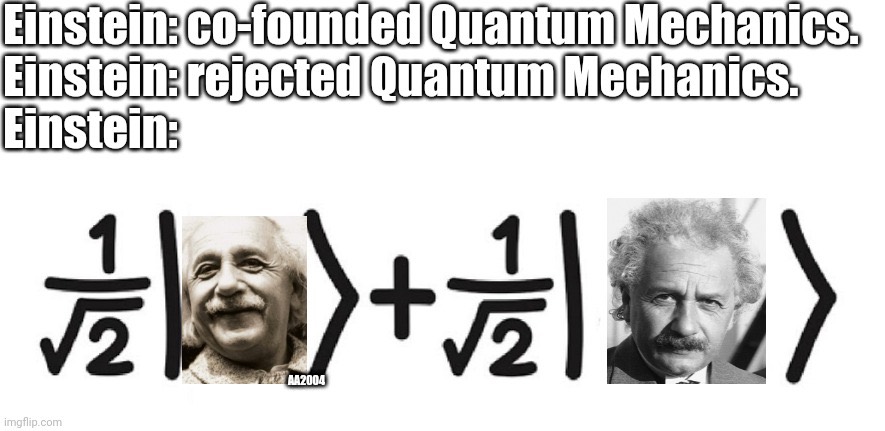
Quantum journey so far...Max Planck and Einstein Viral Memes²
I mentioned right at the beginning when discussing Professor Brian Cox; that, that the journey to explore quantum physics and things can only get better - which I repeated twice and squared. Dearest, I did this to inspire you to take the first steps, and to dip your toes into the quantum mutable quicksand. What the journey actually looks like...
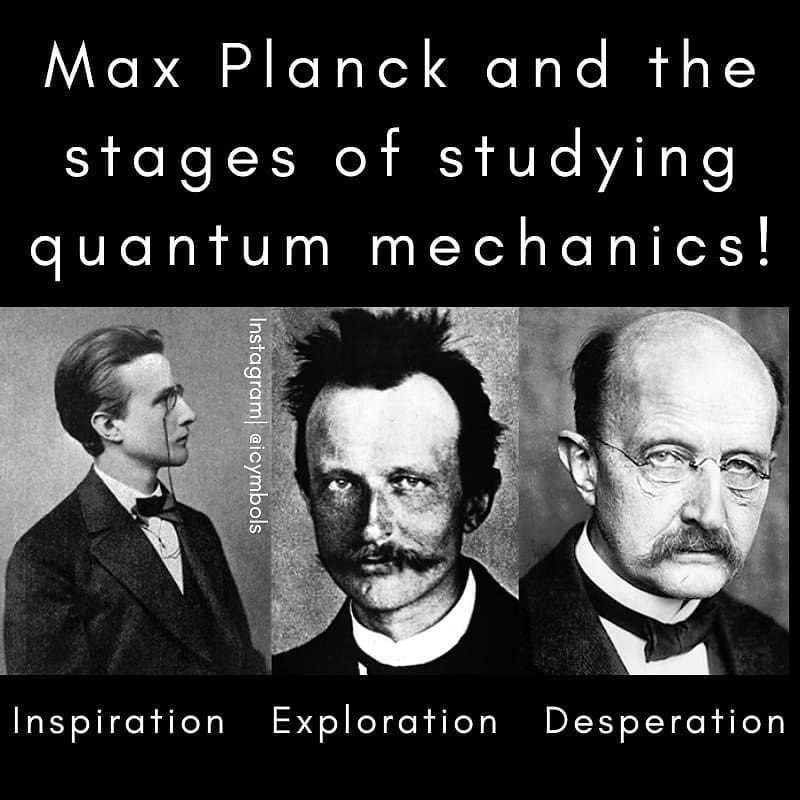
Inspiration = Materialism. Exploration = Idealism. Non-dualism = Beyond Desperation. Same-same-different Einstein:
End of chamber 22
Chambers 1 to 35: all 35 chambers open