Ring VI · Return · Chamber 31
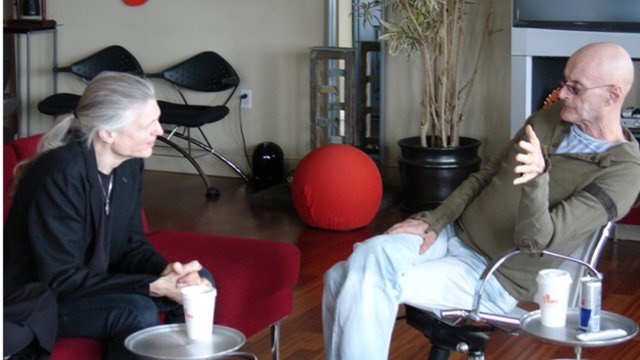
Ken Wilber
About 8 minutes to read
The point is to unify the opposites, both positive and negative, by discovering a ground which transcends and encompasses both. Ken Wilber. Quantum Human pioneer.
Integral Vision - Ken Wilber stands as one of the most influential and original thinkers in the field of consciousness studies. His work, spanning over four decades, has sought to synthesize the wisdom of the world’s spiritual traditions with the rigour of modern science and psychology. Wilber’s “integral” approach - famously and eloquently articulated in AQAL - All Quadrants, All Levels - offers a comprehensive map of human development, experience, and reality itself. “Toward a Comprehensive Theory of Subtle Energies,” extends Wilber’s expansive vision to the domain of subtle energies and the subtle body, proposing a framework that bridges ancient metaphysics and contemporary science. Consciousness-Quotient-Squared - mapping all four quadrants.
The Problem of Subtle Energies - Wilber begins by identifying a central challenge: the concept of “subtle energies” which is ubiquitous in the world’s esoteric traditions and elusive in scientific discourse.
Terms like prāṇa, qi, ki, and the “subtle body” appear in Hinduism, Buddhism, Taoism, and other traditions, yet their ontological status remains ambiguous. Are these energies metaphorical, psychological, or literal forces? Wilber’s significance lies in his refusal to dismiss these traditions as mere superstition or to accept them uncritically.
Instead, he asks: can we develop a rigorous, integrative theory that honours both the phenomenological reality of subtle energies and the demands of scientific inquiry?
To understand the whole it is necessary to understand the parts. To understand the parts, it is necessary to understand the whole. Such is the circle of understanding.
Wilber’s approach is pioneering because he does not reduce subtle energies to either materialist explanations (as mere “bioelectricity”) or to purely subjective states. Instead, he situates them within a developmental and ontological spectrum, arguing that subtle energies are real within their own domains and can be mapped alongside physical, emotional, and mental phenomena. This move opens the door to a more nuanced, pluralistic understanding of consciousness and embodiment.
“The universe gives birth to consciousness, and consciousness gives meaning to the universe.” John Archibald Wheeler. The universe is U-shaped - It-from-Bit-from-Chit.
The AQAL Framework: Mapping Reality
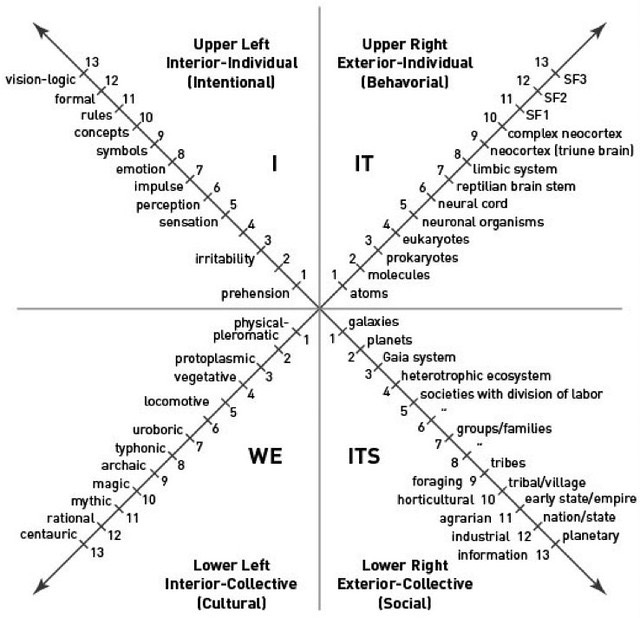
Central to Wilber’s project is the AQAL framework, which posits that reality can be understood through four fundamental perspectives (quadrants): the interior and exterior - the individual and the collective. These quadrants are further differentiated by levels (stages of development), lines (multiple intelligences), states (temporary experiences), and types (personality styles, etc.).
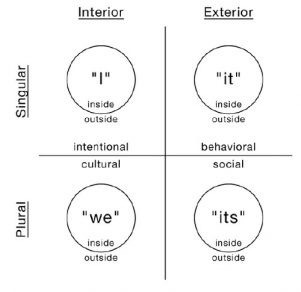
Wilber’s genius is to show that subtle energies and the subtle body are not isolated phenomena but are embedded within this multidimensional matrix. For example, the “subtle body” is not just a physical or energetic structure but also a locus of meaning, value, and cultural interpretation. By situating subtle energies within AQAL, Wilber provides a map that can accommodate both the yogic chakras and the findings of neuroscience, both shamanic journeys and psychological developmental models.
This integrative vision is significant because it resists reductionism and fragmentation.
THE ULTIMATE METAPHYSICAL SECRET, if we dare state it so simply, is that there are no boundaries in the universe. Boundaries are illusions, products not of reality but of the way we map and edit reality. And while it is fine to map out the territory, it is fatal to confuse the two. Ken Wilber, mapping the terrain and exploring the territory. CQ²
Wilber’s work invites us to see consciousness as a vast, evolving tapestry, where science and spirituality, East and West, ancient and modern, can find common ground. Ken Wilber, a quantum human pioneer into nature of consciousness - the Great Chain of Being - Consciousness-Quotient-Squared - a unified-field-of-awareness. E=MC²
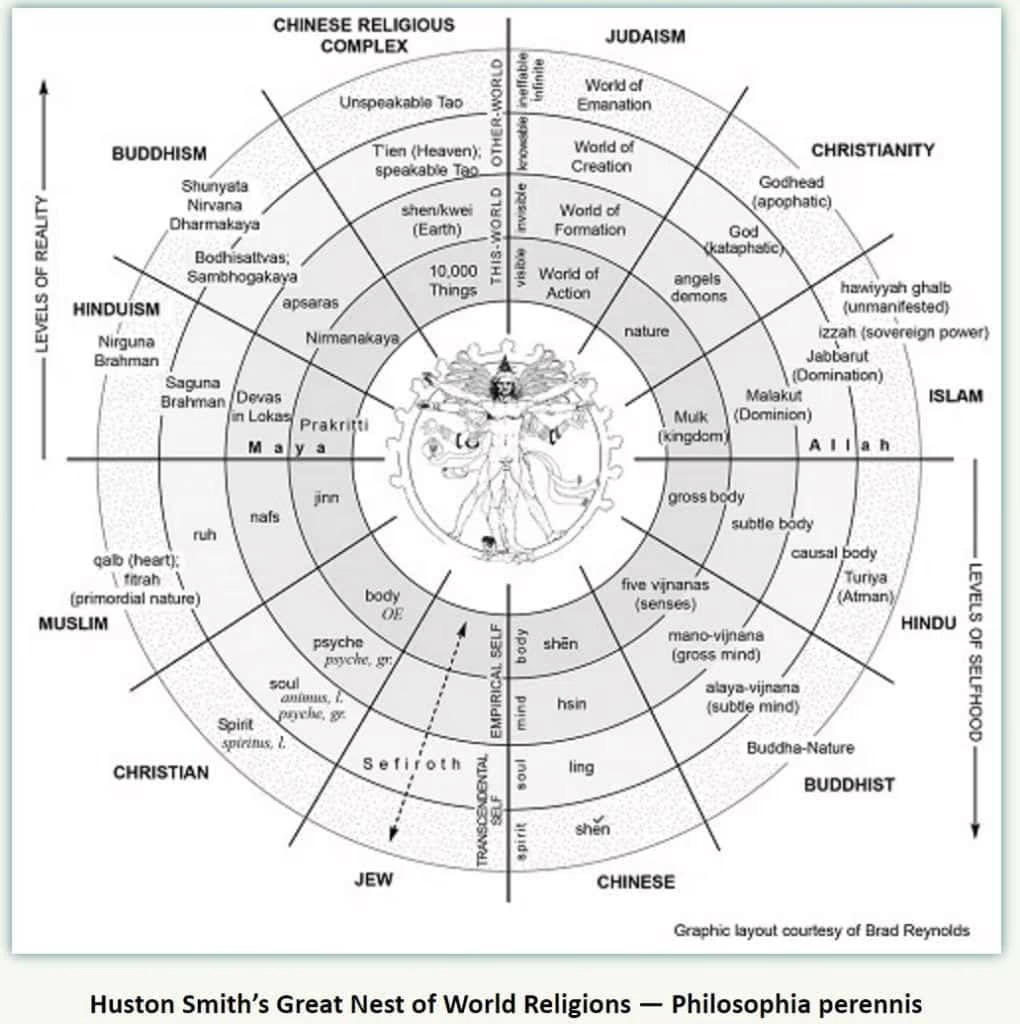
Huston Smith and the Primordial Tradition - Four Levels of Reality
“The Great Chain of Being begins with the Source and proceeds through emanationist, through various stages of manifestation, down to matter and non-being. Thus, Reality is described in terms of a specific structure. The accounts of different traditional and pre-modern esoteric and exoteric cosmologies are similar enough for it to be possible to present a single account embracing all of them.
Such a unified account has already been presented, at least on a basic level, by one contemporary scholar of comparative religion; Professor Huston Smith (formerly of Syracuse University, N.Y.) who (in his books Forgotten Truth and Beyond the Post-Modern Mind) refers to four levels, which pertain to both the microcosm (the individual) and the macrocosm (the universe and reality as a whole):” Huston Smith and the Primordial Tradition Huston Smith, the master map maker, the Great-Chain-of-Being.
The Spectrum of Consciousness and Subtle Energies
Wilber’s theory of subtle energies is grounded in his broader “spectrum of consciousness” model, which posits that human experience unfolds across a series of nested levels: physical, emotional, mental, subtle, causal, and nondual. Each level has its own characteristic energies, bodies, and modes of knowing. Upper-Left quadrant. I.
The “gross body” corresponds to the physical organism and its energies - biochemistry, electromagnetism. The “subtle body” is associated with dreams, imagination, archetypes, and the energies described in esoteric traditions - prāṇa, qi, chi.
The “causal body” is the domain of pure awareness, emptiness, and formlessness.
Wilber’s insight is that each of these bodies and energies is real within its own domain and can be accessed through specific practices - yoga, meditation, contemplation.
This bandwidth and spectrum model is revolutionary because it provides a developmental and experiential context for subtle energies. Rather than treating them as supernatural or unscientific, Wilber shows how they emerge as consciousness evolves and as individuals cultivate deeper states of awareness. The subtle body is not a static entity but a dynamic process, unfolding in the journey of awakening.
The Ontology of Subtle Energies - a key contribution of Wilber’s essay is his nuanced ontology of subtle energies. He distinguishes between three major types of “energy”:
Physical Energies: The measurable forces of physics and biology (e.g., electromagnetism, chemical energy).
Subtle Energies: The energies described in esoteric traditions, which are not currently measurable by conventional science but are experientially real in altered states, dreams, and advanced meditative practice.
Causal Energies: The “energy” of pure consciousness or emptiness, which is not an energy in the conventional sense but the ground of all manifestation.
Wilber’s significance here is his refusal to collapse these distinctions. He argues that subtle energies are not reducible to physical energies, nor are they mere projections of the mind. Instead, they are “in-between” realities - bridges between matter-and-spirit, body-and-mind. This ontological pluralism allows for a more sophisticated dialogue between science and spirituality, one that honours the insights of both without forcing premature synthesis.
Developmental Emergence of Subtle Energies - Wilber’s developmental perspective is central to his theory. He argues that subtle energies and the subtle body do not exist in the same way for all people at all times. Instead, they emerge as individuals develop through stages of consciousness. For example, the ability to perceive and work with subtle energies is often reported by advanced meditators, yogis, and mystics, but is less accessible to those at earlier stages of development. A nested hierarchy.
This developmental approach is significant because it explains both the universality and the variability of subtle energy experiences. It also provides a framework for understanding spiritual growth as a process of increasing subtlety, integration, and realization. Wilber’s model bridges the gap between perennial philosophy (which posits universal truths) and developmental psychology (which emphasizes growth and change).
Epistemology of Subtle Energies - Wilber is acutely aware of the epistemological challenges posed by subtle energies. How do we know they are real? What counts as evidence? He proposes a “three strands of valid knowledge” approach: (1) instrumental injunction (practice), (2) direct apprehension (experience), and (3) communal confirmation (intersubjective validation).
This method, which he calls “integral methodological pluralism,” allows for the rigorous investigation of subtle energies without reducing them to either subjective fantasy or objective measurement alone. Exploring and counterbalancing the opposites; unity.
Wilber’s epistemology is pioneering because it legitimizes spiritual and contemplative practices as valid means of knowing, while also insisting on the importance of critical dialogue and communal validation. This approach opens the door to a new kind of science; one that can study consciousness in all its dimensions, from the gross to the subtle to the causal. Putting consciousness back as the central piece of the human jigsaw puzzle. Who Am I? TAT TVAM ASI. THAT THOU ART. Know Thyself. I AM.
Integration of Science and Spirituality - One of Wilber’s most significant contributions is his insistence that science and spirituality are not enemies but complementary approaches to reality. In “Toward a Comprehensive Theory of Subtle Energies,” he argues that the future of consciousness studies lies in the integration of empirical research, phenomenological investigation, and contemplative practice. CQ²
Wilber’s AQAL model provides scaffolding for this integration. By mapping the domains of science (objective, exterior) and spirituality (subjective, interior) onto the four quadrants, he shows how each can contribute to a fuller understanding of subtle energies and the subtle body. This integrative vision is not merely theoretical; it has practical implications for healing, transformation, and the evolution of consciousness.
Toward a Comprehensive Theory: Ken Wilber’s work is significant for several reasons: He brings together insights of East and West, science and spirituality, ancient and modern; a coherent framework, a master integral mapmaker. He situates subtle energies within a developmental context, showing how they emerge and evolve as consciousness grows. He honours the reality of multiple domains - physical, subtle, causal - without reducing one to the other. He proposes a method for investigating subtle energies that is both experiential and communal, subjective, and objective.
His work informs practices of healing, meditation, psychotherapy, and personal growth, offering tools for navigating the full spectrum of human experience.
In this way, Wilber’s pioneering exploration of consciousness has inspired a generation of seekers, scholars, and practitioners. His vision of the subtle body as a bridge between matter and spirit, science and mysticism, remains one of the most comprehensive and compelling in the field.
Ongoing Journey - Ken Wilber’s “Toward a Comprehensive Theory of Subtle Energies” is more than an academic essay; it is a manifesto for the future of consciousness studies. By mapping the terrain of subtle energies within the AQAL framework, Wilber invites us to embark on a journey of integration, depth, and awakening. His work challenges us to honour the full spectrum of human experience, to bridge the divides between science and spirituality, and to realize the profound potentials of the subtle body.
In a world increasingly fragmented by specialization and dogma, Wilber’s integral vision offers a path toward wholeness - a path that is as rigorous as it is compassionate, as inclusive as it is transformative.
As we continue to explore the mysteries of consciousness, Wilber’s work remains a guiding light, illuminating the subtle energies that animate the dance of life. E=MC²
References:
Wilber, K. (1999). “Toward a Comprehensive Theory of Subtle Energies.” https://integrallife.com/wp-content/uploads/2020/09/Wilber-TowardAComprehensiveTheoryOfSubtleEnergies.pdf
Wilber, K. (2000). A Theory of Everything. Shambhala Publications.
Wilber, K. (2006). Integral Spirituality. Shambhala Publications.
Integral Cartographer
For Ken Wilber
You chart the spectrum of consciousness:
gross to subtle, causal to nondual,
All Quadrants, All Levels, a mandala of being.
Integration is not reduction,
harmony of the opposites,
dialogue of science and spirit.
You build bridges like Bob the Builder,
East meets West, matter and meaning,
self-and-cosmos; everything entwined.
Words, vectors, vision, an alchemical matrix,
wisdom-and-compassion entangled,
two-wings wakening Sat-Chit-Ananda.
To be whole is to be many,
To be many is to be one,
To be one is to be the field,
All things spontaneously arise.
Entangled Mandala
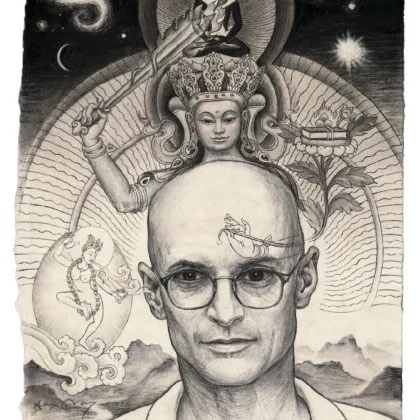
For Alex Grey and Ken Wilber
Art is the sacred mirror.
Alex paints the subtle-body,
Ken maps the subtle mind.
World, a living mandala,
a field of in-finite potentiality.
Entwined ribbons of silk DNA,
each the other’s mirror,
each the other’s bridge.
In Socratic dialogue like a reflection,
a superposition of vision and theory,
a quantum leap beyond duality.
Only by integrating the opposites,
become the luminous bridge,
only by seeing the light within,
the corpus callosum, the cosmos,
quantum human, beingness, isness,
suchness; integration is integral.
End of chamber 31
Chambers 1 to 35: all 35 chambers open