Ring V · Emptiness · Chamber 25
Consciousness-Is-One
About 17 minutes to read
“I regard consciousness as fundamental. I regard matter as derivative from consciousness. We cannot get behind consciousness. Everything that we talk about, everything that we regard as existing, postulates consciousness.” Max Planck, the father of Quantum Theory who received the 1918 Nobel Prize in Physics.
Core idea in a nutshell
The “consciousness-is-one” theory proposes that consciousness is not merely an emergent property of individual brains or organisms, but is instead a fundamental, unified-field that underlies all existence. In this view, individual experiences of consciousness are like waves or ripples on the surface of a single, vast ocean of awareness. This perspective is found in various philosophical, mystical, and scientific traditions, and is often contrasted with materialist or reductionist views that see consciousness as a byproduct of complex physical processes.
Philosophical and Mystical Roots
Advaita Vedanta (Non-Dualism): Ancient Indian philosophy teaches that the true self (Atman) is not separate from the ultimate reality (Brahman). All distinctions are seen as illusions; consciousness is the singular, undivided ground of being.
Panpsychism: This philosophical stance suggests that consciousness is a fundamental feature of all matter; not something that emerges only at a certain level of complexity. In its most unified form, panpsychism aligns with the “consciousness-is-one” view.
Quantum Mysticism: Some interpretations of quantum physics, especially those influenced by pioneering thinkers like John Archibald Wheeler, Fritjof Capra, David Bohm and Amit Goswami, suggest that the universe is an undivided-whole, and that consciousness may be a fundamental aspect of this wholeness.
Scientific and Neuroscientific Reflections
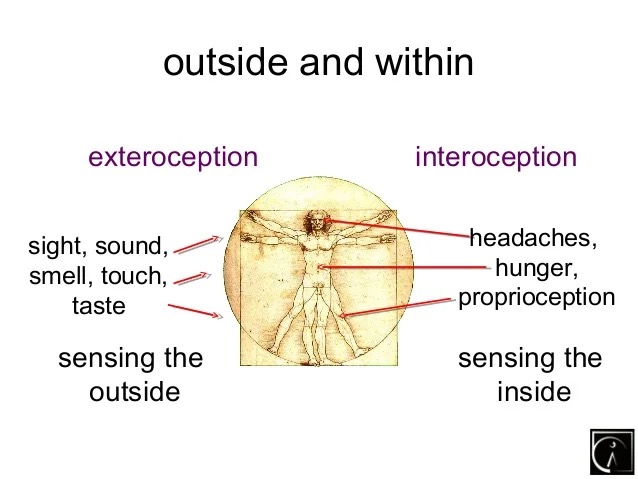
Proprioception and Interoception: In neuroscience, proprioception (awareness of the body in space) and interoception (awareness of internal states) are seen as ways the brain integrates information. The “consciousness-is-one” theory suggests that these are not just individual processes, but reflections of a deeper, unified awareness.
Unified Field Theories: Some speculative scientific theories propose that consciousness could be a field, similar to electromagnetic or gravitational fields, permeating all of space and time.
Implications and Reflections
Interconnectedness: If consciousness-is-one, then the boundaries between self and other, subject and object, are ultimately illusory. This leads to a sense of deep interconnectedness with all beings and the cosmos. Inter-being, inter-be.
Transformation of Perspective: This theory challenges the materialist view that consciousness is a latecomer in the universe, suggesting instead that consciousness is primary, and matter arises within it. Light-animating-matter; the light of consciousness.
Ethical and Spiritual Consequences: Recognizing the unity of consciousness can foster compassion, empathy, and a sense of responsibility for the well-being of all of life - the Bodhisattva vow - to be of benefit to all sentient beings.
This is what the ancients knew and named the nature and power of mind, which modern science names plasticity, or if not measured, labels placebo. Buddha observed the mind as multidimensional; mind, no-mind, mind-is-luminosity; pure awareness - meta-cognition - mind-observing-itself - the witness-observer and the field-of-awareness - awareness-of-awareness-itself - which the Bhagavad Gita exquisitely explores:
XIII:1 Yog-through-Distinguishing-the-Field-and-the-Knower-of-the-Field
“In this chapter, Shree Krishna introduces two terms - kṣhetra (the field) and kṣhetrajña (knower of the field). In simple terms, the ‘field’ may be considered the body and the soul as the ‘knower of the field.’ However, the field is actually much more than just the physical body - it includes the mind, intellect, ego, and all other components of material energy that are part of our personality. In broader terms, except for the soul, who is the ‘knower of the field,’ all material aspects of our entire personality are considered - the ‘field’ of the body.” Chapter 13: Kṣhetra Kṣhetrajña Vibhāg Yog – Bhagavad Gita, The Song of God – Swami Mukundananda (holy-bhagavad-gita.org)
“The ancient wisdom found within the Bhagavad Gita provided these scientists with profound insights and a deeper understanding of the universe’s complexities. While they approached their scientific work through rigorous methodologies and mathematical formulations, their encounters with the Gita sparked contemplation on the nature of reality, consciousness, and the human condition.” Bhagavad Gita's Quantum Legacy | Visionary Physicists | Medium
Ancient Eastern wisdom had a profound influence on the founding fathers of quantum mechanics from Heisenberg to Schrödinger, from Einstein to Oppenheimer; who after the successful test and detonation of the first atomic bomb; recited Bhagavad Gita 11.32 “Now I am become death. The destroyer of worlds.” BG 11.32: Chapter 11, Verse 32 - Bhagavad Gita, The Song of God - Swami Mukundananda (holy-bhagavad-gita.org)
“When I read the Bhagavad Gita and reflect about how God created this universe, everything else seems so superfluous.” Albert Einstein in conversation with Rabindranath Tagore.
“My religion is the reconciliation of the superpersonal man, the universal spirit, in my own individual being.” Rabindranath Tagore. A Nobel scientist meets a Nobel poet; two beautiful and enquiring minds entwined together. Science and mysticism in a back-and-forth Hegelian dialectic meeting at the Socratic intersection. Two illuming minds merging in synthesis-and-symbiosis and illuminating higher truth; genius heightened and magnified. E=MC² einstein-tagore.dvi (dbx6c2burld74.cloudfront.net)
What is the nature of reality? What is the nature of consciousness? What is the nature between inner-and-outer-worlds? Is there a relationship between science, philosophy, consciousness, and beauty? Are we individual separate selves or an interconnected and interdependent whole? Is everything random chance and mere coincidence? Is there any inherent meaning and purpose? These, some of the fundamental questions about the nature of existence and what it means to be human. Know Thyself.
And this is what the ancients knew, which modern civilization; materialism, secularism, consumer culture and instant gratification has nigh-on extinguished like detonating an atomic bomb within; not knowing inside, Who Am I?
“I have come to think that care of the soul requires a high degree of resistance to the culture around us, simply because that culture is dedicated to values that have no concern for the soul.” Thomas Merton, American Trappist monk, theologian, writer, poet, mystic and social activist, 1915-1968. Quantum Human by another name.
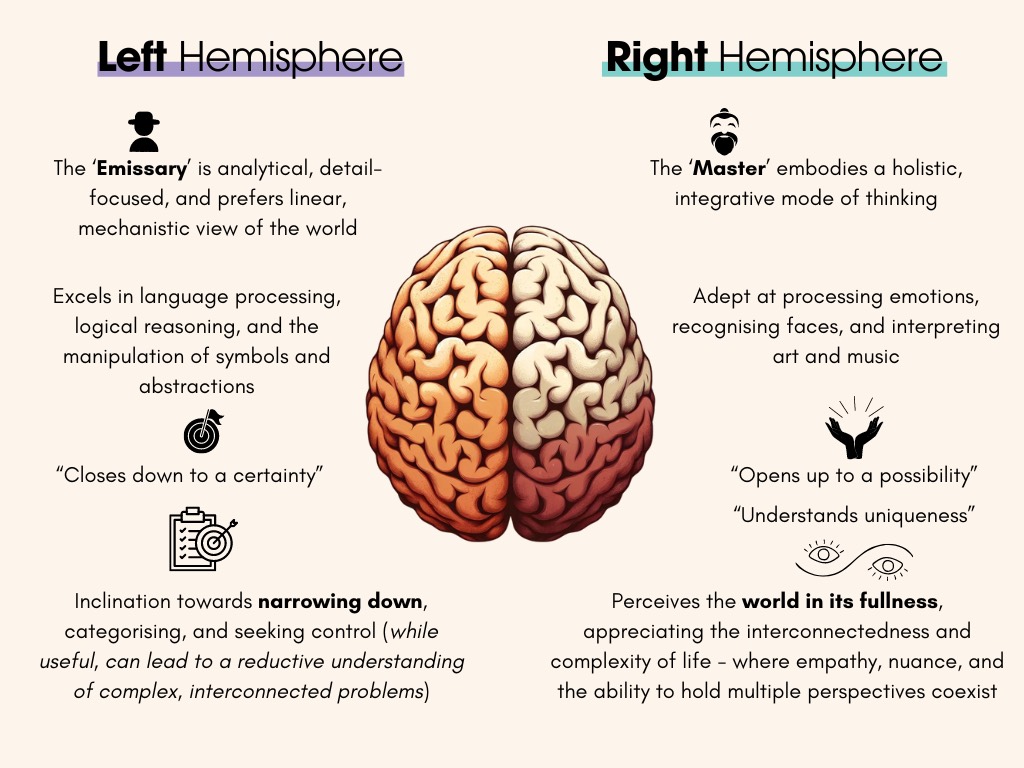
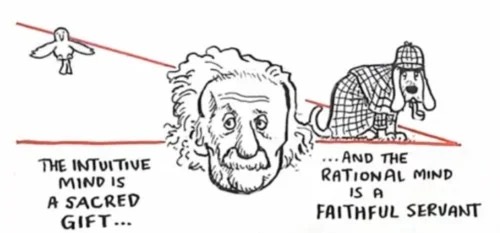
The ancient Greeks valued both logos (logic) and mythos (subjective experience), recognizing the importance of integrating rationality and intuition. Modern neuroscience echoes this duality in the divided hemispheres of the brain. The “consciousness-is-one” seeks to transcend dualism, integrating all opposites into a unified-field-of-awareness.
The metaphor of the “Tree of Life” and the “web-of-being” illustrates how consciousness is not fragmented, but a shared, living reality.
“Who can say if the thoughts you have in your mind as you read these words are the same thoughts I had in my mind as I typed them? We are different, you and I, and the qualia of our consciousnesses are as divergent as two stars at the ends of the universe.
And yet, whatever has been lost in translation in the long journey of my thoughts through the maze of civilization to your mind, I think you do understand me, and you think you do understand me. Our minds managed to touch, if but briefly and imperfectly.
Does that thought not make the universe seem just a bit kinder, a bit brighter, a bit warmer and more human?
We live for such miracles.” Ken Liu, The Paper Menagerie and Other Stories.
The “consciousness-is-one” theory invites us to see ourselves not as isolated minds, but as expressions of a single, universal consciousness. This perspective bridges philosophy, science, and spirituality, offering a vision of unity, interconnectedness, and profound meaning. Wisdom and compassion - consciousness quotient squared - CQ²
Quantum Human by another name. And this is what the ancients knew. E=MC²
In neuroscience, these modes of perception are named exteroception and proprioception which is the left-hemispheres ability and agility to navigate the external world - the awareness of your body in time-and-space, and interoception, the embodied-awareness of inner-space and interior states and being aware of sensations, feelings and emotional self-regulation. Taken together - mediated by the corpus callosum - a unified-field-of-awareness. CQ²
This mapping of the quantum terrain using three lenses - materialist, idealist, non-dualist - invites you to engage with Hegelian dialectic as observer and participant. It acts like an All-You-Can-Eat Quantum-Buffet giving you a taste-and-glimpse of the path and practice to be Quantum Human like Neo exploring beyond the materialist Matrix; beyond the discursive mind, beyond all dualistic distinctions. Mind, no-mind, mind is luminosity. Mind is one's best friend and worst enemy.
Ask questions, reflect, and allow the spiral of inquiry to unfold. Whether you are a philosopher, artist, yogi, or seeker, may you find here a bridge between worlds - a luminous thread connecting wisdom-and-compassion, theory-and-experience, self-and-cosmos.
Tibetan Buddhist Nature of Mind
“Tibetan Buddhism has a unique system of understanding cognition and a profound knowledge of the nature of the mind. Various Tibetan terms express different aspects of this cognitive apparatus. Sem translates as “mind” and “consciousness,” and refers to the ability to think and perceive. Yid is also translated as “mind,” but also “intellectual faculty” and is associated with the idea of “conceptual mind.” Lo is a different term for “conceptual mind” and “intellect.” Namshe or nampar shepa means “consciousness,” “cognition,” and the awareness that there is something that knows and perceives. Another term for awareness is rigpa, which also means “knowledge.” There is “enlightened mind” - thug, associated with the primordial state of the Buddha.
According to the canonical Buddhist Abhidharma texts, the mind is composed of a primary or dominant mind (tso sem) and a secondary mind or mental factors (sem jung). In each moment of the flow of mind (gyun) there is a moment of awareness, which is central, and in parallel are different mental models. The primary mind is like a guide around which other mental factors appear. It is associated with one of the six types of consciousness (namshe tsig drug), which represent the cognitive abilities of the mind and senses (wang po). The six consciousnesses are: visual consciousness (mig gi namshe), auditory consciousness (nawe namshe), olfactory consciousness (ne namshe), gustatory consciousness (chei namshe), tactile consciousness (lu kyi namshe), and mental consciousness (yi kyi namshe). The senses represent a certain type of consciousness, due to the fact that through them we acquire a certain type of information about the external world.
Mental factors are numerous. Shakyamuni Buddha himself stated that there are 84,000 of them in the human mind, similar to the number of his teachings. Each aspect of the secondary mind corresponds to a certain delusion. According to the Abhidharma, there are different levels of classification for mental factors; they can be divided into groups of 51, 1,000, 500, 110, and so on.
According to the Tibetan Buddhist percepts, consciousness is considered one of the five aggregates or skandhas (phungpo nga) that form the human personality. They are the psycho-physical components of beings in samsara and are the main cause of attachment to the self. The five skandhas are: form (zug), sensation (tsorwa), perception (dushe), mental formations (duche), and consciousness (nampar shepa).” Cognitive Apparatus and the Nature of the Mind in Tibetan Buddhism - Buddhistdoor Global An exquisite article exploring nature of mind from a Tibetan Buddhist panoramic perspective - a vast and profound landscape like being on-top of a mountain summit.
Our mind-and-thoughts are shaped by language which colour and filter our relationship with inner-and-outer-worlds. Ancient worlds, a modern landscape, different mentalities’ and neuroses. Many Paths. One Stream.
“A controlled mind is conducive to happiness.” Shakyamuni Buddha. A key question arises; how to control and tame the wild tiger like nature of mind?
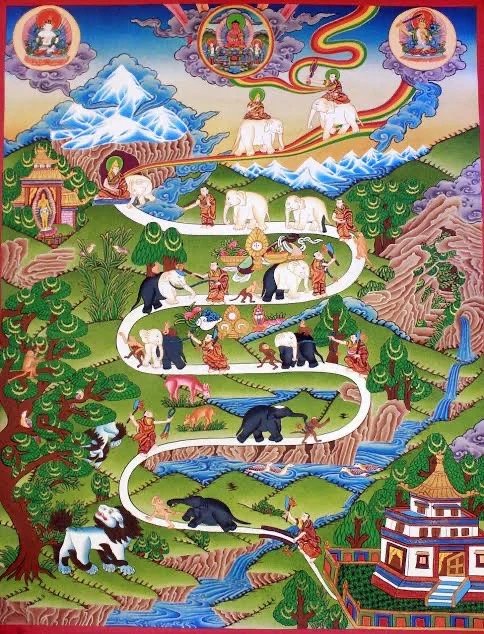
In Buddhism, the nine stages of calm-abiding - mindfulness - a classic roadmap illuminating the journey and path of practice. Many Paths. And the path is the way.
“Pictured are the Nine Deepening Stages of Calm-Abiding. Through the process of perfecting Calm-Abiding, starting with cultivating virtuous actions, we diligently study and ponder the Dharma. We recollect upon the nature of mind, the very wish-fulfilling gem. Our practice begins with the state of mental agitation that is the conventional mind-stream. Through instruction in Calm-Abiding we bring the mind to stabilize on its object of concentration. As pictured here, the monk progressively chases, binds, leads, and subdues the elephant-like mind (whose color progresses from black to white).
At the end of the path a single-pointed concentration is attained, and the ‘purified elephant’ of the mind is now completely settled. The flying monk represents bodily bliss; and his riding of the elephant, mental bliss. Riding the elephant back triumphantly across the rainbow, wielding the flaming sword of perfect insight having attained the flame of clear understanding and remembrance, represents the uprooting of samsara by the unity of Calm-Abiding and Higher Insight.
Levels One and Two, the meditator starts by using the powers of listening and pondering the meaning of the Dharma and this fires-up the motivation and zeal to stay with the concentration on the breath, the object of meditative concentration.
Level Three and Four, the power of continuous non-discursive recollection of the understanding of the dharma gained by studying and the deeply pondering of it, brings about a capacity for periodic engagement of concentration.
Level Five and Six, through the power of Watchfulness or Alertness, although our engagement is still periodic, wavering is diminishing. This power indicates that the meditator firmly and clearly comprehends what is occurring and what he or she is doing.
Level Seven and Eight, the power of Diligence or Effort, the mind is Concentrated and pliant of both body and mind, and the meditator’s engagement in concentration is uninterrupted.
Level Nine, with the power of complete adaptation/habituation full Calm-Abiding is attained, the mind is naturally settled.” Nine Stages of the Mind Staying -The Elephant Path - Tibetan Buddhist Encyclopedia An extra-ordinary and illuminating commentary.
The Ten Ox-Herding Pictures - Teisho - Kubota Ji’un - D. T. Suzuki’s first version
What is Enlightenment? The Zen Buddhist teaching of the ox-herder is another way of understanding a roadmap to enlightenment in ten stages. Ten Oxherding Pictures 十牛圖 Shiniu tu [Jūgyūzu] Verses by 廓庵師遠 Kuoan Shiyuan [Kakuan Shien], 12th century, Oxherding text translations by Victor Sogen Hori
“Here, our essential self is compared to an ox. We seek the ox, grasp it, tame it and finally the self which has always been seeking becomes completely one with the ox. But this also is forgotten so that we now simply carry on our ordinary lives. This is the process described by the Pictures. They show concretely the progression of our practice and are very helpful for a self-examination of our own practice and as encouragement for further practice.
The Ten Ox-herding Pictures have concretely depicted the process in which the imperfect, limited, and relative self (the little child) awakens to the perfect, unlimited, and absolute essential self (the ox), grasps it, tames it, forgets it, and completely incorporates it into the personality. But we must stress that these pictures and verses are merely an indication of the way to practice and not an object for conceptual thought. Thus, the study of the Ten Ox-herding Pictures are very useful for those who are actually striving to make clear the true self in Zen through the actual sitting with aching legs. But for those who want only to learn the rationale of Zen I must warn that these pictures and words will be only “white elephants” of no use whatsoever.”
- taken from the Teisho (commentary) by KUBOTA Ji’un
Ten Oxherding Pictures - Ordinary Zen Sangha An excellent overview of the way and path of enlightenment. Body enlightenment, mind liberation. E=MC²
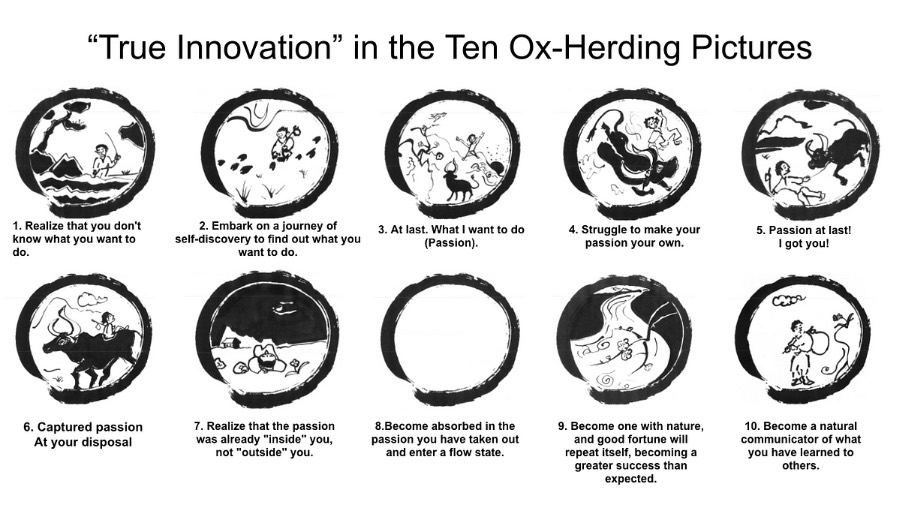
D. T. Suzuki's first version:
"The Ten Oxherding Pictures," translated by D. T. Suzuki, in Manual of Zen Buddhism, Kyoto: Eastern Buddhist Society, 1934. London: Rider & Company, 1950, New York: Grove Press, 1960. pp. 150-171.
“VIII
THE TEN OXHERDING PICTURES
Preliminary
The author of these "Ten Oxherding Pictures" is said to be a Zen master of the Sung Dynasty known as Kaku-an Shi-en (Kuo-an Shih-yuan) belonging to the Rinzai school. He is also the author of the poems and introductory words attached to the pictures. He was not however the first who attempted to illustrate by means of pictures stages of Zen discipline, for in his general preface to the pictures he refers to another Zen master called Seikyo (Ching-chu), probably a contemporary of his, who made use of the ox to explain his Zen teaching. But in Seikyo's case the gradual development of the Zen life was indicated by a progressive whitening of the animal, ending in the disappearance of the whole being. There were in this only five pictures, instead of ten as by Kaku-an. Kaku-an thought this was somewhat misleading because of an empty circle being made the goal of Zen discipline. Some might take mere emptiness as all important and final. Hence his improvement resulting in the "Ten Oxherding Pictures" as we have them now.
According to a commentator of Kaku-an's Pictures, there is another series of the Oxherding Pictures by a Zen master called Jitoku Ki (Tzu-te Hui), who apparently knew of the existence of the Five Pictures by Seikyo, for Jitoku's are six in number. The last one, No. 6, goes beyond the stage of absolute emptiness where Seikyo's end: the poem reads:
"Even beyond the ultimate limits there extends a passageway,
Whereby he comes back among the six realms of existence;
Every worldly affair is a Buddhist work,
And wherever he goes he finds his home air;
Like a gem he stands out even in the mud,
Like pure gold he shines even in the furnace;
Along the endless road [of birth and death] he walks sufficient unto himself,
In whatever associations he is found he moves leisurely unattached."
Jitoku's ox grows whiter as Seikyo's, and in this particular respect both differ from Kaku-an's conception. In the latter there is no whitening process. In Japan Kaku-an' Ten Pictures gained a wide circulation, and at present all the oxherding books reproduce them. The earliest one belongs I think to the fifteenth century. In China however a different edition seems to have been in vogue, one belonging to the Seikyo and Jitoku series of pictures. The author is not known. The edition containing the preface by Chu-hung, 1585, has ten pictures, each of which is preceded by Pu-ming's poem. As to who this Pu-ming was, Chu-hung himself professes ignorance. In these pictures the ox's colouring changes together with the oxherd's management of him. The quaint original Chinese prints are reproduced below, and also Pu-ming's verses translated into English.
Thus as far as I can identify there are four varieties of the Oxherding Pictures: (1) by Kaku-an, (2) by Seikyo, (3) by Jitoku, and (4) by an unknown author.
Kaku-an's "Pictures" here reproduced are by Shubun, a Zen priest of the fifteenth century. The original pictures are preserved at Shokokuji, Kyoto. He was one of the greatest painters in black and white in the Ashikaga period.”
"The Ten Oxherding Pictures," D. T. Suzuki's first version Suzuki - a Zen master painting in words - illuminating the ten ox-herding pictures alive in the readers’ mind.
To end by returning back to the beginning and setting intention for practice and zooming-in on the power of mantra and aligning Self-to-Ishvara; the light of one’s own mind - the lightness-of-being - beings-of-light-entangled-within-the-flesh.
“A mantra is a revealed word, a divine sound that has been received or experienced by an adept in the state of deep samadhi (spiritual absorption). It is a condensed form of spiritual energy, the sound body of the Divine Being. It can also be thought of as a compact prayer. The yogic scriptures often compare mantra to a boat or a bridge that an aspirant can take to cross the mire of delusion created by the external world and reach the center of consciousness within. Mystics and yogis say that mantra is an eternal friend who accompanies the meditator even after death, lighting the way in the realm where the light of the sun and the moon cannot penetrate. According to the more esoteric literature of the yoga tradition, mantra is the essence of guru shakti, the power of the spiritual master. In other words, the mantra is itself the guru. Mantra, God, guru, and one’s highest self are identical.
The branch of metaphysics known as spanda, the science of eternal vibration, holds that all creation evolves from the Word. Here “Word” does not refer to speech uttered by a human voice, or the audible sound produced when two objects strike each other. The Word is anahata nada, the unstruck sound, which vibrates eternally in the realm of pure consciousness. It is the Word that existed before the beginning of creation.
The power of mantra is not limited by time, space, or causation, for mantra is a self-existent, self-luminous reality that can be heard by all who have ears to hear. But mantra transcends sound for, as the scriptures say, mantras are seen by the eyes of the soul rather than heard by the ears. One blessed with the vision of mantra is a rishi (seer).” Pandit Rajmani Tigunait. The Power of Mantra (yogainternational.com)
“Certain rules in chanting given in the Vedas. Every character has a way of pronunciation. Every Vedic passage is set in metre, set way. Specific way of recitation...Chanting in proper way creates certain vibrations. Vibrate certain nadis, then your mental vibrations change.” Sri S. Sridharan, Krishnamacharya tradition.
Rules-of-Chanting-in-Samskritam.pdf (arshadrishti.org) An excellent article on the precise and subtle art of Vedic chanting and correct pronunciation, stress, emphasis, and metre - create excitation and heightened and magnified vibratory states.
Om represents everything - the beginning, the middle and the end, the past, the present and the future. It encompasses all sounds - mankind, nature, machinery … it is the hum of the earth. ~ Mandukya Upanishad. Everything changes - on the Mantra Aum - Ekhart Yoga In this way, every mantra begins with OM.
OM MANI PEME HUM. Buddha mani-mantra of compassion.
“The six syllables, Om Ma ni Pe me Hum, mean that through the practice of a path that is a union of love and compassion with wisdom, you can transform your impure body, speech and mind into the pure exalted body, speech and mind of a Buddha. The merits of reciting this Mantra are limitless and cannot be fully described even by the Buddha. It is said that the sand of the Ganges and the drops of water in the ocean can be counted but not the merits from the recitation of this Mantra. This Mantra is the great love and compassion manifestation of all the Buddhas. It helps us to develop the love and compassion to make our life full of meaning. Also, this mantra can bring healing and can be used as a prayer for other sentient being.” The Meaning Of Om Mani Peme Hum (abuddhistlibrary.com)

In the Buddhist tradition, there are said to be 15 primary reasons for chanting this mantra. 108 is considered an auspicious number and develops concentration and clarity and purification of the mind.
“Tradition is to start with prayer to Patanjali and Krishnamacharya. Vedic Tradition. Everything starts with mantra to create union and protection and ends with mantra.” Forty voices from around the world chant in-union - firing neurons to the auditory cortex - forging a unified-field of supraliminal-awareness - light-animating-matter.
“Let this learning process give us energy. Teaching is a learning process. The ancient way of knowledge is known. More Tejas - energy. Shanti x 3; undisturbed peace. Beyond all disturbances.” Sri S. Sridharan. Senior Yoga Therapy Consultant, Trustee Krishnamacharya Yoga Mandiran (KYM).
By beginning and ending with mantra - this creates a circularity - each practice is interconnected - a beginningless-and-endless-path-to-the-self - an infinity-loop.
In my beginning is my end. In succession
Houses rise and fall, crumble, are extended,
Are removed, destroyed, restored, or in their place
Is an open field, or a factory, or a by-pass.
T.S. Eliot. Four Quartets, East Coker.
End of chamber 25
Chambers 1 to 35: all 35 chambers open