Ring IV · Inquiry · Chamber 20
Yoga Sutra 1.2, Materialism and Idealism
About 4 minutes to read
In this sutra, Patanjali, an ancient Indian yogi and codifier of yoga who lived around the 2nd century BCE - gives the experiential state of yoga - acting as an internal guide and precise metronome to monitor self-practice. Patanjali’s yoga sutras are 195/6 in number, and the germ and genius of Patanjali is that in 428 words, he describes the entire bandwidth of human experience.
Y.S 1.2 This, the most famous yoga sutra which explains the essence of yoga, stilling the fluctuations of the mind-waves, a cessation of all dualistic opposites, moving from an easily distracted mind, in order to arrive at the shore of unperturbed stillness, a non-dual state of awareness - integrating and transcending all dualistic distinctions - complete absorption between seer-and-seen, complete integration between subject-and-object; this, the highest state of yoga - Samadhi - complete absorption.
Why yoga is not 'the stilling of the fluctuations of the mind' - Original Wisdom A sutra is a terse statement much like a zip-file. It requires a masterful pair of eyes to decrypt and decipher Sanskrit which is a compound language - each word can be sub-divided into parts, and each part can have multiple meanings. In this way, I imagine each sutra like a Rubik Cube; each word, a side, each sutra, getting all the colour's right. Lucy Crisfield is a masterful decoder of Sanskrit. And sutra means thread; to weave.
Materialism and Idealism - Cognitive Bias - Is Consciousness Fundamental?
In philosophy, logos and mythos echoed down throughout the ages, shaped and molded into materialism ala Democritus, which emphasizes the material world and the nature of reality as composed of matter and physical laws. In contrast, the philosophy of idealism posits reality is fundamentally mental and/or spiritual ala Plato and later, Immanuel Kant who built on Plato’s scaffolding and architectural framework; molding and morphing into modern philosophy; influencing Western culture and civilization.
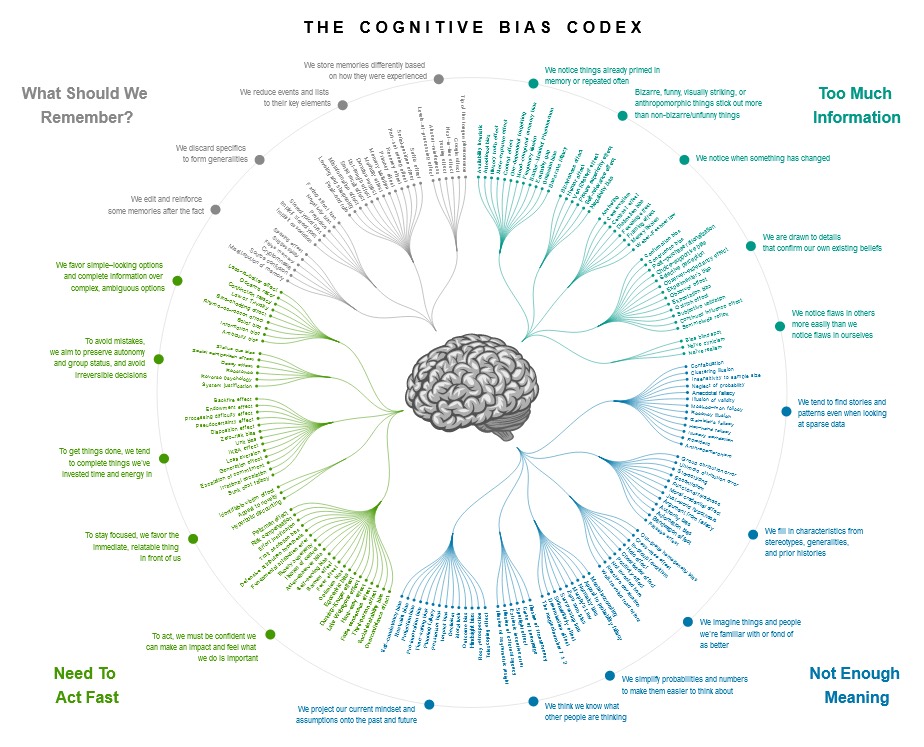
The brain cannot know everything all-at-once - too much information, a need to act fast, not enough meaning, what should we remember? And so cognitive bias is the way the brain evolved to zoom-in and filter out unnecessary information received through the five senses; creating mental shortcuts that influence our decision making, leading us to process information in a selective and subjective manner. There are 188 cognitive biases - problemo - and me be like scratch head like Stan Laurel. Y.S 1.2
Logos and mythos - materialism and idealism - two modes of perception and mental patterns, forming mental habits, hard-wired tendencies; filtering cognitive biases.
Is consciousness fundamental or an emergent property?
Logos and mythos echoing throughout the ages and finding their reflection and resonance in the divided left-and-right hemispheres of modern neuroscience; where mythos; the mythical and symbolic aspects of life are deciphered and intuitively experienced and embodied in the right-hemispheres imaginative realms, and logos is the logical and rational and empirically orientated left-hemispheres objective lens.
The materialist says consciousness is an emergent property from simplicity to more-and-more-complexity - inert matter emerging into living self-aware organisms, see Ramachandran’s phenomenal discourse on the brain and the neurons that shaped civilization.1 The idealist - and other strands of philosophy ala panpsychism - say consciousness is not an emergent state, consciousness does not evolve; consciousness is a fundamental property of all matter, from the smallest particles to more and more complex forms - from light-to-cells-to-brains - the electric universe.
Imagine consciousness not as a static observer but as a dynamic participant in the unfolding quantum play of existence. Every thought, every breath, a ripple across an infinite ocean of probabilities - waves collapsing into particles, particles dissolving back into waves. This is not mere metaphor; it is lived-reality, mind now attuned to its own quantum nature and awareness of the electric-body connecting within-and-without - piezoelectric crystals vibrating - attuned to non-local frequencies - breath coherence.
The ancients intuited this truth when they spoke of prana and qi, subtle currents flowing through invisible channels. Today, science echoes the same through microtubules and coherent quantum states in the brain and bioelectricity. The body is not a machine; it is a symphony of entangled vibrations, a living hologram where each part reflects the whole. To touch your breath with awareness is to touch infinity. The modern world blinds us with its materialist glare - flattening mystery into mechanism, reducing wonder to utility. Beyond this reductionist lens lies an implicate realm where meaning is not imposed but emerges spontaneously, like a lotus blossoming in muddy water. Here, the self is not a solitary island. Now it is a node in a vast network of inter-being, shimmering with non-local connections. The Body Electric.
To live quantum human - embrace paradox - be both particle-and-wave, both local and non-local, both finite-and-infinite. Dance with uncertainty and find freedom and ultimate liberation not in control but in surrender to the divine creative flux; this, the dance of Lila. Only now - in this surrender - a new model of existence arises - one that renders the old paradigm of separation obsolete. For now, in the quantum field, there is no stranger; only reflections of the same luminous essence. Except for the point, the still point, there would be no dance, and there is only the dance. T. S. Eliot. Burnt Norton.
End of chamber 20
Chambers 1 to 35: all 35 chambers open