Ring I · Conditioning · Chamber 2
Self-Enquiry Through Six Lenses
About 6 minutes to read
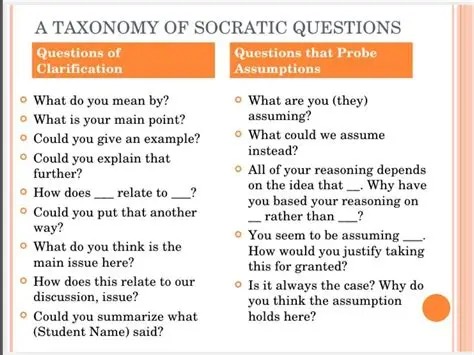
1. Socratic Dialogue: The Art of Questioning
Socratic Dialogue is the foundation of self-enquiry. Socrates taught that wisdom begins with recognizing one’s own ignorance and asking the right questions. In the context of Quantum Human, this means continually re-fining and re-framing our questions about reality, self, and consciousness. The act of questioning is itself quantum: each question opens new possibilities, collapses old certainties, and invites transformation. To be Quantum Human is not to be content with static answers but thrive in dynamic interplay - self-enquiry and self-discovery - TAT TVAM ASI - Know Thyself. Love-after-love.
2. Plato’s Cave: From Shadows to Light
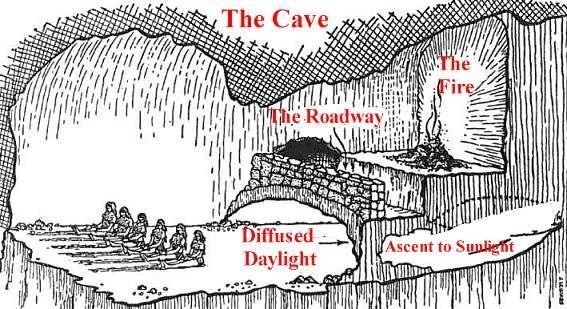
Plato’s Cave allegory describes prisoners’ mistaking shadows for reality, only to discover, upon turning toward the light, a deeper truth. To be Quantum Human is to awaken this metaphor and move from conditioned perceptions and limited identities.
Self-enquiry is the journey from shadow to substance, from illusion to insight. The cave is the classical, deterministic worldview; the light is quantum awareness - reality is not fixed, now fluid - an a-participatory universe - meta-cognition - ever-unfolding. CQ²
3. Hegelian Dialectic: Thesis, Antithesis, Synthesis
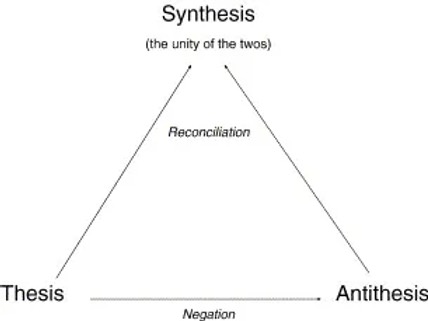
Hegel’s dialectic is a process of evolution through contradiction and reconciliation:
Thesis meets antithesis - this tension births a higher synthesis. Quantum Human embodies this process, integrating opposites - yin-and-yang, intellect-and-intuition, theory-and-practice - a living mandala - Tao; whole-being, inter-being, inter-be. CQ²
Each cycle of self-enquiry is a spiral, not a circle: we return to old questions with new depth - deeper meaning - synthesizing what was once divided. This dialectical movement mirrors quantum superposition and the collapse into presence. E=MC²
4. Del Toro’s Re-Animated Frankenstein: Creation and Transformation
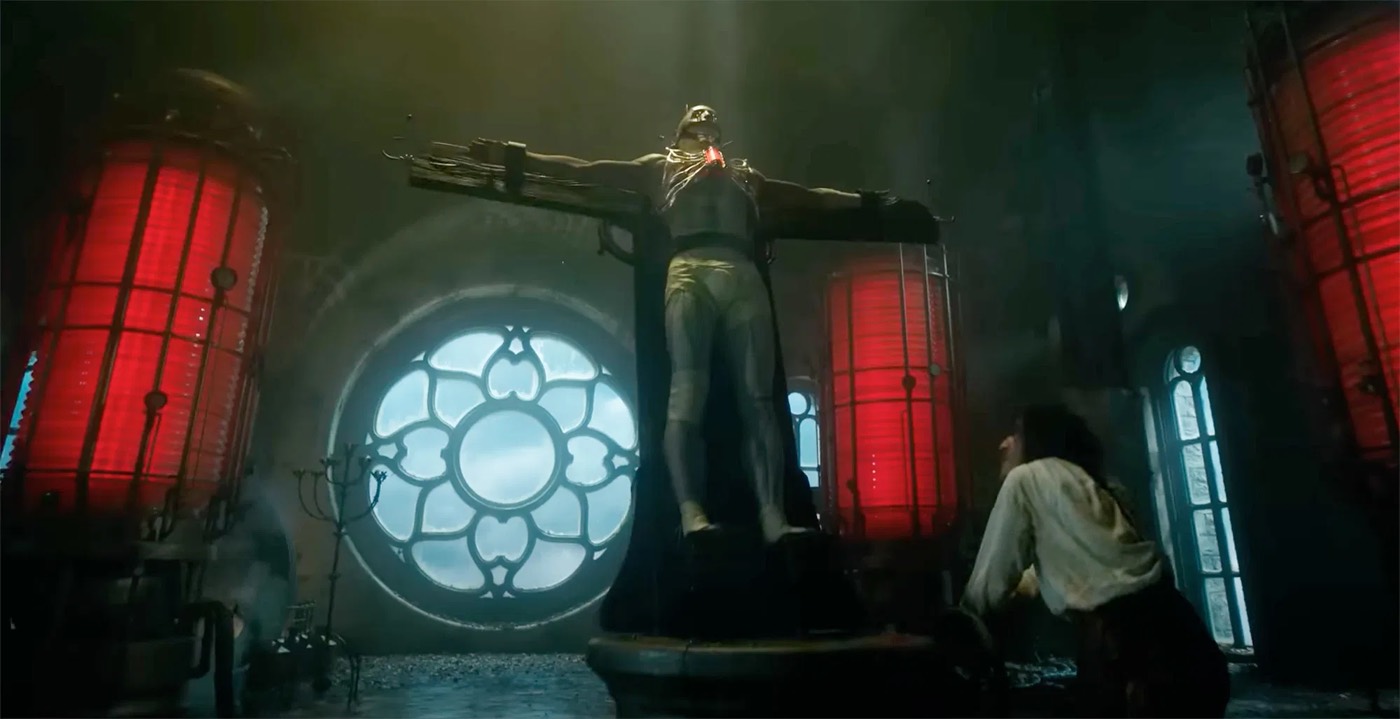
Del Toro’s re-imagining of Frankenstein is closer to Mary Shelley’s original; highlighting the paradox of creation: the monster is both a product of science and a being seeking meaning, connection, and acceptance. To be Quantum Human is the journey of self-creation - embracing our fragmented “re-animated” parts, and integrating them into a coherent, compassionate whole. Like Frankenstein’s creature, we are works in progress, continually re-assembling ourselves through experience, reflection and relationships - mirrors of connection - self-awareness and self-reflection. CQ²
“Guillermo del Toro, our father of monsters, is one of the closest figures we have today to Shelley, Bryon, and the whole Romantic set of the early 19th century. Frankenstein is his passion project, his life’s ambition. He’s described Shelley’s novel as essentially “his Bible”. And with his adaptation, he doesn’t speak for Shelley, but more directly communes with her. It’s not just a translation. It’s a dialogue.
It is, of course, a rich, Gothic vision of malachite silk and crucifixion blood, with costumes by Kate Hawley and production design by Tamara Deverell. But del Toro’s film, already championed for its aesthetic beauty, also engages in a profound understanding of what Shelley’s work might mean for us today. It’s a Frankenstein for now, which recognizes that the author’s warning - “how much happier that man is who believes his native town to be the world, than he who aspires to become greater than his nature will allow” - feels far too late for our world. She feared what Victor Frankenstein might unleash into the world. Now, there’s a Victor Frankenstein at the head of every Fortune 500 company.” Clarisse Loughrey; illuminating, Independent.1
5. The Divided Brain: The Master and His Emissary
Iain McGilchrist’s “Divided Brain” thesis is exquisitely presented by RSA. It explores how the left-and-right-hemispheres of the brain offer fundamentally different ways of engaging with the world. The right-hemisphere is holistic, contextual, and open to ambiguity; it perceives the world as interconnected and alive. The left-hemisphere is analytical, precise, focused, detail-oriented; it abstracts, categorizes, seeks control.
McGilchrist argues that optimal human flourishing - the Quantum Human ideal - requires integration and balance between these modes, not dominance of one over the other. Iain McGilchrist: The divided brain | TED Talk An illuminating masterclass. CQ²
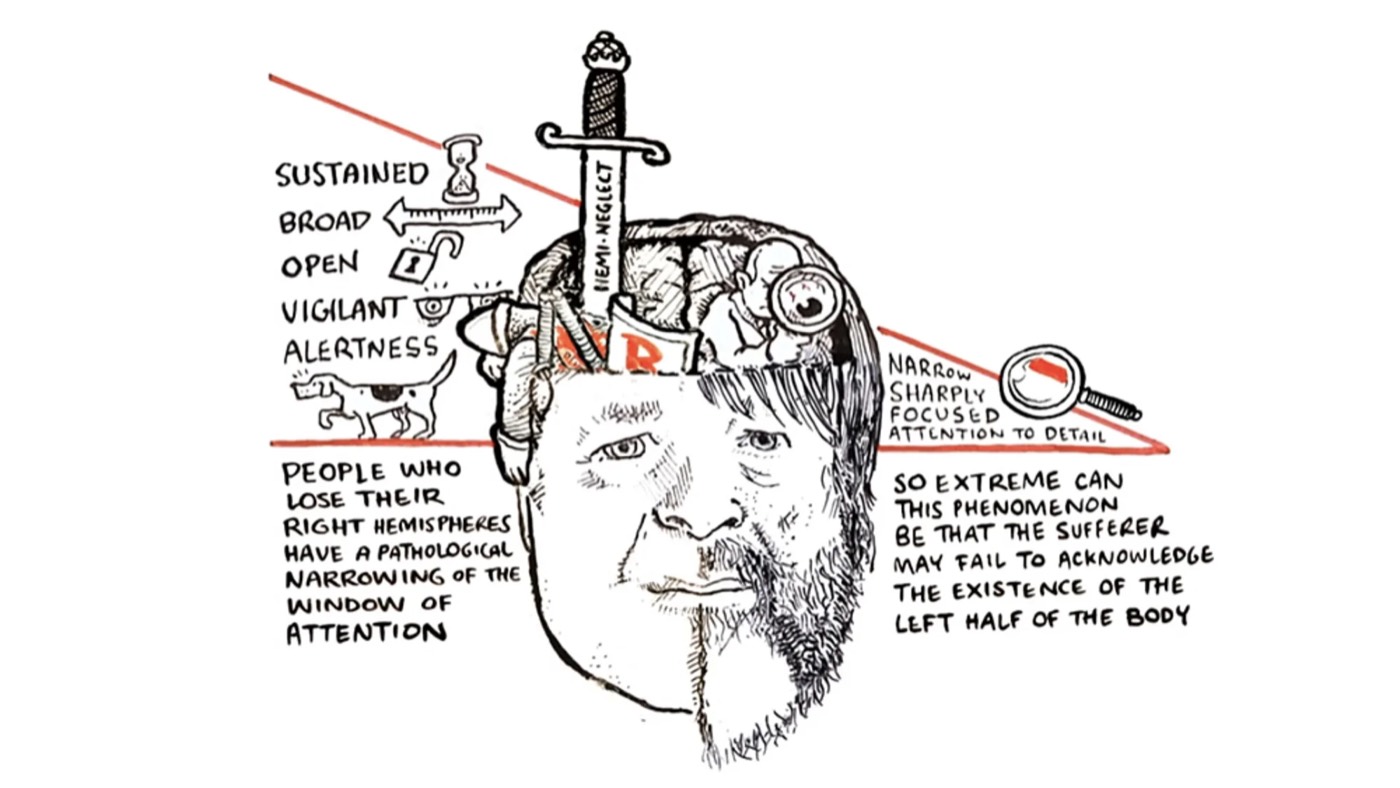
RSA Animate “The Divided Brain” two hemispheres, analytical left-hemisphere - holistic right-hemisphere - the corpus callosum acts as a bridge and mediator. CQ²
McGilchrist’s magnum opus The Master and His Emissary, deeply explores the “how” and “why” the two hemispheres of the human brain - right and left - offer fundamentally different ways of engaging with the world. The right-hemisphere (the “Master”) is embodied, contextual, and open to ambiguity; it perceives the world as interconnected, alive, and ever-changing. The left-hemisphere (the “Emissary”) is disembodied, analytical, focused, and detail-oriented; it abstracts, categorizes, and seeks control.
McGilchrist's The Divided Brain acts as a zoom-in lens - to be Quantum Human means to embody “hemi-sync”- integration of left-and-right-hemispheres, analysis-and-intuition, logic-and-creativity. This balance is the neurological foundation for multiplicity, adaptability, brain coherence - note: always in yang is a dot of yin and vice-versa.
6. “The Neurons That Shaped Civilization”
My other all-time favorite TED Talk is Vilayanur Ramachanran: The neurons that shaped civilization | TED Talk zooming-in on mirror neurons which “mimic, imitate and emulate” the outer environment - an ability to empathize, and learn from others - making civilization, culture, and art possible. These neurons are the biological substrate for empathy, imitation, and the exponential transmission of knowledge.
Mirror neurons symbolize our entanglement with others: we are not isolated individuals; we are participants in a unified-field of co-creation and shared meaning. And world becomes like Bruce Lee entering a-Hall-of-Mirrors-to-the-Self.
And as the Zen saying says; when the student is ready, the teacher appears.
“Just think about this problem for a second. Here is a lump of flesh, about three pounds, which you can hold in the palm of your hand. But it can contemplate the vastness of interstellar space. It can contemplate the meaning of infinity, ask questions about the meaning of its own existence, about the nature of God. And this is truly the most amazing thing in the world. It's the greatest mystery confronting human beings: How does this all come about? Well, the brain, as you know, is made up of neurons.
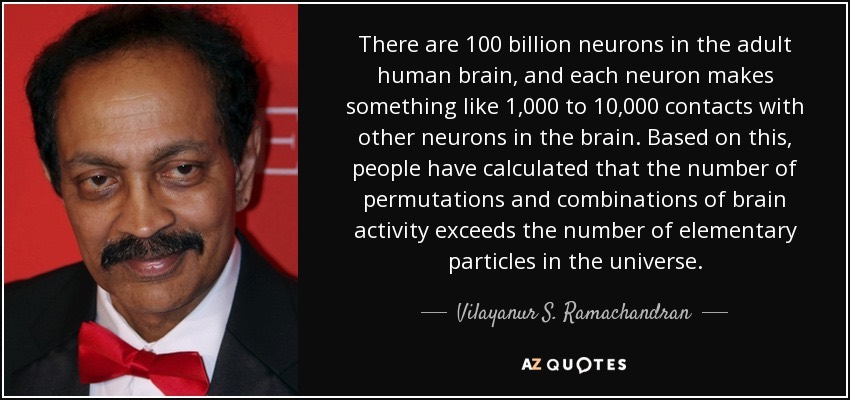
To be Quantum Human is not merely to be a solitary observer - it is to be an integrated and illuminated co-creator, entangled with others through empathy and resonance - shared meaning and purpose. Mirror neurons are the neural correlate of quantum entanglement in consciousness - what happens to one affects the whole. Inter-being.
Yoga works from the inside-out. Yoga and meditation are a work-in. Transform the inner-self; simultaneously, the outer-world appears like a mirror - interbeing like Indra’s Net of Precious Jewels - now reality appears - Everything-Everywhere-All-At-Once.
Summary Table
| Lens | Commentary | Visual | Quantum Human Connection |
|---|---|---|---|
| Socratic Dialogue | Art of questioning, opening possibilities | Socratic taxonomy | Dynamic inquiry |
| Plato’s Cave | Awakening from illusion | Cave diagram | Fluid, participatory awareness |
| Hegelian Dialectic | Integrating opposites | Thesis–Antithesis–Synthesis | Unity of paradox |
| Frankenstein | Self-creation, integration | Frankenstein’s lab | Transformation, wholeness |
| Divided Brain | Left/right hemisphere integration | RSA Animate brain | Hemi-sync, wholeness |
| Mirror Neurons | Empathy, shared meaning | Mirror neuron diagram | Entanglement, co-creation |
Quantum Human Self-Enquiry: The Unified Mandala
Weaving these six strands together - the Quantum Human path is multi-dimensional:
To question deeply (Socratic Dialogue)
To awaken from illusion (Plato’s Cave)
To integrate opposites (Hegelian Dialectic)
To embrace transformation and self-creation (Frankenstein)
To harmonize the hemispheres (The Divided Brain)
To recognize entanglement and empathy (Mirror Neurons)
This journey is not linear but spiral - each return to the question brings new insight, each synthesis, a new wholeness. To be Quantum Human is to be the seeker-and-the-mirror, the question-and-answer, the creator-and-the-created; moving beyond the minds’ dualistic thinking - beyond the mind - beyond all dualistic distinctions. CQ²
And me being inspired like Neo downloading from the Matrix - moving beyond minds’ fear and self-negation - Fear is the mind killer - mirror neuron patterning the Bene Gesserit litany.2 Who Am I? TAT TVAM ASI. I AM THAT - I AM - Know Thyself.
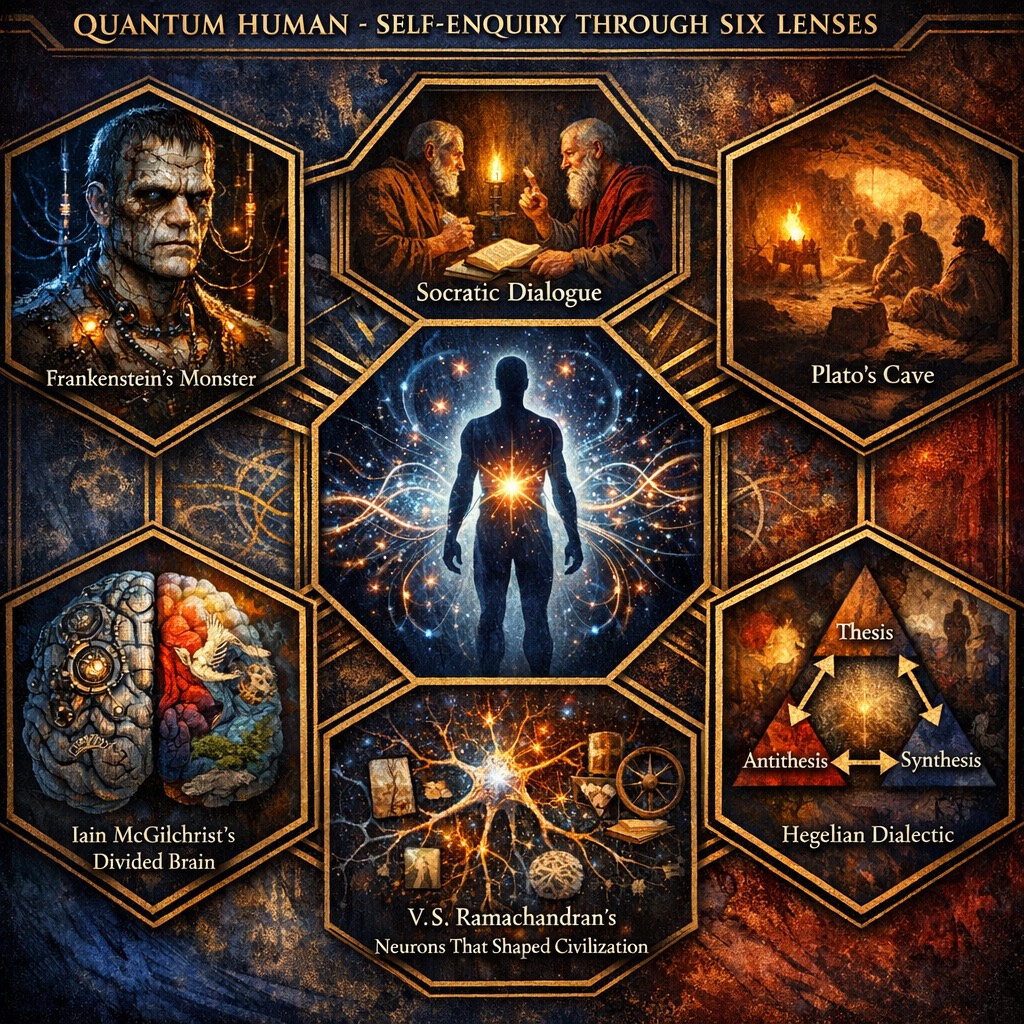
Circle spins in silence
Whisper of light in stillness
mind blooms without edge
return to the inner-void
form dissolves into breath
End of chamber 2
Chambers 1 to 35: all 35 chambers open