QuantumHuman Mixed InternalArts² Seven ChakraJourney What The Ancients Knew

A book in thirty-six chambers, opening one at a time.

702 pages · 36 chambers · 979 references, each one a link

The spiral of thirty-six

Enter at chamber 1, on the outside, and wind inward through the six rings of the Thirty-Six Chambers Mandala to the 36th Chamber, the still point.

  • Open
  • Being opened
  • Unopened

    How much is open

    70of 702 pages open

    All of them in the 36th Chamber so far, sections 1 to 7. The whole book can already be read as a PDF or EPUB.

    Quantum Human · What The Ancients Knew · Minker Chang About

    Ring I · Conditioning · Chamber 3

    TAT TVAM ASI, Swami Sarvapriyananda

    About 1 minute to read
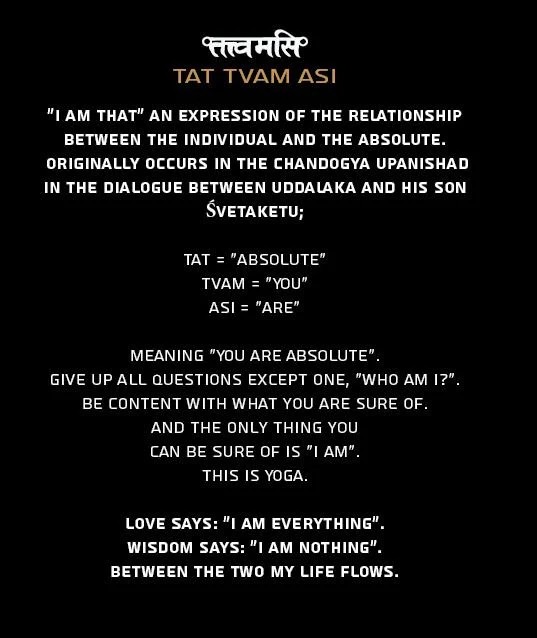
    A black card headed TAT TVAM ASI in Devanagari and English: "I am that", from the Chandogya Upanishad; tat means absolute, tvam you, asi are; love says I am everything, wisdom says I am nothing, between the two my life flows

    Tat Tvam Asi (That Thou Art) | Swami Sarvapriyananda “Vedanta is one of the world’s most ancient religious philosophies and one of its broadest. Based on the Vedas, the sacred scriptures of India, Vedanta affirms the oneness of existence, the divinity of the soul, and the harmony of religions.”

    Swami-ji explores the profound meaning of this phrase, guiding listeners through the philosophical, psychological, and practical implications of non-duality. Tat Tvam Asi is a direct-pointer to the essential-unity of the individual self (Atman) and the ultimate reality (Brahman). “You are That” means your inner-most being is not separate from the in-finite consciousness that is the ground of all existence. Swami-ji unpacks the statement using classical Vedantic reasoning, stories, and analogies. He addresses common doubts and misconceptions, showing how the realization of this truth dissolves boundaries between self-and-world, leading to ultimate liberation - Moksha.

    This talk emphasizes that self-realization is not merely intellectual but experiential - a shift in identity from the limited, conditioned-ego to boundless, witnessing awareness. Practical methods for self-enquiry, meditation, and contemplation are discussed, making this teaching accessible for seekers at all levels. TAT TVAM ASI. Know Thyself. I AM. “There is only one reality. You are that one reality right now.” Swami-ji.
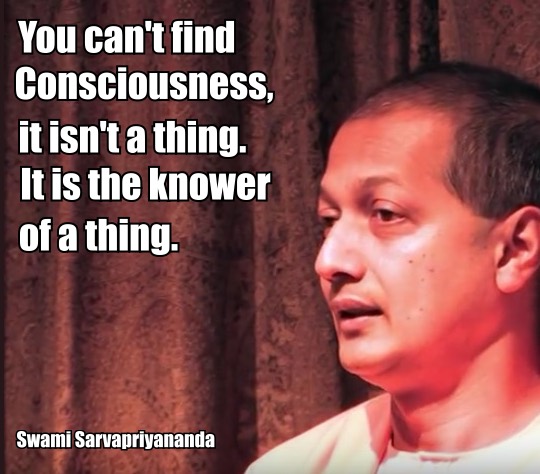
    Swami Sarvapriyananda beside his words: You can't find consciousness, it isn't a thing. It is the knower of a thing

    Tat Tvam Asi - unity-of-self-and-cosmos - mirrors the Quantum Human paradigm. Quantum physics reveals a reality where the observer-and-the-observed are entangled, where boundaries are fluid; similarly, Advaita Vedanta teaches that our true nature is not separate from the whole like a wave is separate from the Ocean-of-Existence. “It’s a state of mind. It’s that place where you lose yourself; you find yourself.” Bodhi. Point Break.1

    Quantum Human - one who recognizes non-dual awareness, moving beyond dualistic thinking, integrating wisdom-and-compassion; living as both seeker-and-sought, question-and-answer. In both traditions, the journey is inward - towards wholeness, embodied presence, realization: TAT TVAM ASI. That Thou Art. I AM. Know Thyself.

    Threads in this chamber: Who am I? · Advaita, Tat Tvam Asi

    The field of correspondences

    A · Constellation. The figures and ideas are the stars: 73 of them, each sized by how many pages it appears on, joined where two share a page. You saw this one in October.
    • Map · ideas
    • Guide · people
    • Practice · embodied

    Point at or tap a star to see what it touches.

    Which chapters are chambers 1 to 35?

      Titles from your Contents list. The numbering is still yours to settle, and nothing on the site depends on it yet.

      Titles and poems
      Reading text

      Choosing a font here changes the whole page, not just this panel. Pick one, then scroll up to the front page and the chamber page to see how the site feels in it.

      QuantumHuman Mixed InternalArts² Seven ChakraJourney What The Ancients Knew

      The opening poem

      ZenHumanQuantumMapGuidePracticePhilosophyScienceFEEEEELPoetryMysticismEntangledYogaTai ChiMeditationYinYangRhythmBoxingChi GongMovementMixedInternal ArtsM.I.A²action‘I’ missing inCQ²NeuronsMirrorMastersConsciousnessQuotientSquaredLee Jun-fanI AMUSYKFEEL

      36th Chamber · Section 1

      Zen Quantum Human

      Structure & Form

      The spacing and alignment matter as much as the words themselves. The poem behaves like a diagram or whiteboard of thought. Vertical stacks imply equivalence. Horizontal movement implies translation or bridging; interdependence, a unified-field.

      This mirrors: Zen koan logic. Scientific mapping. Martial arts training charts. Neural or conceptual networks. The form embodies the theme of entanglement. E=MC²

      Showing the letters as they are now.

      Our advice: whichever titles you choose, keep the long reading text calm. Square letters tire the eye over many pages. Plex Sans is close to the Arial you wrote in.

      Tap the picture for full size